> ## Content Index
> Fetch the complete content index at: https://www.sidorecs.com/llms.txt
> Use this file to discover other available public pages before exploring further.
# Function Without a System: Ideal Supply Chain Design
- URL: https://www.sidorecs.com/insights/idealised-supply-chain-design/
- Published: 2026-11-21
- Updated: 2026-11-21
- Author: Aleks Sidorecs
- License: All rights reserved. Short quotations with attribution and a link are welcome; republication and derivative versions are not.
Nearly ten years ago, I came across an [OODA loop](https://en.wikipedia.org/wiki/OODA_loop) model (observe-orient-decide-act) developed in the 1960s by military strategist Air Force Colonel [John Boyd](https://en.wikipedia.org/wiki/John_Boyd_(military_strategist)) to support fighter pilots' decision-making on the battlefield. What especially impressed me is his nearly scientific approach to assessing the implications of the [second law of thermodynamics](https://en.wikipedia.org/wiki/Second_law_of_thermodynamics) for military strategy.
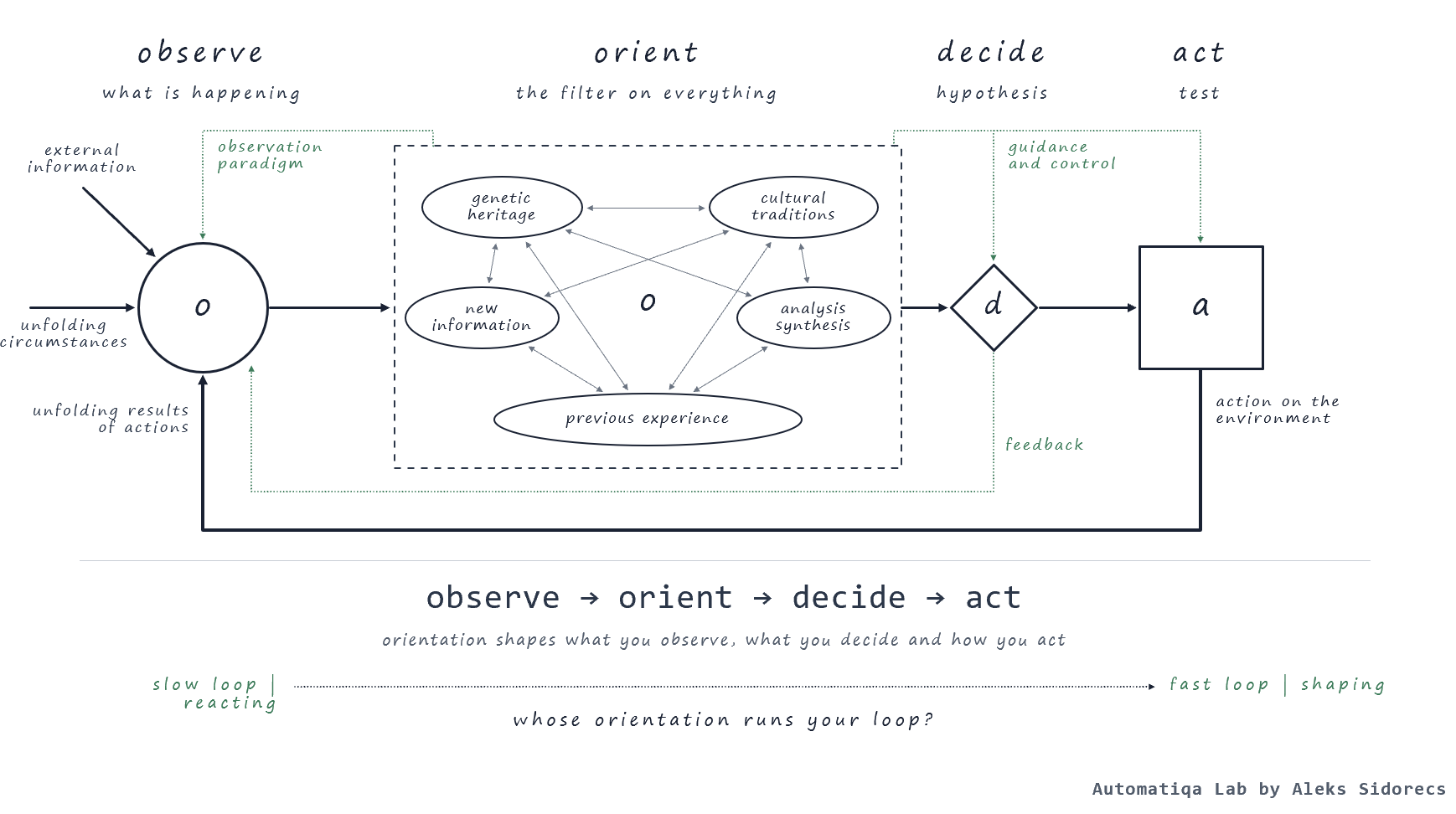
Boyd’s definition of the law was much more 'user-friendly' than the versions we normally find in the works of [Kelvin](https://en.wikipedia.org/wiki/William_Thomson,_1st_Baron_Kelvin), [Planck](https://en.wikipedia.org/wiki/Max_Planck), and other theoretical physicists. He stated that:
> '… entropy of any closed system always tends to increase, and thus the nature of any given system continuously changes even as efforts are directed toward maintaining it in its original form.'
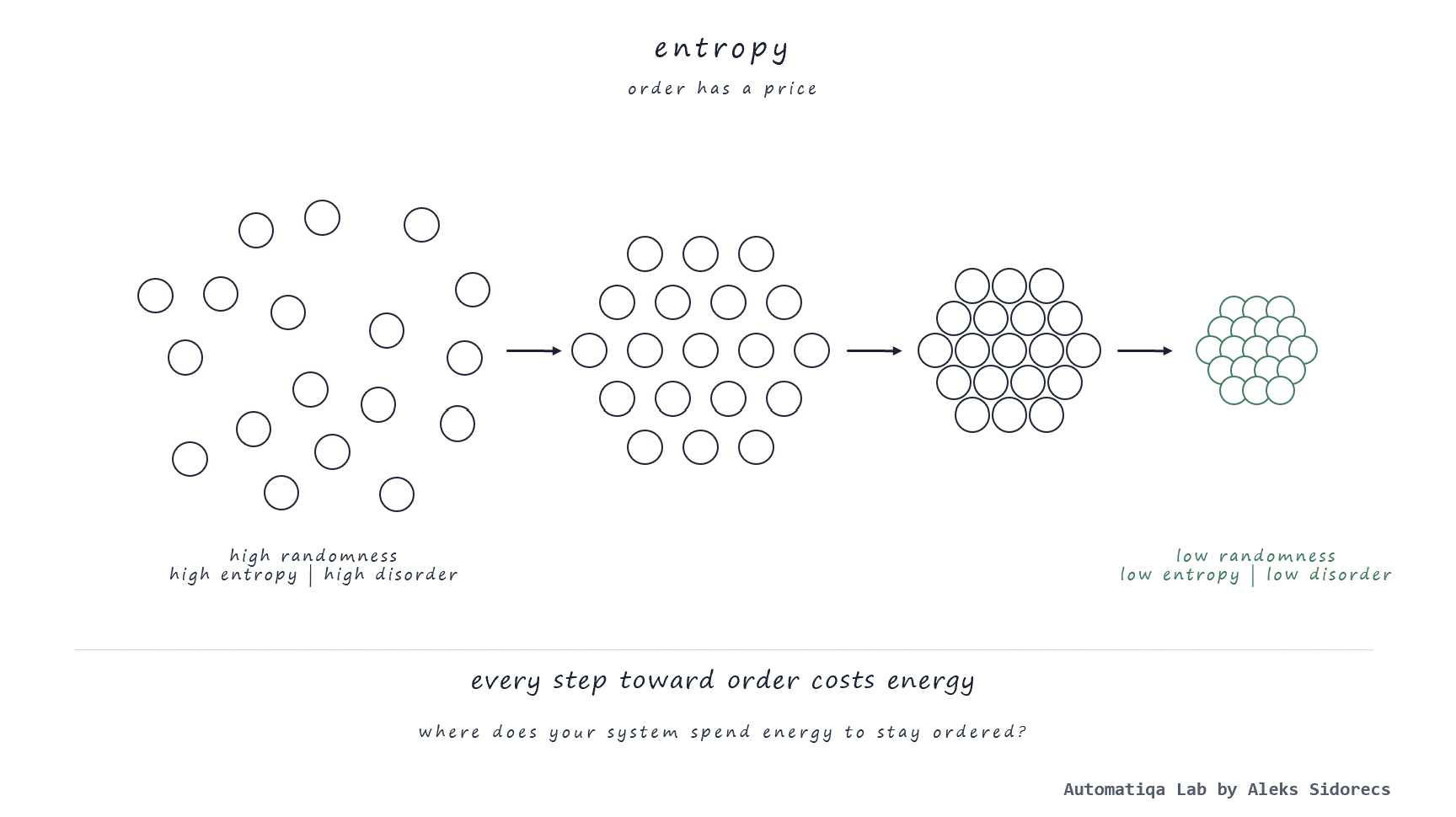
That was an interesting insight which stimulated my further thinking in the context of the supply chain domain, where despite all the efforts that we put in to control the flows, the environment continuously brings to us even more challenging conditions, triggering a natural human reaction - to impose more control and organisation over it. The more we want to organise and control the system, the more energy we spend on it...
While incubating those cosmic thoughts, in my professional career (especially since COVID times) I continuously feel like Don Quixote fighting windmills, because the supply chain challenges my global teams are orchestrating tend to be more a mix of complex contradictions rather than the typical trade-offs we used to manage across various industries twenty to thirty years ago.
This context forces us to be conscious when making specific operating model design decisions, considering the environment demands that it should be both agile and lean, deliver superior service to markets, meet aggressive cost-cutting objectives, unlock efficiencies, and increase the level of customised solutions for end customers or consumers. Contradictions and trade-offs... (I already reflected partially on this in the [Heuristic 04](https://www.sidorecs.com/heuristics/04-dissolve-the-problem/))
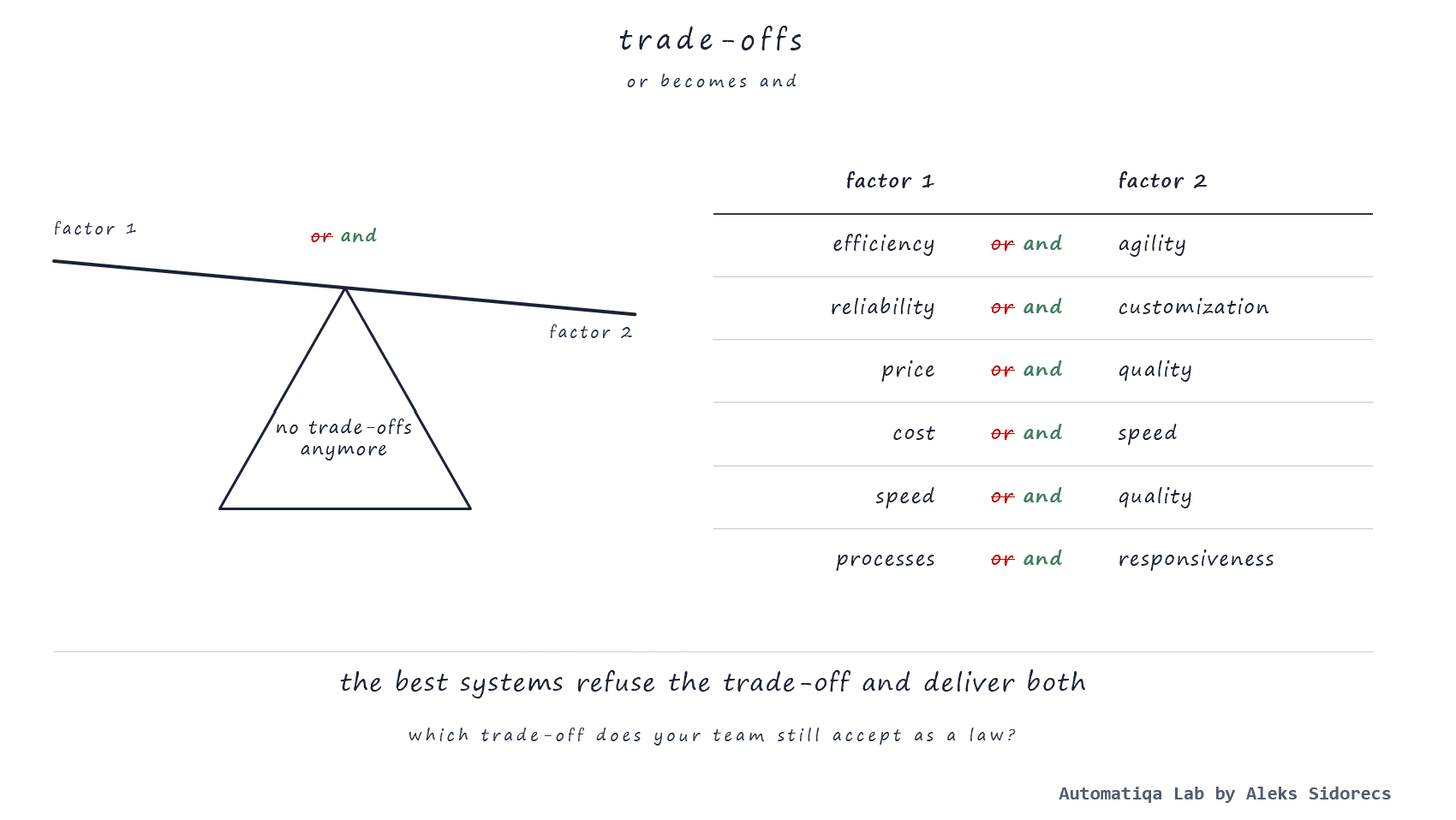
How can we efficiently orchestrate supply chain contradictions? This question keeps pushing me into a rabbit hole of research, learning, and practical application (+ mistakes) up to this day.
In the early 2020s, one interesting statement captured my attention: '…every technical system aims to reach its maximum state of ideality - function is performed (or need is fulfilled), but there's no system behind it.'
That made me pause because I quickly connected it to the conclusions (as interpreted by Boyd) of the second law of thermodynamics and the minimisation of energy consumption. That moment sparked my interest in exploring the methods of [Genrich Altshuller](https://en.wikipedia.org/wiki/Genrich_Altshuller) (founder of [TRIZ](https://en.wikipedia.org/wiki/TRIZ)), which led me to reframe some of his principles and apply them practically.
## Brief overview of TRIZ and its key principles
TRIZ (which translates as the Theory of Inventive Problem Solving) began in 1946, when serial inventor Genrich Altshuller and his students conducted research on thousands of industrial patents. They discovered and managed to 'codify' certain patterns related to the evolution of technical systems, innovation, and systematic idea-generation processes.
Their insight was that the evolution of any technical system isn't random - it's driven by specific rules (aka laws in physics) and follows consistent patterns. These patterns can be used to consciously develop a system along its technical evolution curve and to achieve breakthrough innovation by solving very complex engineering problems. Today, TRIZ is actively applied in companies such as Samsung, Philips, LG Electronics and many others on the Fortune 500 list.
### What is an ideal supply chain? {#what-is-an-ideal-supply-chain}
As I already captured in [Heuristic 04](https://www.sidorecs.com/heuristics/04-dissolve-the-problem/), one core principle we should consider is the system's [ideality](https://www.sidorecs.com/glossary/#ideality). Since supply chains and operating models are engineered systems (with a strong social element), they're architected to perform one or several business functions.
Based on the TRIZ principle of ideality:
> An ideal supply chain performs all the functions it was designed for without using any resources or causing harm to itself, people, its product, the environment, or society (as the [ideality formula](https://www.sidorecs.com/heuristics/04-dissolve-the-problem/#say-the-function-without-the-noun-and-ask-what-would-make-the-problem-impossible) demonstrates in the same Heuristic).
Another way to formulate it: the customer (or consumer) receives the product with no supply chain behind it (I'm curious what your version would be?).
Any change in the supply chain that improves the performance of its executional capabilities, reduces the number of resources, or reduces harmful effects and waste will advance it toward ideality. Such a mental model (I talk about it more later in the article) is especially important when we zoom out to the level of strategic planning and business/operating model architecture.
The supply chain operating model can be changed from the ground up, as long as the new model meets its intended goals. For example, if we want to deliver a specific product to a consumer, we have several configurations at our disposal, each of which applies different operating principles:
- Product is packed and delivered by the courier to the consumer's door
- Pack is picked and delivered to the destination by an autonomous vehicle/drone
- Consumer downloads CAD technical drawing and prints the product at home
Delivery will be considered ideal when the product appears in the right place, at the right time, and in the right quantity, without requiring any logistical system to get it to the consumer's door. Science Fiction? Not anymore, as shown in the previous bullet point on printing products at home.
### How does ideality break psychological inertia? {#how-does-ideality-break-psychological-inertia}
This new way of thinking helps to overcome the [psychological inertia](https://en.wikipedia.org/wiki/Psychological_inertia) that comes from trying to solve problems across operations the same way other companies or industries do. It's especially critical when we intend to redesign the enterprise's operating model to unlock new levels of competitive advantage beyond simple cost optimisation.
What often happens? We have a hammer, and we see the nails everywhere. We tend to solve problems or implement solutions based on predefined templates of models and behaviours, instead of creating tailored, unique system structures relevant only to you, your company, and the particular business context your team operates in.
## Supply chain strategy, trimming and supersystems
Why is this important within the strategic layer of the supply chain model? Because technology becomes obsolete and commoditised quickly as Agentic AI evolves. It'll become harder to deploy any competitive strategy in an environment where everyone can access the same tools, knowledge, solutions, and skills.
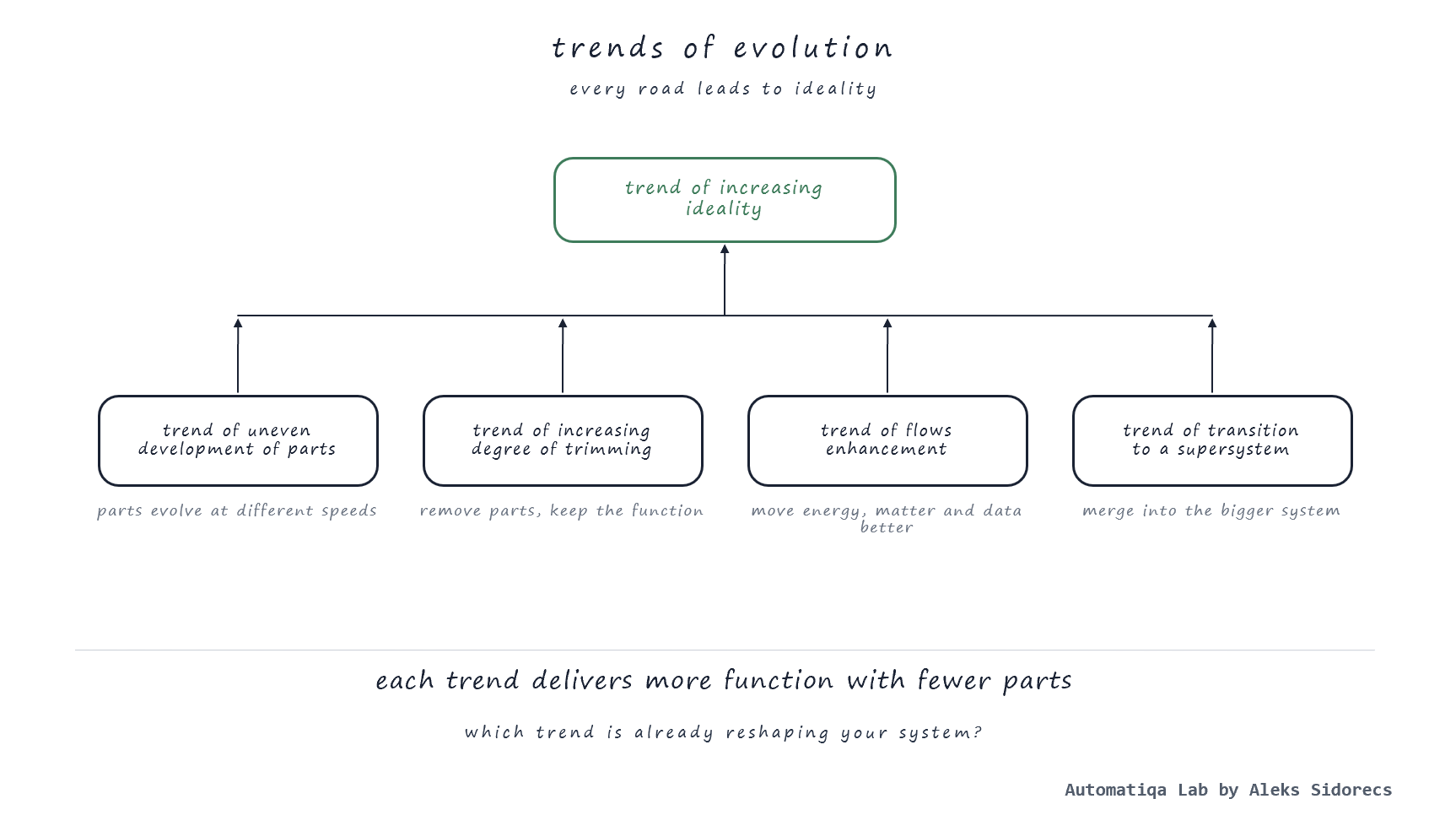
For that reason, it's worth considering some trends related to the evolution of technical systems that supply chain management is part of. But before we dive deep into some of those trends, let me share a few additional useful concepts:
- Trimming
- Supersystem
### What is trimming in supply chain? {#what-is-trimming-in-supply-chain}
Trimming in supply chain. When applying the trimming process, we look for ways to reduce (to trim) some of the components involved in a specific supply chain activity, so that their functions are redistributed amongst other (existing or improved) components. This might lead to lower operational costs, improved safety, and faster processing.
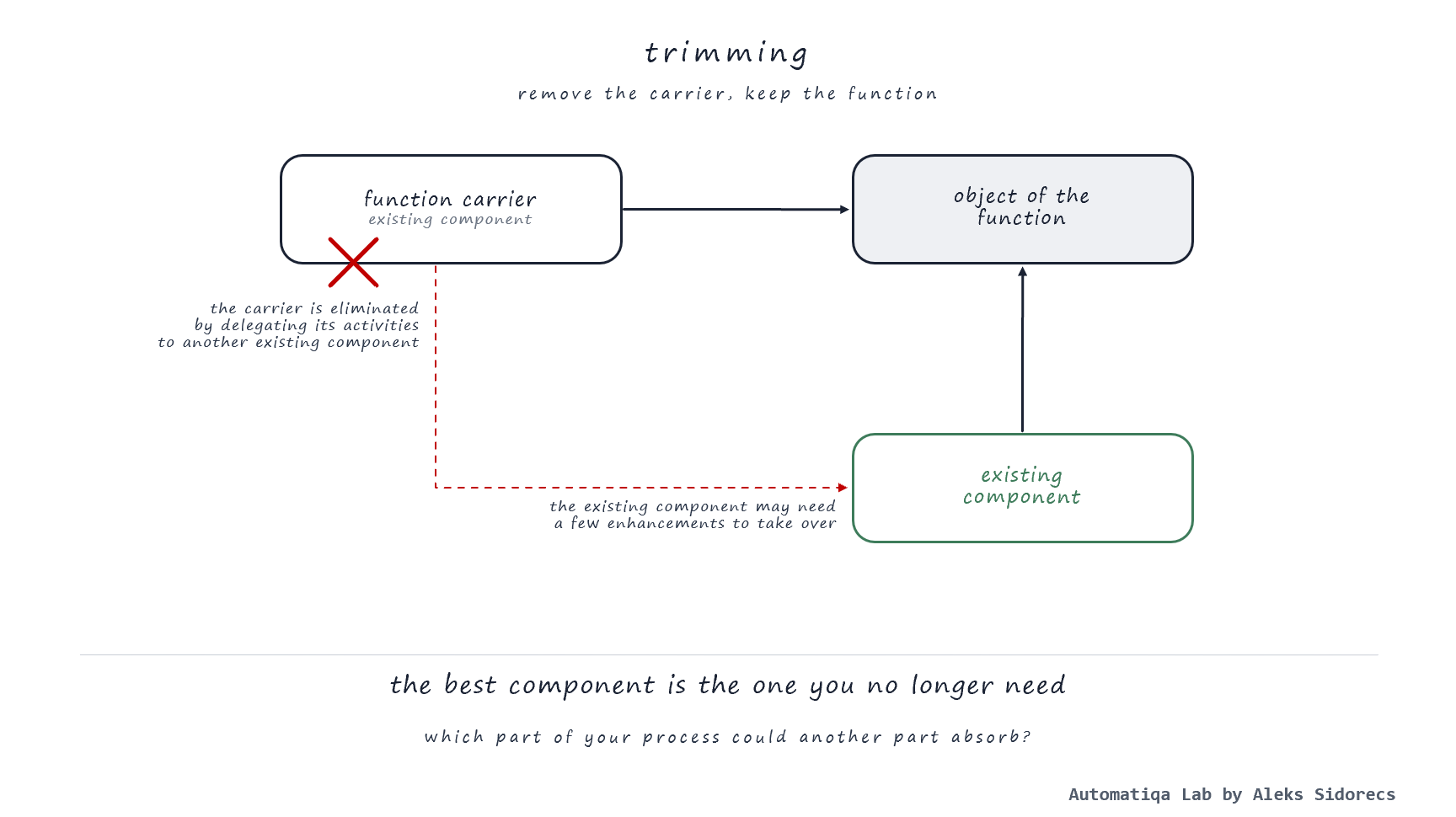
Let's assume that, based on functional analysis (an analogue of process analysis/[value stream mapping](https://en.wikipedia.org/wiki/Value-stream_mapping)), we have identified a set of activities/functions performed within a specific part of the supply chain. For example, to provoke some out-of-the-box thinking, let's look at international container shipments, which are causing many challenges today due to global imbalances in the freight markets.
The Core elements of the ocean freight flow are the following:
Vessel - Container - Product
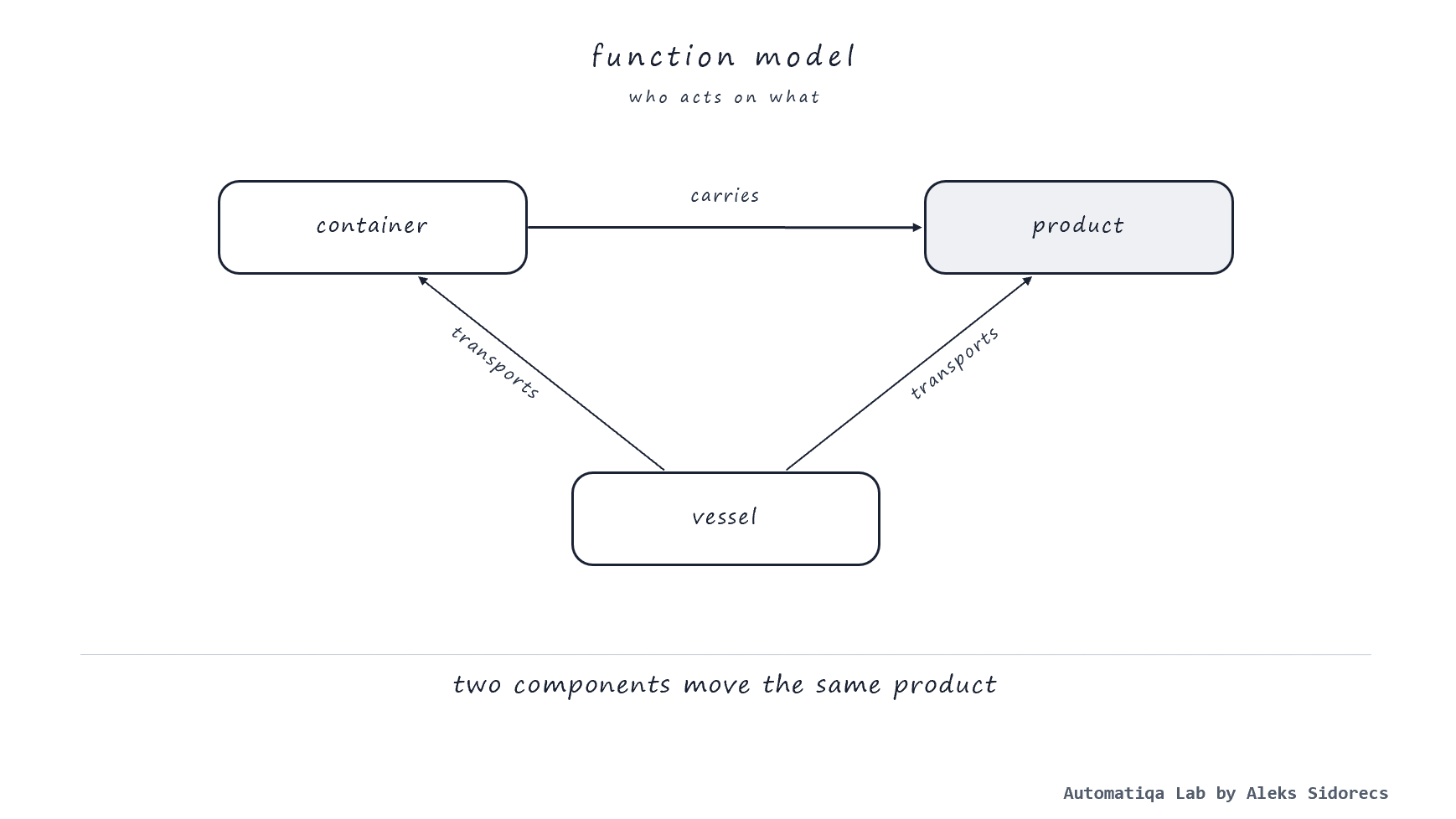
We know that vessel availability is one of the factors currently causing negative effects in many supply chains. So, let's take it out of the equation - trim and delegate transportation to the container itself. So, the new system would be something like this:
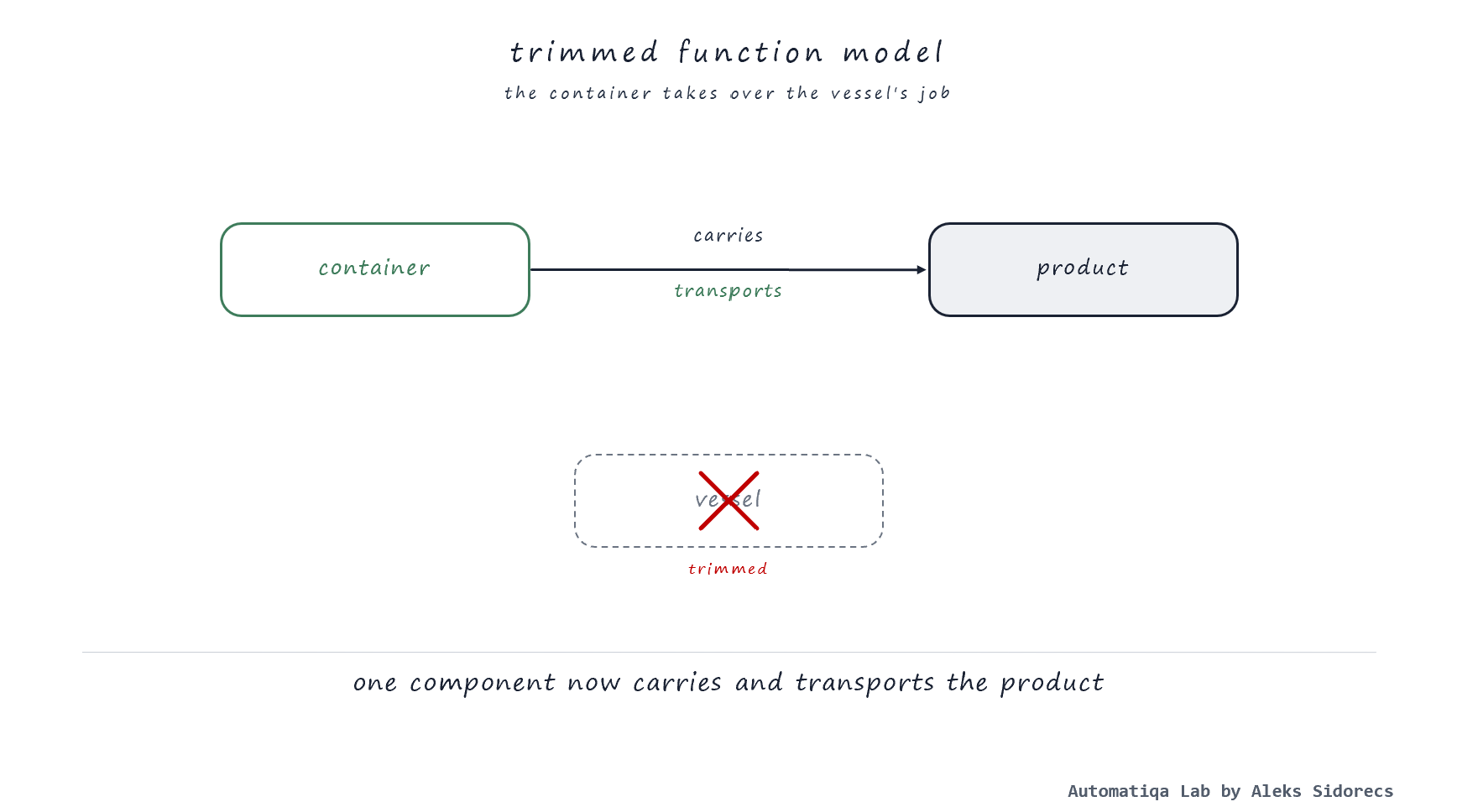
Imagine the ocean full of self-sailing, self-navigating containers using electric drive powered by solar energy (in [Heuristic](https://www.sidorecs.com/heuristics/04-dissolve-the-problem/) I mentioned a more realistic case from my practice, but this one is an interesting demonstration of more provocative ideas that can emerge when we move from using 'nouns' to functional analysis).
I personally find the trimming process a powerful standalone tool that can reduce costs across the value chain and be used as collaborative work between procurement and technical functions, for example.
### What is the supersystem of a supply chain? {#what-is-the-supersystem-of-a-supply-chain}
Supersystem of supply chain. This is one of the core elements here, because supply chain execution isn't an isolated activity, but rather a part of the specific supersystem that the company operates in:
- Supersystem as a source of resources for a supply chain system
- Supersystem as driver of lifecycle within a supply chain system
- Supersystem as a means of control within a supply chain system
- Supersystem as a source of target for a supply chain system's existence
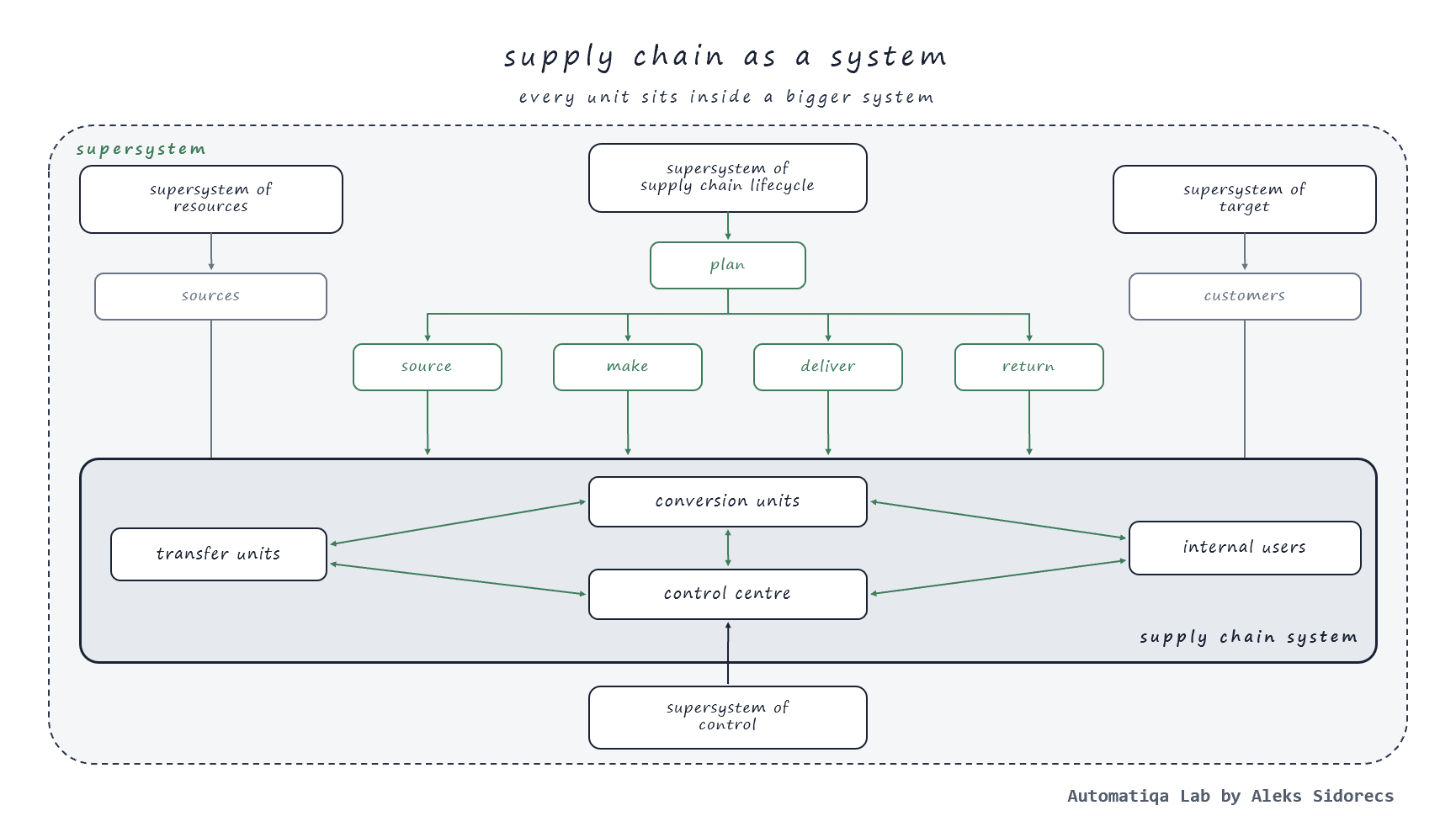
You might think of the supersystem as a business ecosystem. That would be correct to a certain extent, considering there're elements shared between both structures. Yet, a more correct view would be that the business ecosystem represents a sum of several supersystems that share common targets and objectives.
Now, some key elements related to the supply chain as a supersystem:
- The supersystem provides resources necessary for the Supply Chain System to execute its function and target. For example, it's possible to execute its function thanks to access to the sources (vendors) who form a critical part of such a supersystem
- Supersystem drives the lifecycle of the supply chain system, meaning it provides everything necessary to ensure that various execution stages can be performed within the system itself. A minimum number of subsystems is available within a Supersystem to ensure that planning, sourcing, production, delivery, and returns can be executed. For example, in the Deliver stage, the Supersystem provides infrastructure (e.g. roads) that enables the execution of logistical functions within the supply chain
- Supersystem provides control over the Supply Chain System, enabled by the minimal number of subsystems within Supersystem itself. For example, the driver operates the forklift in the warehouse, but the Warehouse Management System is used to guide the picking locations
- Supersystem as a source of Supply Chain Systems Target that provides the minimal number of subsystems necessary to ensure the system can effectively execute its main purpose and function. For example, a supersystem provides customers or consumers who have specific expectations related to the final product of such a system. Otherwise, the system would be supplying goods to markets that don't actually exist (e.g., supplying refrigerators to the North Pole, even though we can argue that, with climate change, it might become a reality soon).
### Why must the supersystem support the change? {#why-must-the-supersystem-support-the-change}
Let's return to the technical systems trends and their applicability within the supply chain domain.
Most interesting is that by combining knowledge of these trends with S-curve analysis, we're well positioned to forecast several scenarios for the further development of supply chain systems in the context of a specific business. This gives us a means to design a long-term transformation roadmap for a specific operating model and its subsystems.
Why is this important? [Idealised supply chain design](https://www.sidorecs.com/glossary/#idealised-supply-chain-design) principles apply across several layers, each with its own tools and toolkits to solve strategic, resource-based, and operational challenges within the supply chain.
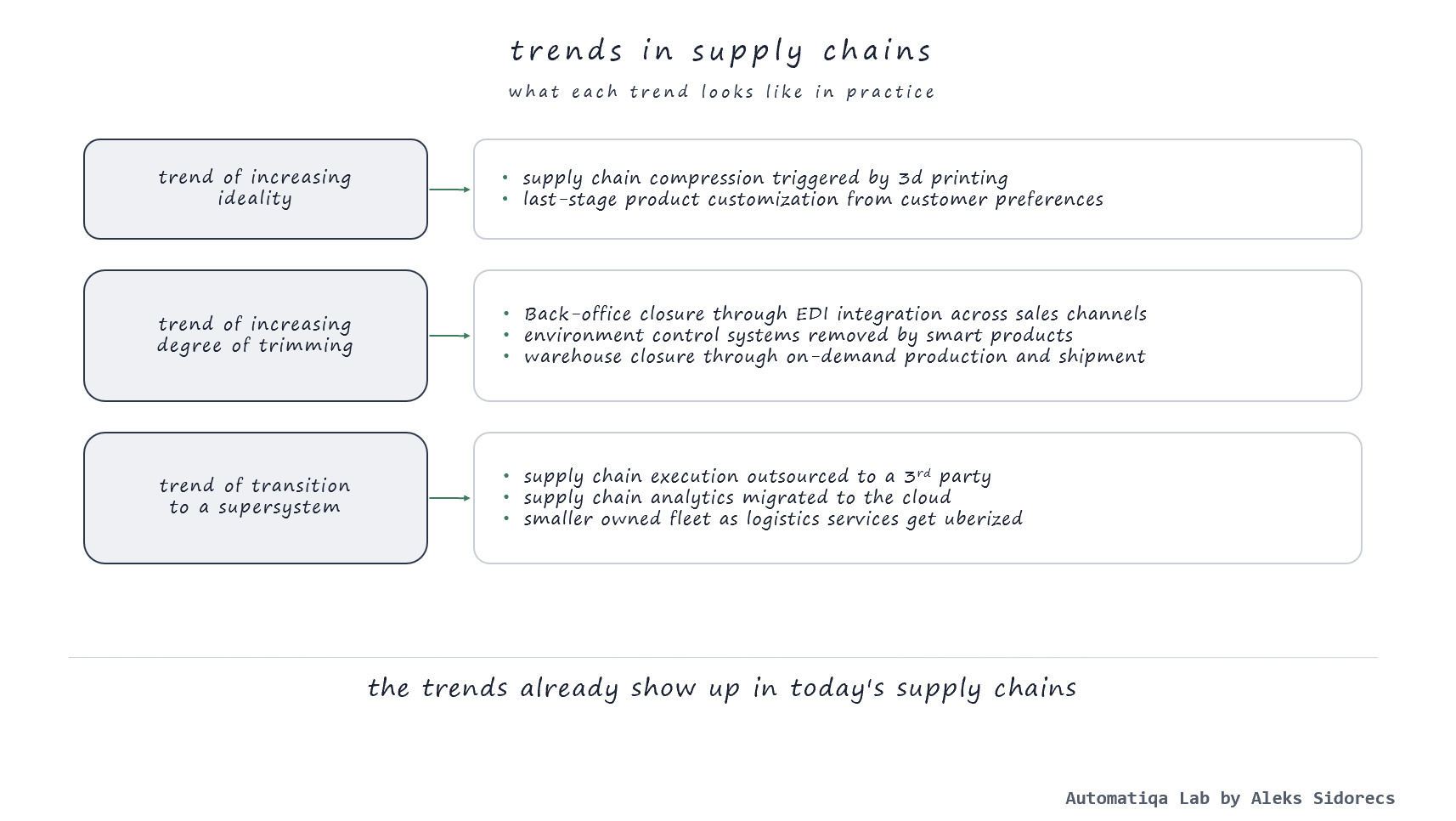
This means we need to work at a strategic level first and take a systematic, holistic look at the supply chain as a whole, analysing its subsystems and the current state of the supersystem. As supply chain engineers and architects, we want to avoid implementing changes across the business value chain in a way the supersystem cannot support.
For example, we already have hydrogen-powered engines and cars available, but we lack access to the fuel itself. Another example is developing automated warehouses for inbound cargo handling, but your supply base isn't ready to adopt because of new palletisation requirements, so you can't have smooth warehousing operations and low exception handling.
At the strategic level, we move into resource management blended with processes and flows. Those are the layers where we normally start facing the first contradictions that won't accept simple trade-offs, but require disciplined, structured work to resolve them. And that is where the miracle of idealised supply chain design begins.
## Cognitive inertia and design problems
Such an idealisation unleashes out-of-the-box thinking because it relaxes self-imposed cognitive constraints (=inertia) and encourages exploration of areas that normally would be untouched due to cultural, organisational, or professional taboos.
That's why, in my view, for any of us to turn the apparently impossible into the possible across supply chains, it's necessary to remove or relax limiting factors that stem from considering feasibility too narrowly.
It means approaching solutions, systems, and supply chain design decisions in a way that removes mental barriers and challenges our thinking, activating breakthrough capabilities that positively impact the company, its ecosystem, and society overall.
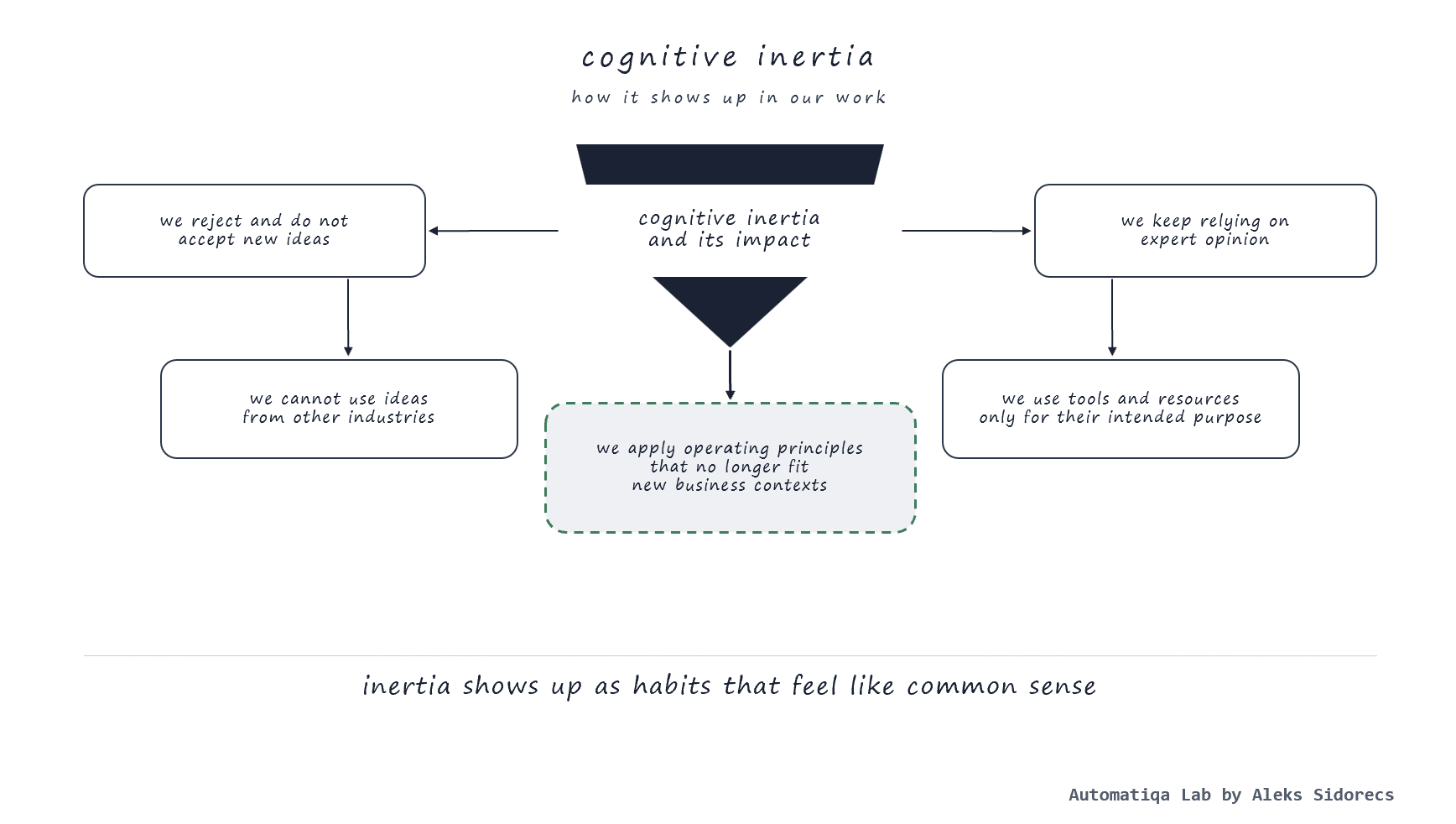
Typically, when we face a specific challenge or task, we unwittingly try to apply solutions, techniques, or models that we already know. This happens unconsciously at the level of mental reflexes. The thing is that such inertia is one of the properties of the human psyche, which is expressed in the fact that consciousness, the human mind, is often subject to the force of habit. Under its influence, when thinking about problems, ideas similar to those already known come to mind first. The issue is that old ideas are not suitable for new and continuously changing conditions (for example, when people start applying corporate hierarchy patterns to the design of agentic harnesses).
I've been part of various corporate 'Quantum Leap' programmes to realise at the end that the company invested huge efforts and resources just to make it run at the same speed as its top competitors (well, it is a best-case example) instead of coming up with new breakthrough business models, creating new markets and value?!
The reason is that, in our daily work, [cognitive inertia](https://en.wikipedia.org/wiki/Cognitive_inertia) limits our ability to innovate and come up with new ideas and disruptive ways to solve systemic issues.
### What causes cognitive inertia in supply chain decisions? {#what-causes-cognitive-inertia-in-supply-chain-decisions}
In the psychological literature, you might find many factors that cause cognitive inertia; some are also attributed to an individual's unique personality: fear of making mistakes, cognitive laziness, self-doubt, and self-criticism.
Here, I prefer to highlight those that, in my opinion, have the biggest influence on the supply chain community's work and the choices it makes. Some authors argue that simply being aware of these factors solves 50% of the issues when it comes to automatic behaviour and handling internal barriers, but I'm a bit sceptical, as I haven't seen real evidence to support such claims.
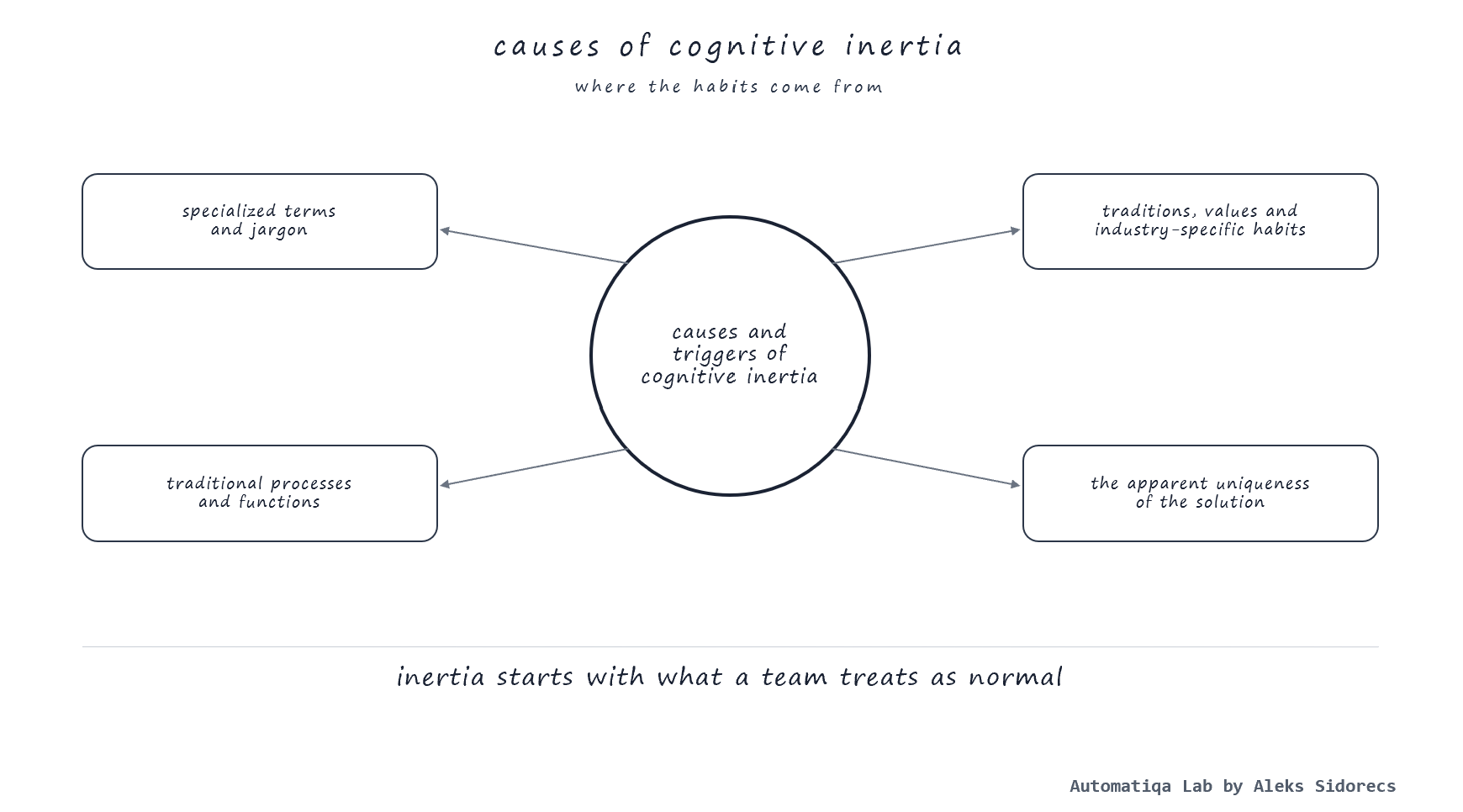
- Use of specific terms and terminology. This lies in setting and seeing the problem in generally accepted terms within a specific discipline, with each term reflecting an already existing technical solution. The disadvantage of such formulations is that the special terms impose on the solver the content corresponding to them. Special terms can be different: highly specialised (warehouse, forecast), general technical (sensor, drone), functional (planner, operator), household (food, package), universal (ecosystem), and so on.
That is why formulation of the problem often becomes a self-hypnosis that essentially programs thought in a specific research direction.
For example, from [Heuristic 04](https://www.sidorecs.com/heuristics/04-dissolve-the-problem/), the term 'Warehouse' could put the person in a position of thinking about a dedicated facility. This mental model triggers the solution exploration within the boundaries of the term.
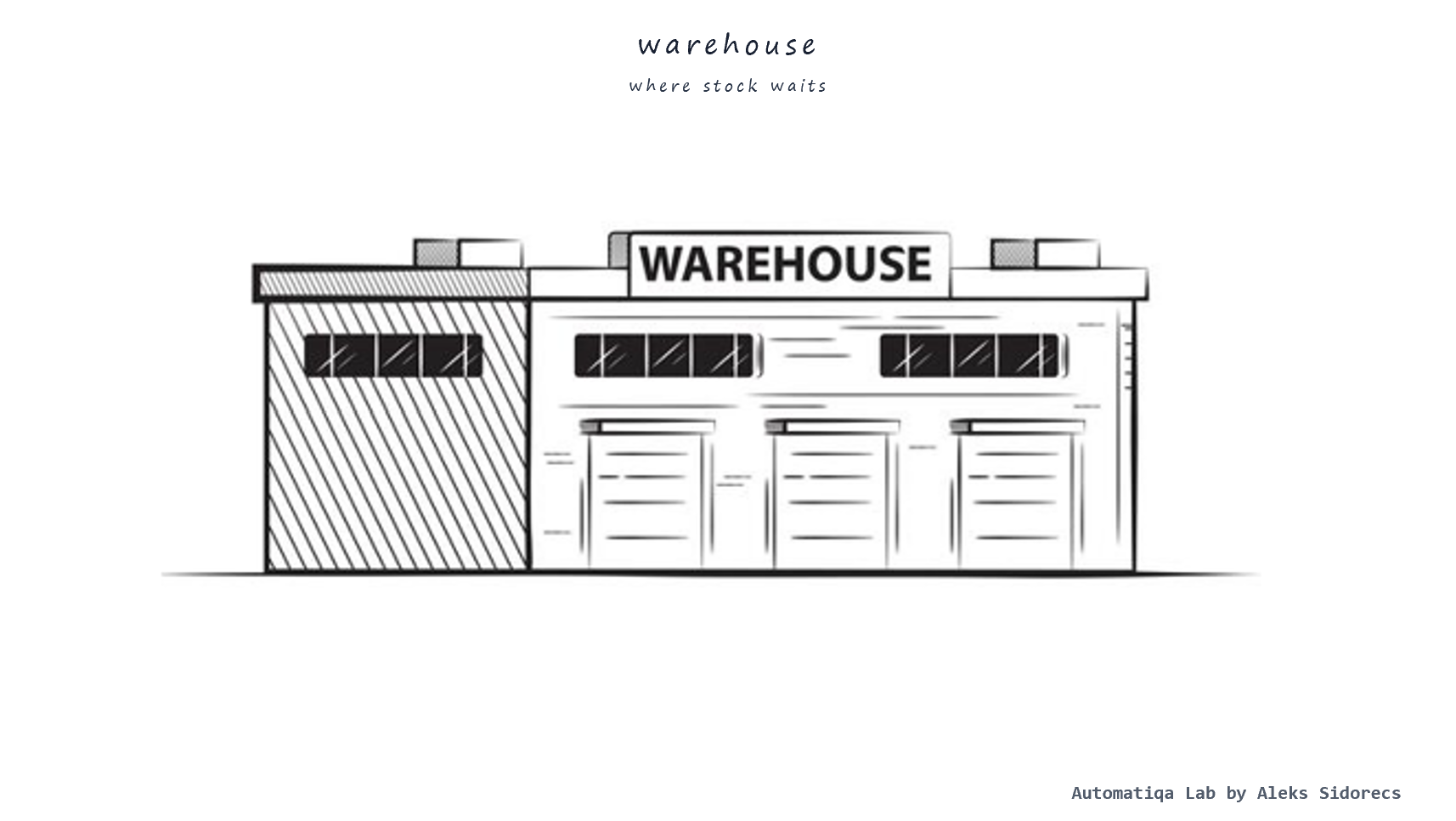
There's also another way of approaching it - abstracting it to the level of the function or desired activity that is expected to be performed within the supply chain: to store. When I look at the problem of storing the goods, I get quite a few mental images:
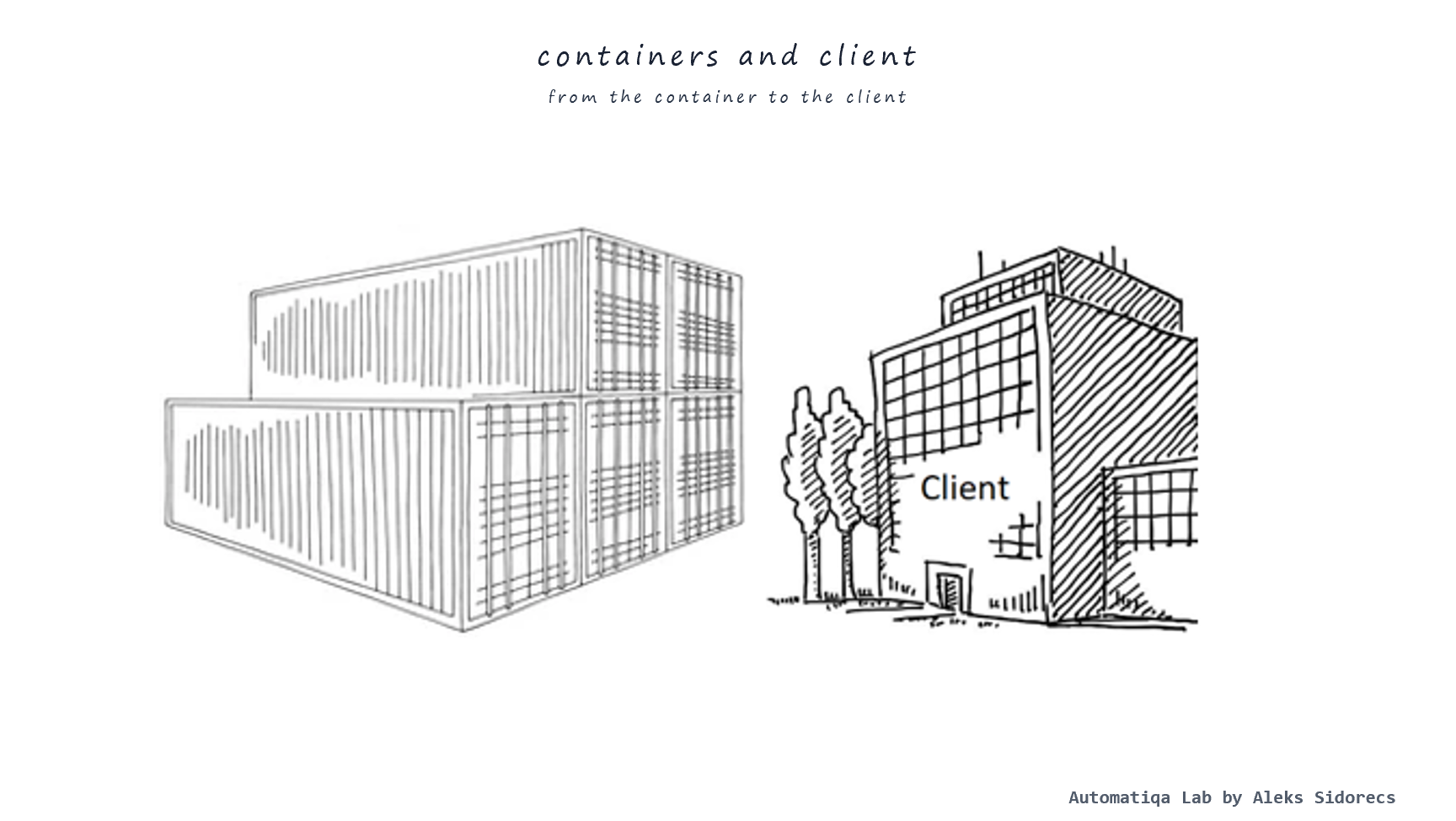
- In searching for solutions to my problem, I might come to the idea of not investing in additional warehousing facilities, but rather: a. keeping goods and storing them in containers or b. making arrangements with customers so the goods can be stored at their facility in a true spirit of asset/facility sharing, since they have unutilized space.
But here it is important to consider the Ideality principles that I highlighted previously - the ideas are still not optimal. We want to challenge it further, considering we are aiming:
a. Receiving the value at no cost (= storage for free)
b. Having no system while the specific function is still being performed (= the product requires no storage)
- System of values and traditions, industry-specific habits. Tradition and habits (professional, corporate, national, territorial, religious, etc.) strongly influence how we live and collaborate, the types and content of objects around us, and how we work and think. On top of that, we also have value systems that are highly contextual and shape how we perceive things and concepts. This often prevents us from seeing reality in a different light or from a different angle.
- Influence of traditional process and function. This type of inertia covers two cases:
a. First relates to the habitual sequence of actions and operations. In such cases, cognitive inertia can manifest in everything: how you handle the process, how you perform a certain operation on a factory floor, and the order in which you carry out the entire sequence of processes across the supply chain. It's not without reason that we say that habit is our second nature, and it applies both to individuals and companies
b. In the second, it denotes the habit of the object performing a traditional function. For example, a shop is a place to buy products; a factory is a place to produce goods; a van is a means of transporting goods. But can a shop or van perform another function? Of course, and a lot of them.
- Apparent uniqueness of the solution. This one, in my opinion, requires special attention. The reason is that this kind of cognitive inertia stops us from making overall progress towards Ideality, as it manifests in the following: if there is one solution, why bother with alternatives? Every problem or challenge has several possible solutions, and if you don't invest time and resources to validate alternative scenarios, you risk missing some promising opportunities.
In such cases, I usually represent this by using an [Ishikawa diagram](https://en.wikipedia.org/wiki/Ishikawa_diagram) to show the full spectrum of potential solutions. In this case we consider the objective of improving a specific KPI to the desired state of 98%:
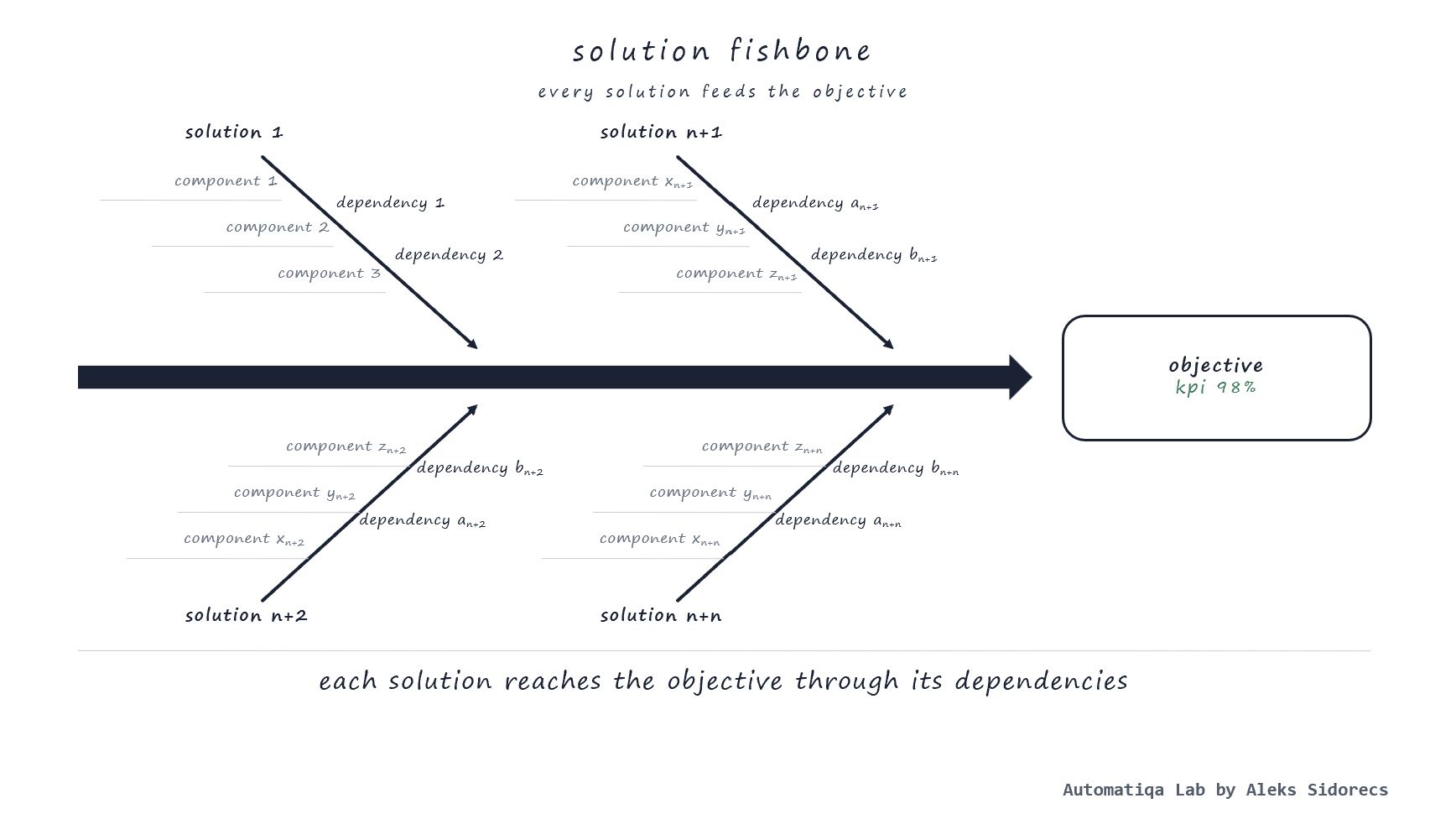
What often happens – to address a specific issue, a dedicated team jumps straight to a Solution 1 or 2 that is most comfortable (and sometimes consensus-driven) without validating assumptions and checking the alternatives. As a result, only marginal improvement is achieved, and the organisation misses the opportunity to identify and implement the model that would accelerate breakthrough performance transformation.
### Why does cognitive inertia keep us in trial and error? {#why-does-cognitive-inertia-keep-us-in-trial-and-error}
Why is all this important for us as supply chain practitioners? The major reason is that, when we are continuously influenced by cognitive inertia, a lack of systems thinking, and an inability to step out of our comfort zone, we are set up for a vicious cycle of trial and error that drifts us away from opportunities to identify and deploy 'ideal' operating models and chains of networks.
And the worst part is that it takes thousands of trials and errors to come up with a working (though still not ideal, given the trade-offs) solution that, in most cases, still carries a significant risk of not meeting critical business objectives.
Let me visualise it as a web of vectors to show how cognitive inertia actually moves us away from the proper solution when we are on a dangerous path of trial and error:
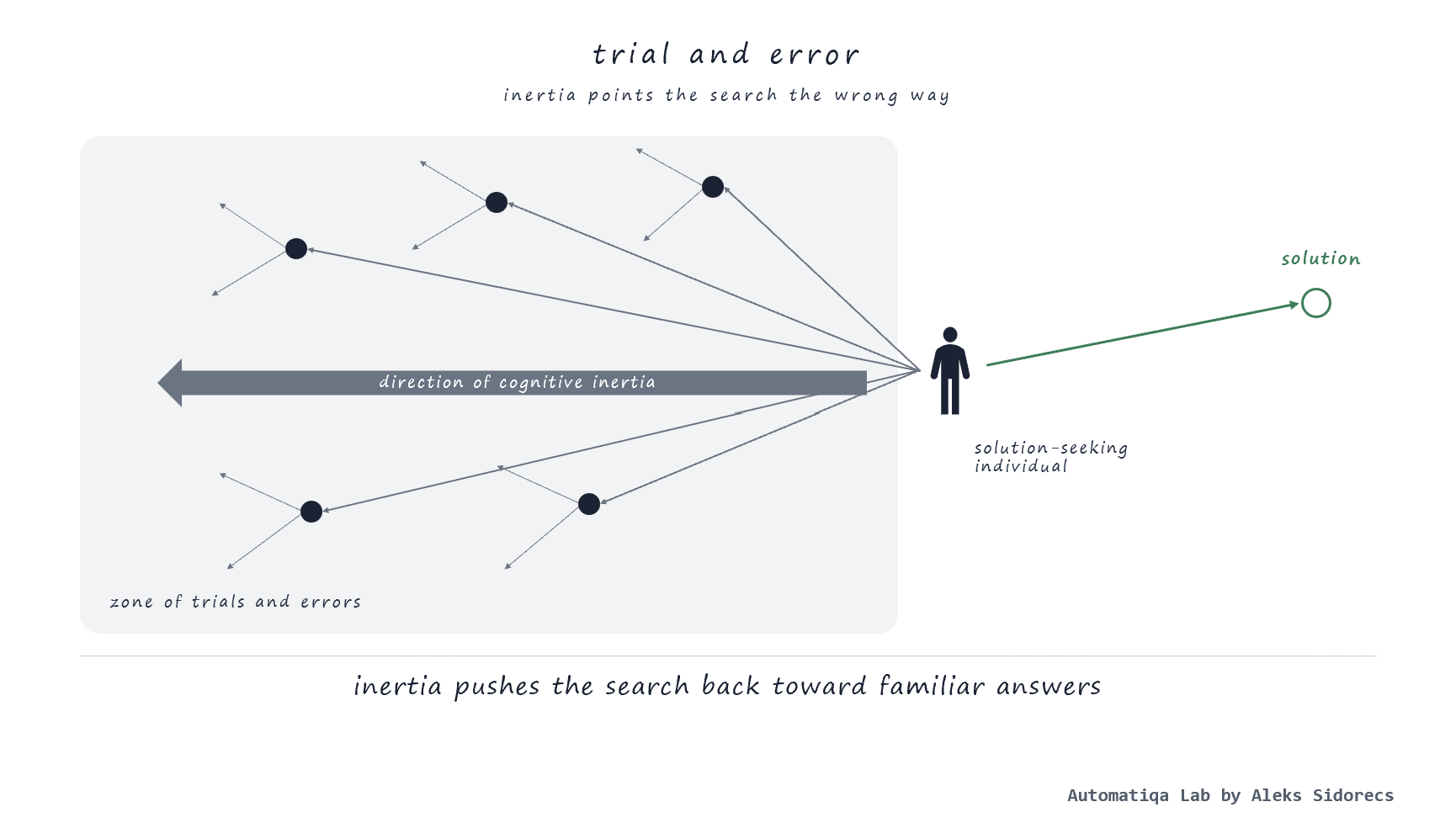
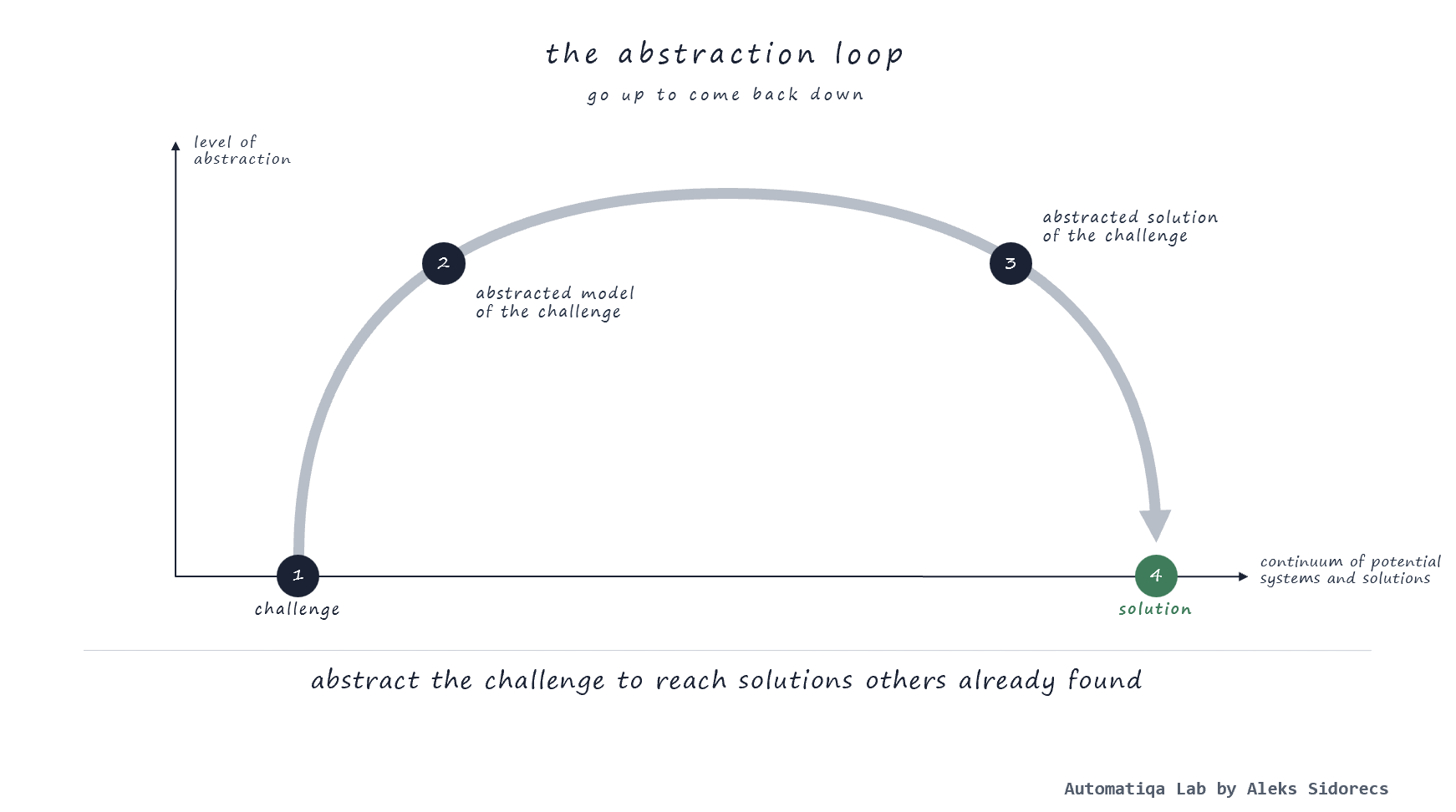
That's the reason why the abstraction-oriented methodologies are required to help us move from the inert zone of thinking to explore the spectrum of solutions that:
a. move us to the ideal supply chain system and/or
b. create new systems by shifting to a new S-curve
Elon Musk summarised it greatly in [one of his interviews](https://x.com/Erdayastronaut/status/1203840982497792005):
> “The best part is no part. The best process is no process. It weighs nothing. Costs nothing. Can't go wrong”