# Aleks Sidorecs - full text
> Re-thinking operating models for the moment operations meet the algorithm. Two decades running global supply chains, now applied to how physical operations, business architecture and AI get designed together.
Every published page, in full. Index: https://www.sidorecs.com/llms.txt
==============================================================================
# About
- Employer: ED&F Man Commodities (Volcafe)
- Based in: Switzerland
- LinkedIn: https://www.linkedin.com/in/alxsidr/
- Wikidata: https://www.wikidata.org/wiki/Q140796815
- Also known as: Aleksandrs Sidorecs, Alex Sidorecs, Alecs Sidorec
Aleks Sidorecs is a supply chain, operations and technology transformation leader based in Switzerland, with two decades running global supply chains at Procter & Gamble, Zeppelin, Johnson & Johnson, Holcim, Olam, Julius & Clark and ED&F Man Commodities (Global Head of Supply Chain at Volcafe Business Unit). He writes about re-thinking operating models for the moment operations meet the algorithm, and founded Automatiqa Lab to build the tools that test that thinking.
Most supply chains are built to operate from the past. I architect operational models engineered to orchestrate the future. I don't just move products - I engineer profitability.
## Beyond automation. Into orchestration.
As an EBITDA architect, my mandate is to transform fragmented, legacy flows into intelligent capabilities that systematically drive margin expansion and extended business value. I bridge the critical gaps between physical operations, business architecture, and technology - always with a human-in-the-loop.
### Operational Leadership
- End-to-end supply chain strategy
- Operating model re-engineering
- P&L ownership & EBITDA expansion
- Global turnaround programs
- Continuous Improvement initiatives
- Post-M&A integrations
### Applied Intelligence
- Agentic AI & interoperability
- Workflow automation
- Multi-agent orchestration
- Control tower & digital twins design
- Enterprise OT architecture
### Digital Transformation
- SAP S4/HANA & Microsoft Dynamics
- TMS & WMS deployments
- Control Towers roll-out
- IoT & sensor integration
- Data strategy
- ML and analytics
- Bespoke in-house developments
### Leadership & Method
- Lean Six Sigma practices
- TRIZ / Inventive Problem Solving
- Agile & Scrum delivery
- 300+ people developed globally
- 4 greenfield functions established
- 12 global turnaround programs
## Track record
### 2025 - Present - Global Head of Supply Chain, ED&F Man Commodities | Volcafe
Switzerland. Transforming supply chain from cost centre to profit centre. Driving EBITDA expansion, unlocking working capital efficiency, deploying scalable operating models, and leading digital, data & AI transformation across the soft commodities value chain. Enabling AI in daily operations and redesigning the operating model around it. Building the talent to run it - upskilling teams so that people, data and agents work as one operating model.
### 2025 - Present - Architect | Applied AI for Supply Chain & Operations, Automatiqa Lab
Switzerland. Founded an open-source lab that turns agentic AI into working tools for supply chain and operations. He explores how specific solutions impact operations, and what constraints technology, talent and operating models put on them.
### 2022 - 2025 - Associate Partner / Principal: Supply Chain Capabilities & AI, Julius & Clark
Switzerland. Led advisory assignments at a boutique consulting company - end-to-end maturity assessments, transformation roadmap development, operational capability upskilling powered by technology, analytics and automation. Developed operating model playbooks for global process excellence. Delivered end-to-end value chain re-engineering assignments, including deployment of SAP S4/HANA and MS Dynamics / D365.
### 2018 - 2021 - VP, Head of Supply Chain & Logistics, Global, Olam International
Switzerland - 21 countries, 73 operating sites. Established a greenfield function for a CHF 20B+ agriculture and food leader. Owned functional P&L and a 100+ person global organisation. Engineered the operating model across procurement, logistics and customer service. Double-digit cost optimisation with direct EBITDA contribution. Executed bespoke development and deployment of the end-to-end supply chain orchestration platform.
### 2014 - 2018 - Logistics & Procurement Lead, Global, Holcim (LafargeHolcim)
Switzerland - 80 countries, 4 business units. Led post CHF 30B merger integration for logistics and procurement. Managed a team of 70+ across 80 countries, overseeing CHF 5B group-wide spend. Established global standards, processes and a continuous improvement culture. Owned technology strategy for supply chain resilience.
### 2011 - 2014 - Supply Chain Procurement Manager, EMEA, Johnson & Johnson
Switzerland. Delivered market access strategies through supply chain localisation. Drove operational and digital upskilling of external manufacturers. Executed a 4PL outsourcing initiative end-to-end. Integrated multiple acquisitions including Synthes (CHF 21B).
### 2007 - 2011 - Supply Chain Transformation Lead, Europe, Zeppelin Group
Switzerland. Delivered supply chain diagnostics and a performance turnaround strategy. Developed operating model design across business units and deployed the new operating model including TMS and WMS implementation. Launched continuous improvement practices based on Lean Six Sigma.
### 2002 - 2007 - Logistics & Distribution Manager, Nordics, Procter & Gamble
Latvia - Central & Eastern Europe. Where it all started. Led logistics across CEE during P&G's aggressive acquisition period - Wella, Gillette, Braun, Duracell integration. Pioneered EDI and the regional SAP roll-out, owned S&OP for the region, built the mid and long-term logistics strategy.
## Speaking and events
Full list: https://www.sidorecs.com/events/
- 2026-10-02: 17th SCTA Forum & Dinner, Montreux (panellist) - https://www.sc-ta.ch/events/17th-forum-dinner-2026/
- 2026-09-28: AI-enabled Negotiation Preparation, online on Zoom (panellist) - https://events.cips.org/AIEnabledNegotiationPreparation
- 2026-06-18: The Invisible Chain, Zurich (co-host) - https://www.capgemini.com/ch-en/news/events/the-invisible-chain/
==============================================================================
# Heuristics
Heuristics are one-page rules for operations and supply chain, from a practitioner who keeps learning and applying them.
------------------------------------------------------------------------------
## Heuristic 01: Requisite variety in supply chain
- URL: https://www.sidorecs.com/heuristics/01-requisite-variety-in-supply-chain/
- Maxim: Match the variety or pay for the difference.
- Updated: 2026-09-21
## Problem
### What is requisite variety in supply chain?
**Requisite variety in the supply chain shows that any department can control only as much variation as it can absorb, and everything beyond that brings associated costs, delays, or constant troubleshooting.**
The supply chain world is a brutal place where professionals continuously fight against entropy. Each day, week, or month, it challenges practitioners' skills and ability to respond across logistics, procurement, manufacturing, or warehousing domains. Even with deterministic processes, systems, and tools, we still can't respond to the non-determinism of that reality. This gap never reveals itself directly because it hides behind rush orders to customers, sudden stock-level changes nobody can explain, or exception handling that becomes a full-time job. Another frequent signal we might overlook is the escalations that operators trigger when they see the problem but aren't allowed to act on it.
## Why it's hard
### Somebody has been paying for it all along
**Every counteraction taken as a response to the problem adds costs or complexity to the operating model.** When we remove variation from the entropy equation, it costs us flexibility or revenue. The individuals who're in the front driving seat are often the ones who're rarely empowered enough to respond to it. I ran transformation playbooks myself a few times before the maths caught up with me.
## The rule
### Three activities, pick one
**The operating model of any company can only control such factors that it can keep up with.** In general, there're three activities that supply chain professionals can perform:
- **reduce — Reduce what comes in.** You know it through standard specifications, buffer inventories or capacity, contract terms that limit surprises and other.
- **increase — Increase what you can absorb.** Let the edge of your organisation decide or get finer details of operations through more robust data models. Ensure there're more options to act, execute the workflow loops faster, use AI and [agentic solutions](https://www.automatiqa.io/oodaa/) to multiply response velocity.
- **accept — Accept what is left.** It's a conscious organisational choice by design as it should get an assigned price or cost, and clear ownership allocation.
> **Formula**
>
> **Vr ≥ Ve** — Ashby's law
>
> Where Ve (environment) represents the number of distinct situations the operation faces. At the same time, Vr (response) is the number of distinct actions the supply chain can take at each time step. Operational control fails whenever Vr is smaller than Ve. I've adapted it from the works of W. Ross Ashby on [cybernetics](https://en.wikipedia.org/wiki/Variety_%28cybernetics%29).
## The Variety Shortfall Test
### Which layer is short?
Nothing complicated here, just have a look at the operational challenges. Pick the one that keeps coming back to your team, repeatedly. When you slice it, clarity will come with what layer is actually short:
1. **Can't see it** — The signal never reaches anyone in time.
2. **Can see, can't act** — The person who sees it has no right to respond.
3. **Can act one way** — There's a single lever, and it's always the expensive one.
4. **Right action, too late** — The loop closes after the damage is done.
**Focus on addressing that layer, not the noisiest one.**
## Run on
> A case from the construction materials sector I worked in some time ago. Our customers could place same-day orders until late morning at no cost. The plants saw orders as they came; the dispatcher had the right to act. We lacked several response options for a variety of operational needs, and every morning became a continuous fight over available drivers to meet demand.
>
> We didn't add more drivers, additional trucks, or sophisticated software to increase the response velocity. Instead, we shifted the customer order cut-off time to the previous afternoon and priced same-day execution. As a result, the most urgent customer requests vanished overnight, and the rest paid for the overtime.
>
> The variation was still there. What changed - the customers were no longer sending it to us for free.
## How this rule gets misapplied
- More reports and data don't give real control over your operations. It just breeds illusions unless they really change what someone can do.
- Centralisation with wrong mindset likely to take the response velocity from the edges and reduce overall operating model capacity to absorb variety at the relevant nodes.
- Trying to eliminate the leftovers instead of pricing it - some variation is the real business; with a right mindset it can be translated into additional profit streams.
---
> **Match the variety or pay for the difference.**
------------------------------------------------------------------------------
## Heuristic 02: Asymmetric supply chain physics
- URL: https://www.sidorecs.com/heuristics/02-asymmetric-supply-chain-physics/
- Maxim: Diagnose the shape before you prescribe the cure.
- Updated: 2026-09-21
## Problem
### When do classical supply chain strategies stop working?
**When I review various operations management playbooks, I often find theories and concepts built on one unspoken assumption: symmetry.**
It doesn't mean they're wrong; I've seen and managed symmetric models across consumer goods, automotive, life sciences, and other sectors. Buyers and suppliers are highly interdependent and operate in a relatively predictable environment, often guided by aligned principles such as shared data, balanced risk, and mutual leverage.
Then I moved into a different industry vertical built around 12.5 million smallholder farmers worldwide. Welcome to the soft-commodities and agrifood sector. There are no conveyor belts; weather and climate shape my supply chain strategy as much as, and sometimes more than, the company's P&L. Traditional frameworks break down, and conventional experience becomes irrelevant. To be clear, I wasn't dealing with a broken supply chain. I had simply moved into a different universe, operating under a different algorithm and physics.
## Why it's hard
### Same tools and operating modes, but wrong physics
**Symmetric supply chains are built on Newtonian logic.** If a product promotion drives a 5% sales increase in retail, it triggers relatively linear behaviour across all nodes involved, including distributors, brand manufacturers, Tier-1 and Tier-2 vendors for chemicals and packaging, and so on. Cause and effect are roughly proportional, and a standard ERP or APO system handles it well.
Asymmetric supply chains are different because they run on a different fuel - chaos theory. A weather anomaly, such as frost in Minas Gerais, a micro-region in Brazil, might trigger commodity exchange algorithms and reprice the entire market within hours. This will consequently affect international physical flows, container availability at ports, and warehouse capacity at destinations - in days, not months.
To make things even more challenging, asymmetric operations often manifest in two forms. The frost example is idiosyncratic because only one supply chain node fails. Another form is represented by a super El Niño weather pattern. It triggers a wave of multi-node issues worldwide, with dry weather in Brazil, through East Africa, and highly humid conditions in Vietnam. All nodes fail together within a 12-month window, making it impossible for farmers to grow high-yield crops to meet global market demand.
As a result, when practitioners approach asymmetric realities with a symmetric toolkit and playbooks, whether standard contracts, software, or process excellence, it feels like measuring temperature with a ruler.
I'm certainly not the first one seeking a mathematical approach to the operational problems. The authors of ["Factory Physics"](https://en.wikipedia.org/wiki/Factory_Physics) (Wallace Hopp and Mark Spearman) have provided a great portion of the evidence that various processes follow predictable rules of behaviour and that these can be described using algorithmic models. Where "Factory Physics" ends, my empirical research begins.
## The rule
### One question facing three architectures
**Before selecting any technology or solution, setting functional objectives, or deciding on an operating model's architecture, practitioners should define which shape they're facing.** Without this step, it's hard to make any design call, and professionals risk making ones that don't fit the real physics their business faces.
- **symmetric — Interdependent and balanced.** Symmetry is a form of dependency that creates balance. When both parties have access to each other's information and decision-making, they create partnerships based on mutual dependence and sometimes - shared assets. This type of partnership creates transparency, so all partners know their role in the supply chain and what is expected of each participant. The most common examples of this type of physics exist within the automotive and manufacturing industries. When external, non-deterministic factors hit one node, the whole ecosystem adjusts to restore the supply chain to homeostasis: inventory, production capacity, and other elements.
- **asymmetric — Bottlenecked and skewed.** The "funnel" shape indicates an asymmetrical operating model. At the lower end of the funnel, we often find a fragmented, unevenly distributed network of participants, comprising mainly artisanal producers and small and medium-sized enterprises. Market access and most value-added activity occur in and are controlled by the mid-section. At the neck (narrowest point): capital and data. Agricultural production and raw material extraction best represent such physics in operations. With non-deterministic negative factors, compared to symmetric structures, there's nothing to adjust around them; the shock travels up the funnel to the market and back down to the base, which absorbs it.
- **hybrid — Centred around the brand and layered.** A brand-centred hybrid is recognisable by how much it influences trends, inventory allocations, and overall market dynamics. The most typical hybrid physics exists in the fashion and Sportswear industry verticals.
Operating models generally have a low-risk, asset-light structure, which means they rarely take on internal production/execution risks and prefer outsourcing. At the same time, hybrid structures don't absorb external shocks evenly. This is defined by contractual arrangements between the network's agents: the brand owner and contract manufacturing network absorb different halves of the shock. For example, demand and inventory risk stay with the brand; execution and capacity risk stay with the supplier. The supply chain restores itself as long as neither side's half exceeds what it was designed to carry.
At the same time, the companies I worked for ran on hybrid physics: asymmetries existed upstream, and they executed symmetric flows downstream. Normally, this starts creating process contradictions because the operating model gets stretched across both ends of the spectrum and fits into neither.
> **OVR = σ²(outside) / σ²(total)** — the Outside Variance Ratio
>
> The situation discussed in previous parts of this heuristic can also be expressed mathematically. The simplest equation that comes to mind is the formula stated above. σ² (sigma squared) refers to the variance at a node. It covers variables such as order volume, lead time, yields, and other relevant factors. σ² (total) is the total variance faced across operations. σ² (outside) represents the variance attributable to factors outside the company's walls.
>
> So, what is the conclusion? When we calculate OVR, it shows the share of variance driven by factors outside the company's walls. It can be weather and climate issues, price and cost volatility, new regulations, and other factors. Low OVR indicates symmetric physics, while asymmetries occur at higher OVR.
>
> [Heuristic 01](../01-requisite-variety-in-supply-chain/) requires V(response) ≥ V(environment). The current one defines the source of V(environment). OVR is the field estimate behind the third test question that follows, and it is ordinal in practice - no need to measure it to two decimals.
## Test
### Which shape are you in?
Three things to question for each of your end-to-end flows. Validate them on a flow level, not company or business unit. As mentioned earlier on hybrid physics, any company may have an upstream flow in one form and a downstream flow in another. Answer from the most recent 12 months of incidents, not from the value stream map.
1. **Do you choose your suppliers, or do they choose you?**
2. **Plan within error of 10%** — Can you forecast next quarter's incoming volume with an error of less than 10%?
3. **Inside or outside** — When something gets wrong, is the cause of problems usually inside your walls or outside them?
**Two or more "outside" answers, and you are asymmetric, whatever the value stream map says.**
## Run on
> Since April 2026, I've been reading global climate reports as supply chain strategy documents and spending time with in-house and external climate experts. Some peers asked why. The WMO had warned that a new El Niño is likely to strengthen through 2026, possibly into one of the strongest on record, peaking, as usual, around Christmas.
>
> I ran the three questions on the agricultural network I work with. The suppliers choose us. Next quarter's inflow depends on rain. The cause sits in the Pacific. Three "outside" answers.
>
> So, the forecast stops being just a climate report and becomes a strategic plan. Origin qualification had to be moved forward in time - an alternate origin activation takes months, so the call went out on a weather forecast, not on a basis of existing conditions. It shapes where we'll hold stock buffers and how far ahead of the El Niño peak to act. Consequently, we mapped which new port pairs would activate under several scenarios for volume drift between impacted origins, and repriced working capital due to longer transit times and larger inventory buffers. The forecast peaks around Christmas. The architecture was set long before.
## How this rule gets misapplied
- Deploying Lean Six Sigma or continuous improvement initiatives on an asymmetric supply chain. There's a strong chance it would optimise buffers and standardise a lot of workflows that silently absorbed outside variability.
- Driving supply base diversification and alternative sourcing initiatives, missing the part that they all depend on one common driver - one climate system, one port, one currency, one sub-tier source. It looks diversified on paper, but risk isn't compressed at all.
- Licensing or building planning solutions/tools for symmetric demand and giving it a forecast you don't control - a harvest, an artisanal mine, a driver pool. The plan is precise but becomes perfectly wrong.
## Related heuristics
[Heuristic 01](../01-requisite-variety-in-supply-chain/) says to match the variety or pay for the difference. Heuristic 02 tells where the variety comes from and where it lands.
---
> **Diagnose the shape before you prescribe the cure.**
------------------------------------------------------------------------------
## Heuristic 03: Decision loop readiness
- URL: https://www.sidorecs.com/heuristics/03-decision-loop-readiness/
- Maxim: A company is never ready. A loop is, or it isn’t.
- Updated: 2026-10-18
## Problem
### Why do AI readiness scores never tell you what supply chain operation should do on Monday?
**Every agentic AI readiness assessment I’ve seen tends to score a specific segment of operations or a whole company. I have a problem with that approach; in 99% of cases, every agent I’ve built or deployed across operations stalled at a decision point.**
I’ve used process mapping/frameworks (e.g. value streams from Lean Six Sigma, BPMN) for most of my supply chain and transformation career. The key aha moment for me, which sparked a lot of reflection, came when I started applying process diagrams to define activity zones that could be handed off to an AI agent. Like a case where 60+ workflows for the order-to-cash pillar were identified by our team. In the diagram, each candidate represents a clean lane with triggers and steps. You can see inputs, processing steps/execution and final outputs highlighted. But that’s how it looks on paper or on a PowerPoint slide. When you hand each such workflow to Agentic AI, it reaches the point where a human must decide, and that is where all the promised miracles vanish. 10 cases like this shifted my thinking and led me to conclude the problem wasn’t triggered by an unread agent or company. The loop itself was a core issue - by design.
Since then, I've stopped asking how prepared my company or its supply chain is for agentic AI. Instead, I'm asking how prepared the specific decision loop is.
## Why it's hard
### A company doesn’t decide. A decision loop does.
Why doesn’t scoring company-level readiness make sense? Because readiness is a property of things that have a capability to respond. The company itself (as a standalone unit of measure) can't respond per se. The response property (or capacity) comes via individual decision-making loops within a company instead. [Heuristic 01](../01-requisite-variety-in-supply-chain/) indicated that the variety of possible responses should be at least as wide as the variety of incoming stimuli from the outside world/internal operations. On top of that, an operating model diagram or org. chart can't capture the range of possible responses because each decision loop triggers a response individually - through the person owning the loop when a supply chain exception lands on the desk Monday at 9:00 am. As soon as we average this across the entire organisation to get a single readiness score, we risk creating a number with no real substance.
I define the term decision loop as a network of handovers that ends in a specific decision, combined with a feedback loop that sends the outcome back to the person who will decide next time.
The process map, irrespective of the methodology we use, rarely captures the network of handovers that lead to specific decisions. I've rarely seen any that captured the inputs the decision-maker had on hand (at the moment of deciding), and the same applies to tracing the outcome loop. Process maps are illusory because most of the flows look fine on paper only. In daily operations, loops often stay open because a specific task waits for a Thursday meeting; an operator decides over the phone, and no one records it in any database; or an outcome never reaches the person who needs it most.
Another challenge: decision loops tend to cross many boundaries (that’s why I use the term “network of handovers”), and process diagrams tend to fully ignore that. For example, when the loop stays inside one function and one system, it's kind of a technical job. Its sister loop that crosses a function, a system, and a specific profit centre often becomes political, regardless of the scale and impact of the decision. That’s why, in my opinion, a company-level assessment/scoring can’t see the difference and, most likely, is one of the key reasons some pilots get cherry-picked for visibility (political) but are forced to die because they have low or no real impact across operations or the broader business.
## The rule
### One loop, traced end to end, before any paid assessment
*Before you **decide** to engage paid readiness assessment from consultants or launch a pilot - just pick one decision loop and assess that.* The objective is simple: to trace the flow from the trigger to the decision and through the return path of outcomes. Here we also should count the number of boundaries it’s going to cross. Based on those inputs, you can judge the specific decision loop's AI handover readiness. Then you repeat it for the next loop and so on. The temptation is to average results into a score/rating, but the problem, as many supply chain practitioners would recognise, is that the average is exactly where information and signals die.
> **b = f + s + p**
>
> f, s and p are 1 if the loop crosses a function, a system or a P&L boundary between trigger and return, 0 if not. b runs from 0 to 3. You can also extend this formula to add more variables, since no single company runs decision loops on a unified template compared to ERP systems.
>
> It ensures the proper triangulation, validating in detail the type of work the loop needs to become AI agent-friendly:
>
> - b = 0 or 1 points to boring engineering work - very easy and simple to delegate
> - b = 2 drifts you to organisational design issues first (instead of simple AI deployment); someone must own a loop that currently crosses two functions.
> - b = 3 gets us into political games. No model type or quality is going to change that.
>
> ***x** from [Heuristic 02](../02-asymmetric-supply-chain-physics/)* calculates how much variety lands in your organisation from outside the company walls. In Heuristic 03, b points to many intra-company walls it's crossing before anyone actually responds to it.
## Test
### Is this loop ready?
Pick one decision from the last three weeks. Important that you pick really a decision, not a process or KPI - just a decision. Next step is to answer from the angle of what has happened (not from the procedure!):
1. **Who decided?** Can you identify the person and the specific moment in time and space? In cases where the answer points you to something like “the Thursday meeting” - it’s not a loop at all; it’s a queuing issue.
2. **What inputs were available?** List the inputs that were available to support the decision (in the moment it was made). Also make sure to capture the ones that should have been there but weren’t by the time of making it (very important).
3. **Did it return the outcome?** Did the outcome reach the person (with a form/shape that they can use or apply) who's likely to take the same decision next time?
**Three “yes” and b ≤ 1: the loop is ready for agentic AI. Just one “no“: the operational readiness score/rating is irrelevant until this loop closes.**
## Run on
> Here's a case from my practice: a customer order with 25 containers in transit through the Indian Ocean. The client became insolvent, and the decision looked easy - we just had to reroute the order with 40-foot containers by changing the port of destination (POD). Final outcome? We had to sign off on payment to the shipping line for demurrage and detention charges of nearly USD 1 million. The main driver was that it took the organisation nearly four weeks to sync internally and resolve the issue.
>
> Now let me demonstrate how tracing the loop works. First, we identify the trigger: the insolvency notice from the client in Slovenia that lands on the credit risk department's desk. Next, we spot the first handover to a sales team member who managed the contract and relationships with company X. No surprise that the second handover landed with the logistics operator who handled shipment execution and title documents (e.g. Bill of Lading). The third handover went to finance - they owned the exposure. The output loop - there's none, which means that next time (in similar cases) the loop would start from zero.
>
> What was on the hands (in terms of inputs) when the situation developed that way: the exposure figure arrived after the carrier’s free time had run out. Did it come back: no. b = 3 - function, system (contract, booking, ledger) and P&L (one unit had sold, another held the stock).
## How this rule gets misapplied
- Hiring external advisors for a company-level readiness score assessment and using it to define an AI deployment roadmap across operations. As mentioned above, the biggest problem with this approach is that it's going to average closed loops with open ones and likely will highlight “medium” readiness for the whole bucket.
- Diagnosing the process flow instead of the decision loops. The value stream map (VSM) will always look perfect. But reality will always drift from the diagram because the VSM doesn’t account for an invisible part represented by a decision at the 7th step waiting for a cross-functional meeting.
- Choosing the first loop by initiative visibility (political) or the one that the leadership team asks about, instead of prioritising by b. A b = 3 represents reorganisation at full scale, not a pilot.
- Considering that your loop is ready since the data exists. The inputs in the warehouse and the inputs the decision maker had at a specific moment are completely different and irrelevant things.
- Deploying an AI model on a loop nobody really traced. I’ve done this: yes, the model finally worked, but the decision point it fed hadn’t been mapped. As a result, the loop never closed, and expected ROI from agentic deployment was behind vs. initial business case indication.
---
> **A company is never ready. A loop is, or it isn’t.**
------------------------------------------------------------------------------
## Heuristic 04: Dissolve the problem, don't just (sub-) optimise the supply chain
- URL: https://www.sidorecs.com/heuristics/04-dissolve-the-problem/
- Maxim: A problem optimised is a problem kept.
- Updated: 2026-11-01
## Problem
### Why does every continuous improvement initiative leave the problem in place?
**Every improvement initiative I've signed off or shown did the same to any problem - it just became much cheaper to maintain.**
The key challenge is that every individual problem across operations with an assigned KPI has a tenure. Yes, we can improve specific parts of operational execution, and if we do it right, we would observe specific KPIs start drifting toward a target state. I've delivered many such initiatives, whether improving working capital by optimising forecasting and cash flows, or by reducing demurrage and detention costs through better planning of inbound flows from port terminals to destination warehouses. The key issue is that the problem shrinks, but it remains permanent twelve months later.
I'm continuously asked to deliver supply chain configurations that are agile and lean, powered by high service levels against cost targets that the company defines for its P&L periods. Those aren't trade-offs a plan could balance as it was in pre-COVID times. As a result, I developed a habit of seeking new methods outside of the classical supply chain and operations textbooks (or legacy career experience). In the early 2020s, this led me to [TRIZ](https://en.wikipedia.org/wiki/TRIZ), a concept I trained in for three years and earned certification in through applied problem-solving use cases in daily operational work.
One key TRIZ definition that initially caught my attention and dropped me into a rabbit hole of inventive problem-solving exploration was this: the function is performed, but there is no system doing it. Take a minute to reflect. I do still remember how it made me think intensely and repeat those words over the next few days before I sat down, took paper and redefined it for my discipline: the customer (or consumer) receives the product, with no supply chain behind it. That is how the concept of Idealised Supply Chain Design started forming in my head, and I still use it to this day.
## Why it’s hard. Very, very hard.
### Operations are built to solve - they are not designed to dissolve issues
**An optimised problem is a disorder held in place by energy, and the energy bill never stops.** It's interesting how [John Boyd](https://en.wikipedia.org/wiki/John_Boyd_(military_strategist)) translated the [second law of thermodynamics](https://en.wikipedia.org/wiki/Second_law_of_thermodynamics) for army and business strategists: even while effort intends to keep it as is, any system in any condition will have a natural tendency to drift toward disorder (always!). As a result, the more control we try to impose, the more energy (e.g., organisational) it would take to maintain the status quo. In the supply chain, this energy shows up as a stock buffer, a status update report, an additional vendor, or thirty-minute meetings for shipment review at our factory in Germany.
Another systems thinker who significantly influenced my operational philosophy is [Russell Ackoff](https://en.wikipedia.org/wiki/Russell_L._Ackoff). In his works and lectures, he often mentioned four ways to treat any operational problem: absolve it, resolve it, solve it, dissolve it:
- situations when we hope it just goes away define absolving
- when we deploy a good enough or acceptable fix is resolving
- solving becomes the best answer any system allows - that's where optimisation happens
- to ensure that same problem doesn't occur, we have to dissolve specific elements of the environment it sits in.
What matters is that the middle two are what a typical supply chain function measures and rewards. At the same time, design decisions sit in another’s budget (e.g. CAPEX, commercial or IT), since the fourth is a pure design act. I remember a multi-billion family business that owned every factory across four countries in the baby care medical devices sector - previously, market entry was defined by greenfield CAPEX projects and their deployment lead time. But it didn't take long for new players to figure out how (triggered by [Obamacare](https://en.wikipedia.org/wiki/Affordable_Care_Act) opportunities) because they relied on outsourcing (contract manufacturing) to enter those markets first. Lead time was a property of a choice, so the choice was never on the table.
The word choices (especially the nouns) do the rest. When we define the problem through the noun 'warehouse', somehow every solution becomes linked to a physical facility. When we pick 'forecast error', every solution centres on better forecasting. I call it self-hypnosis because, before anything starts, the term's usage already programs the search for a solution, and it looks exactly like the cat in the following figure:
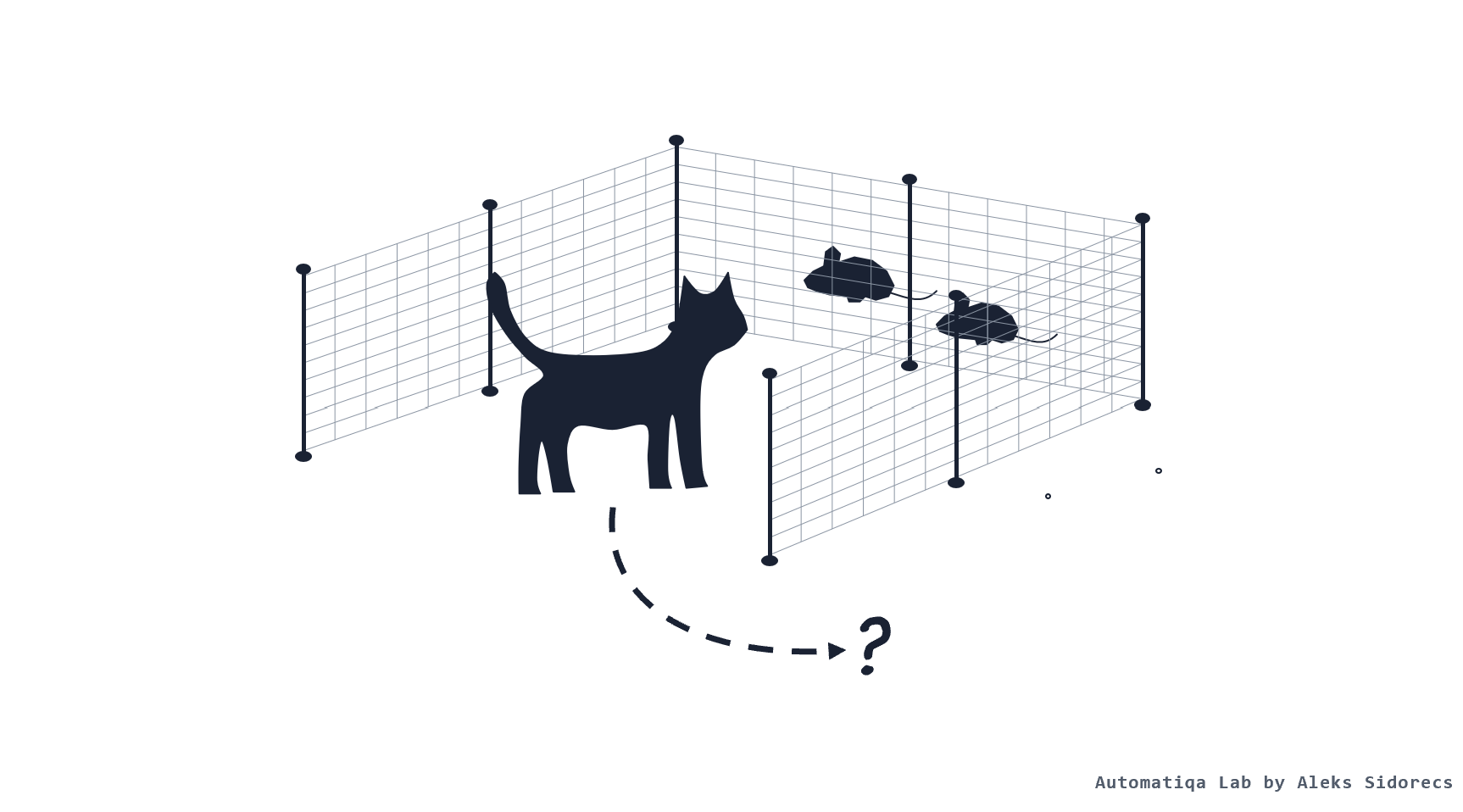
That's the reason I argue that the function to store something has more solutions than the noun (e.g. warehouse) does. The key issue here is that optimisations are often more legible than dissolutions. Baseline, target and before-and-after indicators mark optimisation outcomes. In the case of dissolutions - things that are measured just gone and there's no after-metric. For example, that's why cost savings and cost avoidance are permanent topics of discussion between Head of Function and Finance teams. Well, nobody gets a bonus for a KPI that no longer exists.
## The rule
### Say the function without the noun and ask what would make the problem impossible
**Always frame the function the problem sits on without using its name before pushing an improvement initiative. You must clarify what conditions or elements must be true for any problem to stop (re-) appearing at all.** You only optimise what you failed to dissolve, not vice versa. Register the failed attempt in the business case (in the form of a post-action debrief), so the next person doesn't start from scratch.
> **I = ΣV / (ΣC + ΣH)**
>
> Two TRIZ principles shape the core of this heuristic. Meaning that, for less cost and harm, systems must evolve toward more useful function. The ideal final result is when the supply chain function (e.g. goods delivery) is performed, and the system executing it is no longer needed. Ideality (I) is the sum of Value (V) it delivers (speed, flexibility, availability) over the sum of costs (C) to run and harm (H) produced (waste, lead time, working capital, emissions). Again, when the product arrives and nothing is behind it - it's the ideal chain condition we should aim for.
>
> It's also interesting to see how the same ratio moves differently with optimisation and dissolution initiatives - the same ratio moves in two different ways. For example, if we take storage costs as the denominator - optimisation is likely to shrink it by a few per cent. But it also adds a few elements to hold optimisation outcomes there: an additional stock report or system, buffer rules, etc.
>
> When the denominator falls by less than the savings, the new element triggers the next optimisation initiative. At the same time, when the dissolution initiative can set the new or existing element to zero, terms that existed only to watch it go with it. Because product still gets delivered, value on top does not move - the whole difference exists below the line.
>
> Match the variety or pay for the difference, says [Heuristic 01](../01-requisite-variety-in-supply-chain/). The third option this heuristic names is removing variety source inside your walls, leaving nothing to match.
## Test
### Is this problem being optimised or dissolved?
Pick one project from your backlog (avoid any temptation to run it as a workshop!).
1. **Write down the noun.** Here we describe the problem as anyone names it: demurrage, forecast error or late delivery.
2. **Write down the function it performs (no nouns in the sentence!)** It can be: 'to store', 'to move', and 'to recondition'. Test point here: if you cannot say it without the noun, the noun owns the project.
3. **Ask the ideality question three times.** Formula elements might guide you, for example: a. can the function be at no cost?, b. can the function be performed without any execution/operational system behind it?, c. can it be performed with no harm, waste and inventory?
4. **Review the whole business case.** Does it still point to the specific KPI and owner?
**The problem will not go away if you keep the noun and the KPI/owner survive the project. It makes sense to fund it only after dissolution activities were attempted and recorded as failed with key lessones and takeaways**
## Run on
> Back in 2021, a warehouse make-vs-buy assessment with the respective CAPEX letter was on my agenda for bulk products. The business case considered standard options such as leasing, construction, or redesigning existing facilities. Every scenario represented a greenfield or brownfield investment project. Before the first meeting, the noun 'warehouse' had already done its work of kicking off [psychological inertia](https://en.wikipedia.org/wiki/Psychological_inertia).
>
> So, in the middle of the business case development process, I decided to test a different approach. The noun was 'warehouse', and I reverted to its original function: to store goods between arrival and consumption. Two options appeared that the noun had hidden:
>
> - our customers had a lot of unused space at their facilities, so why not leverage it, especially for some of them it would be a significant lead time reduction (e.g. through vendor-managed inventory, while the rest of the stock could be repositioned for others when needed)
> - the second idea uncovered something more interesting: the container leverage. Containers are built to move, but nothing stops us from using them for storage (after some redesigns to ensure product quality doesn't deteriorate over time). Additional benefit: we could reposition containers with stock across locations where it would make sense, introducing additional operational efficiencies as tested through formula - so we this case.
>
> As a result, the goods stayed in the metal box, were stored in it, moved by rail etc. The unit that held the inventory became the unit that shipped it, so our yards became the warehouses.
>
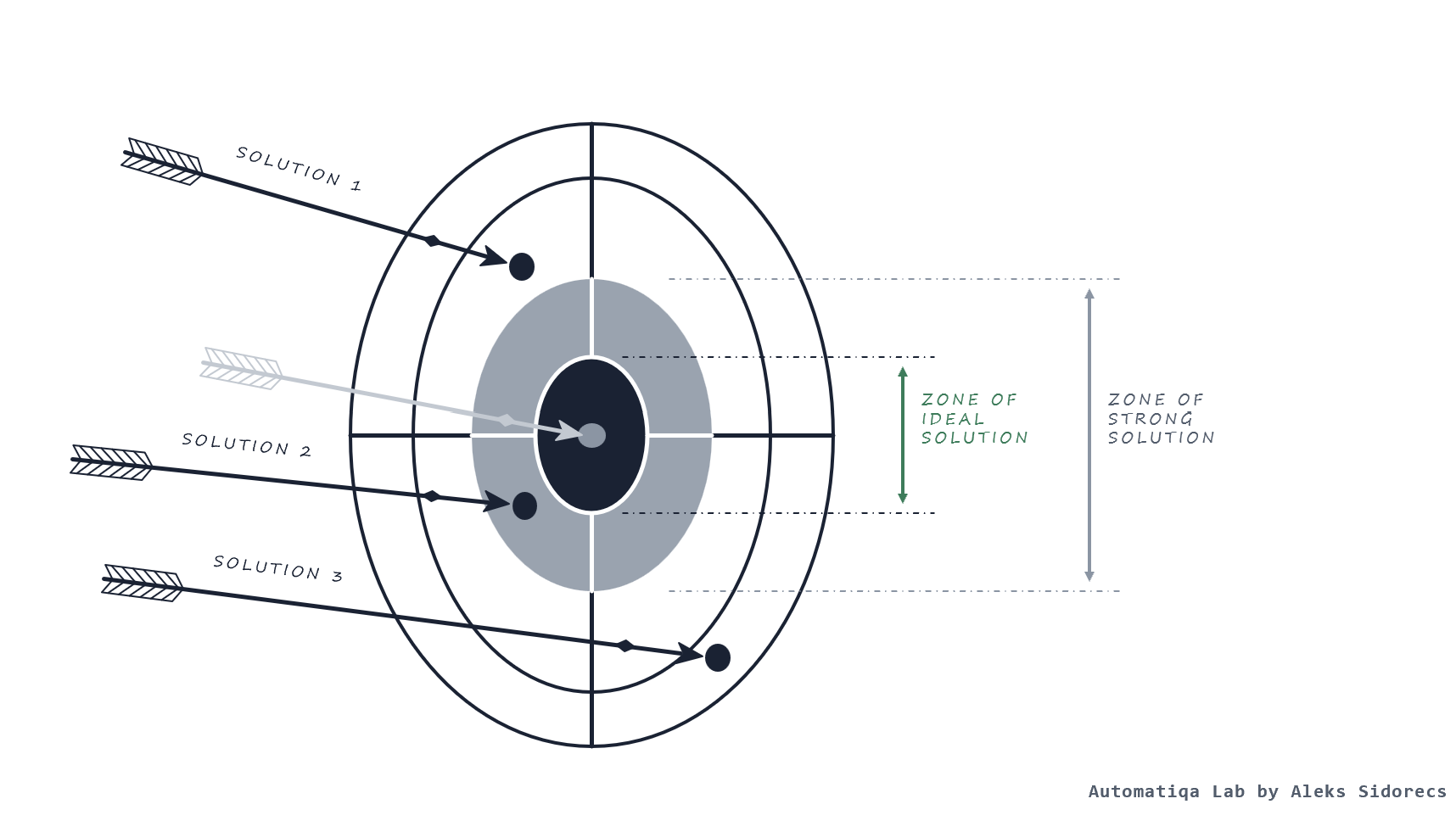
> Later the ideality questions got applied to test the case: storage at no cost was close but not there; a container in a yard still cost a box and a yard. At the same time, the product still needed storage, and a function performed it. So, as such, full ideality wasn't reached. Despite this and thanks to avoiding self-hypnosis, we managed to step out of dancing around the noun 'warehouse'. The solution was elegant: one fewer system, fewer greenfield/brownfield projects, and no new KPIs to monitor.
## How this rule gets misapplied
- Dissolving the problem at the level of organisational structure. Merging two departments won't dissolve issues - it just hands the problem to a new owner.
- Optimisation automation. An AI agent can cut demurrage costs by booking trucks before the container lands at the terminal, using real-time vessel data. But containers still have to wait at the terminal. The reason is that inbound flow arrives faster than the warehouse can take at the moment (e.g. high season etc.). Indeed, the wait is shorter, but the cause and underlying issues stay untouched. It's just an optimisation powered by better inference, nothing more or different.
- Dissolving variety you don't own. You can't dissolve unexpected promotions that your largest customer decided to launch at the last moment as a reaction to their competitor's activities in the retail market. You can't influence their promotion calendar design decisions, but you can dissolve the part of design that turns such promotions into firefighting.
- Removing the control mechanism before the cause is addressed. Because of a cause, we introduce every necessary control across the chains. When the forecasts are consistently wrong - we introduce safety stocks. What if the project aims at removing the forecast error? Finance takes stock out in the first quarter to fund the initiative. Fast forward six months later - the buffer is gone, but the error didn't dissolve as such. The customer will feel that pain first. Only when the cause hasn't shown up for long enough can we be comfortable cutting the control mechanism.
---
> **A problem optimised is a problem kept.**
==============================================================================
# Glossary
- URL: https://www.sidorecs.com/glossary/
- **Asymmetric supply chain**: An asymmetric supply chain has a funnel shape - a fragmented base of artisanal producers and small enterprises, market access and value controlled in the mid-section, capital and data at the neck. There is nothing to adjust around a shock, so it travels up the funnel to the market and back down to the base, which absorbs it. In the research literature the same phrase usually means relational, informational or dependence asymmetry between trading parties; the sense used here is structural - the shape of the network and where the variance enters it. Source: https://www.sidorecs.com/heuristics/02-asymmetric-supply-chain-physics/
- **Contractual flow**: Contractual flow - commercial commitments, title transfers, quality terms, arbitration rules. In my world, the contract isn't just the source of information about a trade or commercial deal - it's the trade itself. Source: https://www.sidorecs.com/insights/supply-chain-orchestration/
- **Decision loop**: A decision loop is a network of handovers that ends in a specific decision, combined with a feedback loop that sends the outcome back to the person who will decide next time. Readiness for agentic AI is a property of the loop, not of the company - see b = f + s + p, the count of function, system and P&L boundaries the loop crosses between trigger and return. Source: https://www.sidorecs.com/heuristics/03-decision-loop-readiness/
- **Deterministic kernel**: Deterministic kernel - The same thinking explains why, in this project, netting, allocations, and compliance protocols will be deterministic by design: same inputs -> same repeatable result. An LLM might explain the plan or create a draft email to chase shipping documents from the vendor, but every number in that text should come from the deterministic kernel. Source: https://www.sidorecs.com/notebooks/commodities-supply-chain-planning/01-problem-statement/
- **Ecosystem calibration**: Ecosystem calibration - all four flows (in my case it's from farm to cup), partners, irrespective of their maturity level and sophistication, get calibrated to shared signals and standards, with no conductor in between. Source: https://www.sidorecs.com/insights/supply-chain-orchestration/
- **Four-flow orchestration**: Four-flow orchestration - all four flows that represent every function and legal entity across a single enterprise or group of affiliated companies. Handovers are automated in an integrated way, so that every function, system, process, and P&L form a unified fabric of business execution. Source: https://www.sidorecs.com/insights/supply-chain-orchestration/
- **Heuristics**: Heuristics is the author's series of one-page rules for operations and supply chain, each carrying a problem, a rule, a test, a real case, the mistakes and a maxim. Source: https://www.sidorecs.com/heuristics/
- **Hybrid supply chain**: A hybrid supply chain is brand-centred and layered - asymmetric upstream, symmetric downstream. Brand owner and contract manufacturers absorb different halves of a shock by contractual arrangement, and the model restores itself only while neither half exceeds what it was designed to carry. Distinct from the common usage, where a hybrid operating model means centralised functions combined with decentralised ones; that is a question of who reports to whom, this is a question of which physics each end of the chain runs on. Source: https://www.sidorecs.com/heuristics/02-asymmetric-supply-chain-physics/
- **Idealised Supply Chain Design**: Idealised Supply Chain Design is a design method that abstracts a supply chain problem to the function it has to perform, then moves the system toward the ideal of performing that function with no system at all. It redefines the TRIZ ideal - the function is performed, but there is no system doing it - for supply chain - the customer (or consumer) receives the product, with no supply chain behind it. Source: https://www.sidorecs.com/heuristics/04-dissolve-the-problem/
- **Ideality (I = ΣV / (ΣC + ΣH))**: Ideality (I) is the sum of Value (V) it delivers (speed, flexibility, availability) over the sum of costs (C) to run and harm (H) produced (waste, lead time, working capital, emissions). Systems must evolve toward more useful function for less cost and harm; the ideal final result is when the supply chain function is performed and the system executing it is no longer needed. Optimisation shrinks a term in the denominator and usually adds elements to hold it there; dissolution sets a term to zero. Source: https://www.sidorecs.com/heuristics/04-dissolve-the-problem/
- **Locus**: Locus is the horizontal axis of the Variety Map - where the variety is absorbed. Locus runs from edge to the centre. Moving left on Locus enables shortening response time and keeping local knowledge as a differentiator. Moving right pools scale and leverages scarce skills. In cases where the decision loop's response window is shorter than the cycle time of the round trip it needs to make to the centre and back - the loop shouldn't be allowed to be positioned at the centre. Source: https://www.sidorecs.com/playbooks/01-operating-model-physics/variety-map/
- **Mechanism**: Mechanism is the vertical axis of the Variety Map - how a loop's uncertainties are absorbed and graduated by what is encoded. Mechanism runs on a spectrum - from judgement to encoding, from manual (T1) to self-tuning (T5). Moving up on Mechanism lowers the cost per decision and raises the cost of uncertainty. Source: https://www.sidorecs.com/playbooks/01-operating-model-physics/variety-map/
- **Operating Model Physics**: Operating Model Physics is a method for designing operating models. Each decision loop is placed on a two-axis map by where operational surprises are absorbed and how. Source: https://www.sidorecs.com/playbooks/01-operating-model-physics/
- **Outside Variance Ratio (OVR)**: The Outside Variance Ratio, or OVR, is the share of an operation's total variance that originates outside the company's walls - sigma squared (outside) divided by sigma squared (total). A low OVR indicates symmetric physics; asymmetry appears as OVR rises. It is ordinal in practice, a field estimate rather than a figure measured to two decimals, and it is the quantitative form of the third question in the heuristic 02 test. Source: https://www.sidorecs.com/heuristics/02-asymmetric-supply-chain-physics/
- **Requisite variety in supply chain**: Requisite variety in the supply chain is the rule that any department can control only as much variation as it can absorb, and everything beyond that brings costs, delays or constant troubleshooting. Stated formally as Vr >= Ve - the distinct actions an operation can take in a time step against the distinct situations it faces - after W. Ross Ashby. Source: https://www.sidorecs.com/heuristics/01-requisite-variety-in-supply-chain/
- **SCOPEC**: SCOPEC - I chose the name SCOPEC because it describes what I want to build: a test tool covering supply chain operations planning and execution in commodities. Source: https://www.sidorecs.com/notebooks/commodities-supply-chain-planning/01-problem-statement/
- **Second landscape**: Second landscape - Every supply chain runs on two distinct technology landscapes. The official one records what happened: every transaction, supply chain event, and data point. Alongside this, there's another- a second landscape that enables daily operational decisions. The last one also defines what happens next. Source: https://www.sidorecs.com/notebooks/citizen-developers-in-supply-chain/01-the-system-of-record/
- **Supply chain orchestration**: Supply chain orchestration - touches one of the four flows (one of the functions) and gets only one view of the data. Decisions are still routed via operators. Source: https://www.sidorecs.com/insights/supply-chain-orchestration/
- **Symmetric supply chain**: A symmetric supply chain is interdependent and balanced - partners share information, decision rights, risk and sometimes assets, so when an external factor hits one node the whole ecosystem adjusts to restore inventory and capacity to homeostasis. Source: https://www.sidorecs.com/heuristics/02-asymmetric-supply-chain-physics/
- **Variety Map**: The Variety Map is grounded in two axes and a square. A loop's uncertainty/surprises get absorbed where the locus runs from the edge towards the centre. The mechanism defines how to shift from judgement to encoding. Every decision loop in an operating model should have one point on it. Its four quadrants are Craft, Desk, Engine and Autopilot. Source: https://www.sidorecs.com/playbooks/01-operating-model-physics/variety-map/
- **Variety Shortfall Test**: The Variety Shortfall Test takes the operational problem that keeps coming back and asks which of four layers is short - you cannot see it, you can see it but cannot act, you can act only one way, or the right action lands too late. The short layer is the one to fix, not the noisiest one. Source: https://www.sidorecs.com/heuristics/01-requisite-variety-in-supply-chain/
- **Waystation**: Waystation - a stop between systems where work arrives in one format, is checked by a human hand, and leaves in another with a new name. Waystations are where variety leaks and spreadsheets breed. Source: https://www.sidorecs.com/notebooks/citizen-developers-in-supply-chain/01-the-system-of-record/
- **Zero-shot model**: Zero-shot model - They are pre-trained on synthetic and real tables. My current understanding, in simple words, is that they take a table they've never seen and produce a calibrated prediction without any training run. Source: https://www.sidorecs.com/notebooks/zero-shot-models-in-supply-chain/01-problem-statement/
==============================================================================
# Events
- URL: https://www.sidorecs.com/events/
Events I have hosted, chaired or spoken at, newest first. Each links to the organiser's event page and, where I wrote one up afterwards, to my reflections.
## 2026-10-02 - 17th SCTA Forum & Dinner
- Role: panellist
- Where: 2m2c - Montreux Music & Convention Centre, Montreux
- Event page: https://www.sc-ta.ch/events/17th-forum-dinner-2026/
- Reflections: https://www.linkedin.com/posts/alxsidr_two-days-in-montreux-with-700-coffee-ugcPost-7512457499749490688-R9cT/
- Press: Geopolitical shocks are reconfiguring the Swiss industry's coffee supply chains (swissinfo.ch, 2026-10-22) - https://www.swissinfo.ch/eng/food-supply-chains/geopolitical-shocks-are-reconfiguring-the-swiss-industrys-coffee-supply-chains/92244668
I joined the logistics panel at the Swiss Coffee Trade Association's 17th Forum in Montreux with Dany Barkha of Sucafina, José Luis Pérez of Commodity Supplies AG, Mirja Nibbe of CMA CGM and Christian Jacob Hansen of the Global Maritime Forum, moderated by Dean Sanders of Etymos. The question was how coffee moves beyond reactive crisis management to connected flow across ports, shipping, data and forecasting.
## 2026-09-28 - AI-enabled Negotiation Preparation
- Role: panellist
- Where: online on Zoom
- Event page: https://events.cips.org/AIEnabledNegotiationPreparation
I joined the expert panel at the CIPS Denmark webinar with Elisabeth Schlag-Lawrence of CatalystProcurement and Dr. Charlotte de Brabandt of ZF Group. After start-ups showcased their AI tools for negotiation preparation, we stress-tested them with our own questions, then took the audience's live.
## 2026-06-18 - The Invisible Chain
- Role: co-host
- Where: Ambassador House, Zurich
- Event page: https://www.capgemini.com/ch-en/news/events/the-invisible-chain/
- Reflections: https://www.linkedin.com/pulse/invisible-chain-event-ai-supply-biggest-lever-aleks-sidorecs-fuvie/
As a CIPS Switzerland committee member, I co-hosted The Invisible Chain with Martin Weis of Capgemini - an evening in Zurich on how AI-driven operating models reshape margins across procurement, supply chain and finance.
==============================================================================
# Notebook: Zero-shot prediction models in supply chain
- URL: https://www.sidorecs.com/notebooks/zero-shot-models-in-supply-chain/
------------------------------------------------------------------------------
## Chapter 01: Problem statement: what I'm solving
- URL: https://www.sidorecs.com/notebooks/zero-shot-models-in-supply-chain/01-problem-statement/
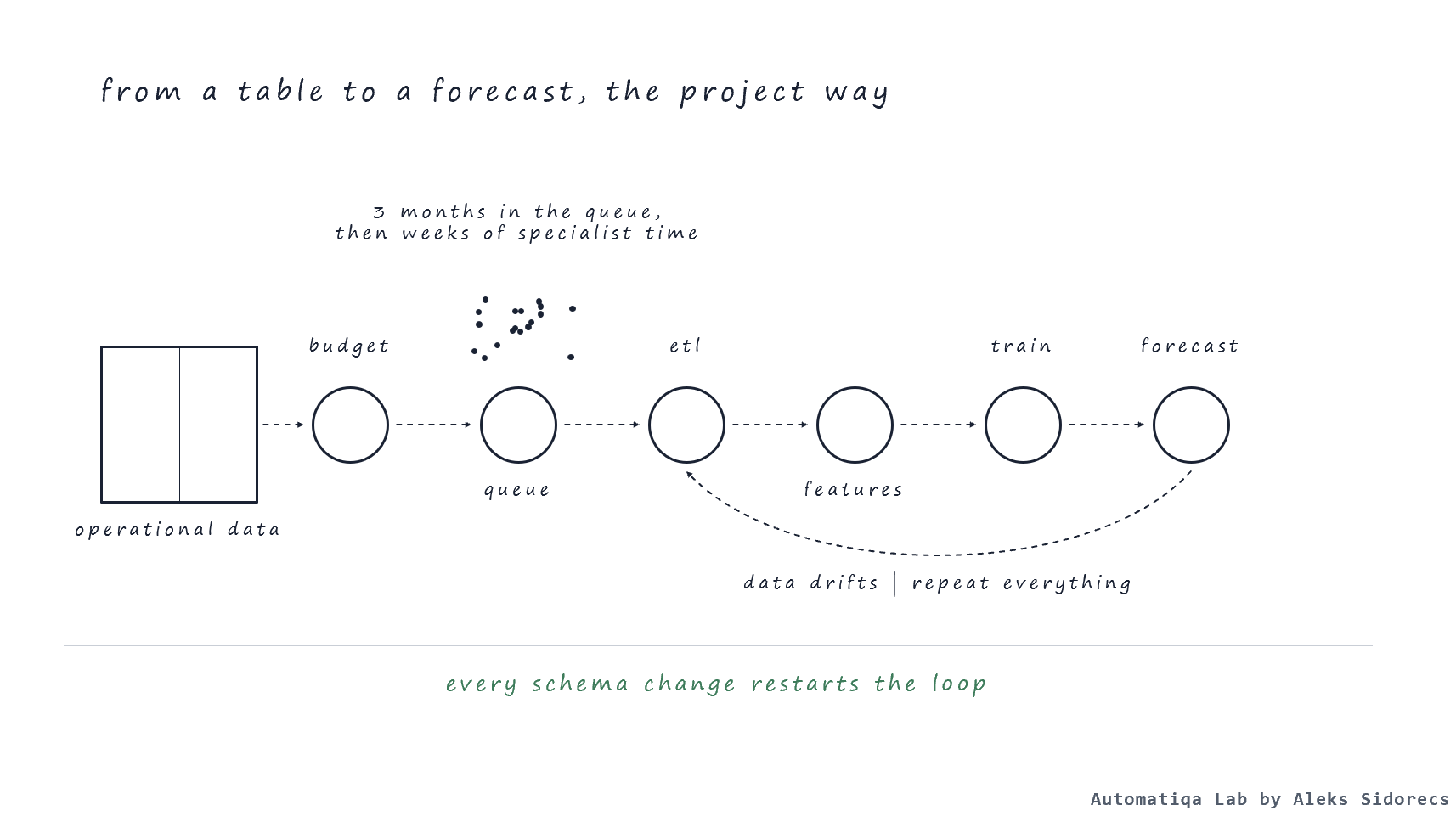
Historically, my teams across Europe, Asia or Central America consistently maintained large amounts of data to feed predictions and forecasts. This operational data was continuously collected across most parts of the value chain: shipment history with actual vs. promised dates, last-mile deliveries with defects upon receipt, demand by SKU, and any other metrics you can think of.
What I observed was that the answers to those questions, almost everywhere, were in spreadsheets or were based on an operator's judgment. Alternative methods also existed, but getting from a table to a proper forecast or prediction was always a painful project.
Such projects have to be budgeted, consider cross-functional resources, and require access to resources that everyone is competing for. I remember a case when my function required a specialist to run a standard ETL pipeline and train the model. This also required keeping the model alive as the data drifted. Requests like this keep data scientists busy for at least a few weeks, and my team had to wait three months to get the person available for our initiative.
## My experience with probabilistic chaos and LLMs
For me, the outcomes of LLM tests were always quite disastrous. Yes, I know that any language model is powered by a probabilistic engine because it predicts the next token. It's certainly no surprise that no LLM can predict operational delays across the supply chain. What further supports my anti-LLM thesis is that the confidence any LLM highlights never correlates with how often it's actually accurate.
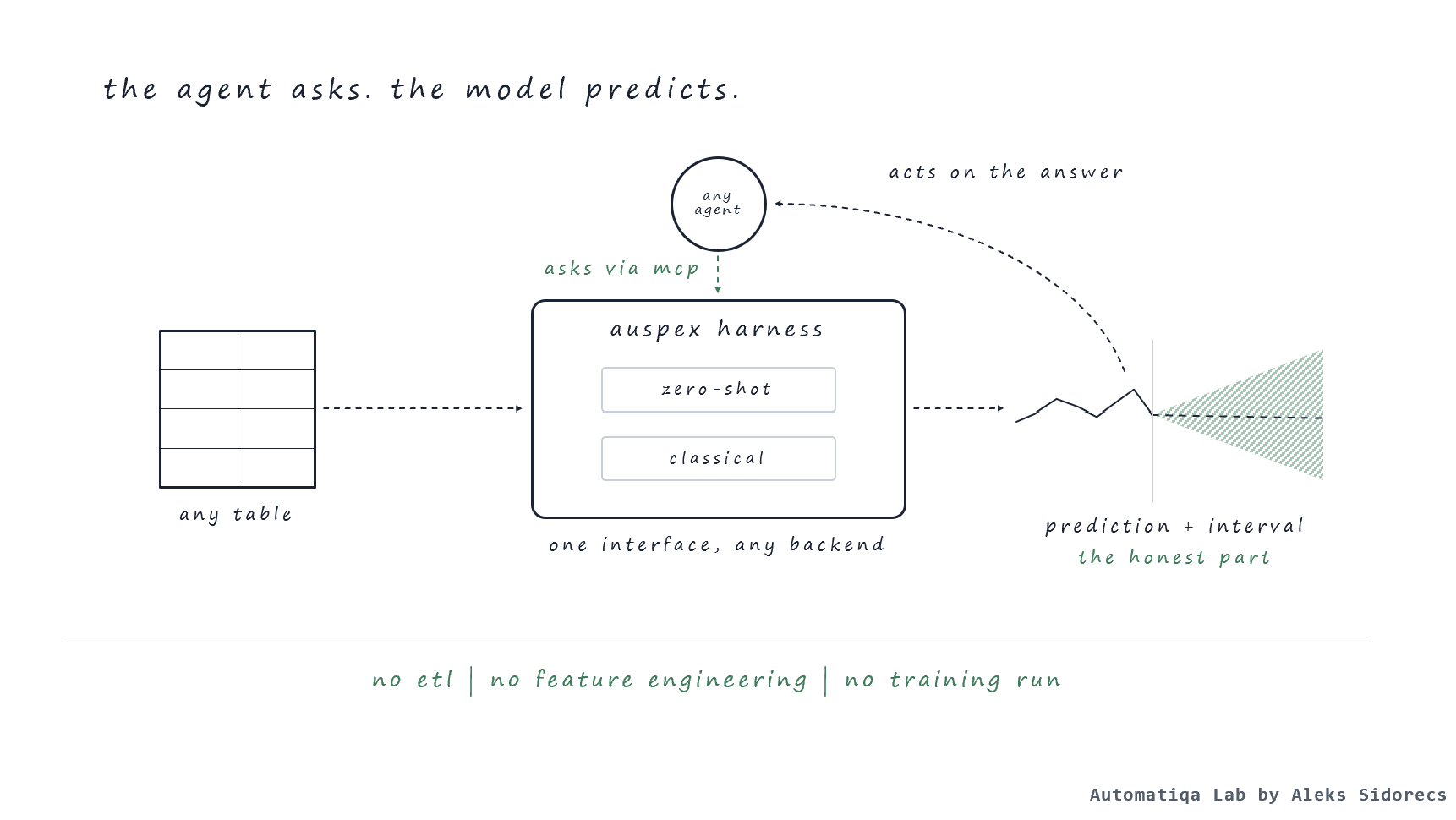
I've built many probabilistic agents, so I can understand their strengths and weaknesses and identify areas where they can contribute. The issues start the moment I ask for a forecast. Why? Because it's just a confident guess. In my view, the LLM's job should be just to ask for the prediction, get it, and define actions based on it.
This is how the project harness idea came to mind. The objective was shaped by the task of just keeping those two roles separated. Lately, I connected this idea to zero-shot models, which I further explore in my project.
## What changed: how it helps and what accelerates the approach
First thing to admit, I'm quite amazed by zero-shot models' potential. They are pre-trained on synthetic and real tables. My current understanding, in simple words, is that they take a table they've never seen and produce a calibrated prediction without any training run. But whether those intervals are realistic is a separate validation point that the project aims to measure.
I have some hopes, especially that this design will bring me as close as possible to classical ML outcomes. But hope is one thing. I still have to validate the concept, confirm it experimentally, and report the final results.
To prepare the project, I've spent a few weeks selecting a model. Most of the candidates I've preselected include their own libraries and definitions of what a prediction or forecast is. In the middle of this process, I realised that moving from experiment to solution will take many hours of work. The main reason is that, to compare the zero-shot model with a classical baseline, the outcomes need two separate code paths. That is why I will put everything under a single user interface.
## My expectations from the project
Any supply chain operator logs in, defines the columns to predict, and gets results with certain confidence intervals. No resource overkill, feature engineering, or any complex ETL required. It should be cheap and efficient (we are moving to a world where decisions become assets, not data or models themselves, right?).
Operational realities will also shape how we execute specific tasks and responsibilities. I expect a shift in how individuals approach shipment status - the agent will do all the messy chasing. At the same time, insights-powered action would stay human for quite some time. That's also why autonomy will be earned through a track record rather than as a default setup.
This will form new habits and expectations. Any solution will be expected to include built-in connections, including [MCP](https://modelcontextprotocol.io/), which I will deploy in this project as well.
I will focus mainly on a few cases/problem statements. But this could be extended further depending on how the project matures and my time availability over the next four weeks.
First is **tabular prediction**, which is well-positioned for operational cases such as identifying shipment delay risks. And yes, it can apply to many other areas across logistics, procurement, and manufacturing. I suspect cases like vendor scoring or OTIF issues for each shipment would fit it well, too. But I will leave some of this outside of the project, letting other peers test and conceptualise it further.
The second will be **time-series forecasting**. That one gets super useful for SKU-level demand patterns and inventory management. Would also be interesting (subject to my time capacity) to challenge it in a freight rate development simulation.
## How I will judge the completion
At the moment of writing this update, I want to nail just four components and see how those will perform (but this might change during the course of development):
1. As mentioned earlier, one interface for any task/objective irrespective of backend: zero-shot or classical
2. To have a confidence interval for each prediction/forecast outcome. The main reason is that estimates without ranges are likely to overstate the numbers
3. MCP connector availability due to reasons described earlier
4. I expect no hidden states here, as predictions are going to be functions of the tables and overall solution configuration. Built-in backtests will help me to validate overall harness/model calibration.
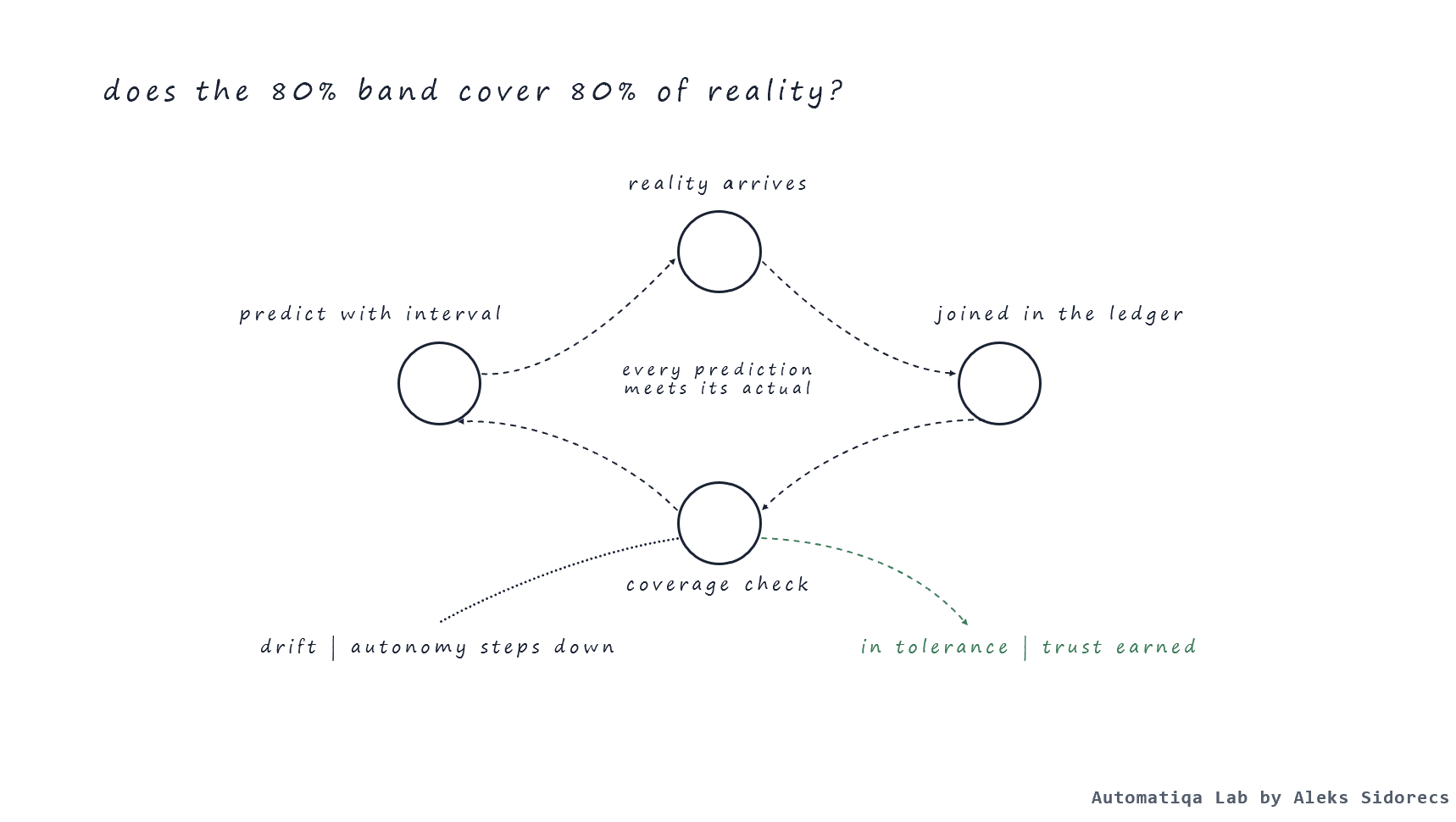
I chose the project name "Auspex" because it represents, for me, the ancient meaning of someone who reads the environment and predicts what's coming.
==============================================================================
# Notebook: Supply chain planning and execution in commodities
- URL: https://www.sidorecs.com/notebooks/commodities-supply-chain-planning/
------------------------------------------------------------------------------
## Chapter 01: Problem statement: why commodities require different planning and execution solutions
- URL: https://www.sidorecs.com/notebooks/commodities-supply-chain-planning/01-problem-statement/
Most supply chain solutions I've used were designed/tailored for specific products or industries: a finished good, a [bill of materials](https://en.wikipedia.org/wiki/Bill_of_materials) (BoM), a lead time, a supplier confirming a date of goods receipt for PO number. The commodities industry is a completely different beast, and almost none of that is relevant (in terms of how supply chain tools are designed and configured. Some other logic still stays relevant).
There are many complex attributes that define the state of the commodity product: origin, grade, crop year, certification. Its quantity and quality are only final after sampling (e.g., a pre-shipment sample that gets sent to the customer for approval before cargo is loaded and leaves the port). The supply side follows a crop calendar rather than a production schedule that is applicable only for a small fraction of processing activities at origin (in case of soft commodities). And the date a shipment was promised is the date it is least likely to leave - welcome to the world of asymmetric supply chains that I covered in [Heuristic 02](https://www.sidorecs.com/heuristics/02-asymmetric-supply-chain-physics/).
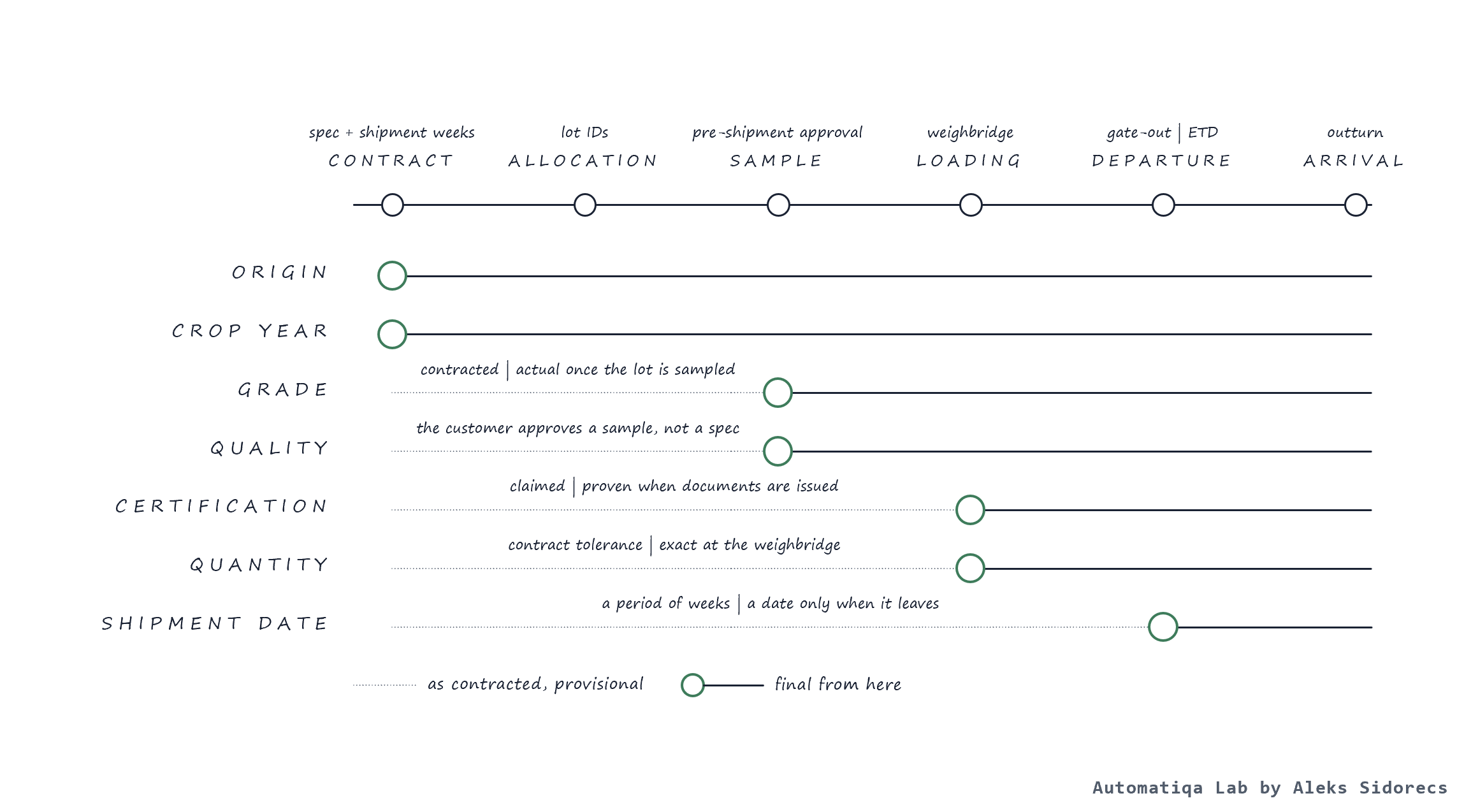
After some years in this industry, I've discovered the gap is never in the data. The trading system (e.g., CTRM) records every commercial transaction and volume allocation, with shipment periods normally expressed as specific weeks of the month. The freight management platform would monitor vessel bookings and every shipment milestone (e.g. gate-in, gate-out, departure and arrival, etc.). The gap is created by the absence of the specific layer capable of turning those records into a proper end-to-end supply chain plan: what we are short of, in which month, from which origin, and what it costs to bridge it (for example, from stocks somewhere in the warehouse).
In most cases, operations create that layer in spreadsheets (the [second landscape](https://www.sidorecs.com/glossary/#second-landscape) I already covered in a separate publication about [Citizen Developers in supply chain](https://www.sidorecs.com/notebooks/citizen-developers-in-supply-chain/)). It gets rebuilt every month (or day) by operators who knew the business too well to need a tool - until the complexity of the supply chain network and external variability outgrew human cognitive capabilities to manage it all ([Heuristic 01](https://www.sidorecs.com/heuristics/01-requisite-variety-in-supply-chain/) nails it down in the form of a specific rule).
## Why the usual supply chain solutions are not so relevant for commodities
S&OP ([Sales & Operations Planning](https://en.wikipedia.org/wiki/Sales_and_operations_planning)) and S&OE (Sales & Operations Execution) are often delivered as two distinct modules or products. A monthly consensus plan via S&OP and a weekly or daily execution view with S&OE. The handover between the two is often missing or poorly calibrated (another word from commodities: calibrating with a client on product taste profile, bean screen size, etc.).
In (soft-) commodities, those two nodes are one problem that's nearly impossible to separate in time and space (I mean separating planning from execution activities).
The second issue is how standard tools treat the operational dynamics of commodity supply chains. Tools like SAP or MS Dynamics take a lead time and add a buffer. In commodities, a purchase contract usually doesn't arrive late by a fixed number of days because some lots (another unit of measure not captured by conventional technology) arrive on time, while others likely spread out over weeks and frequently get late (which means most contracts might be split into individual shipment orders that have different cycle times).
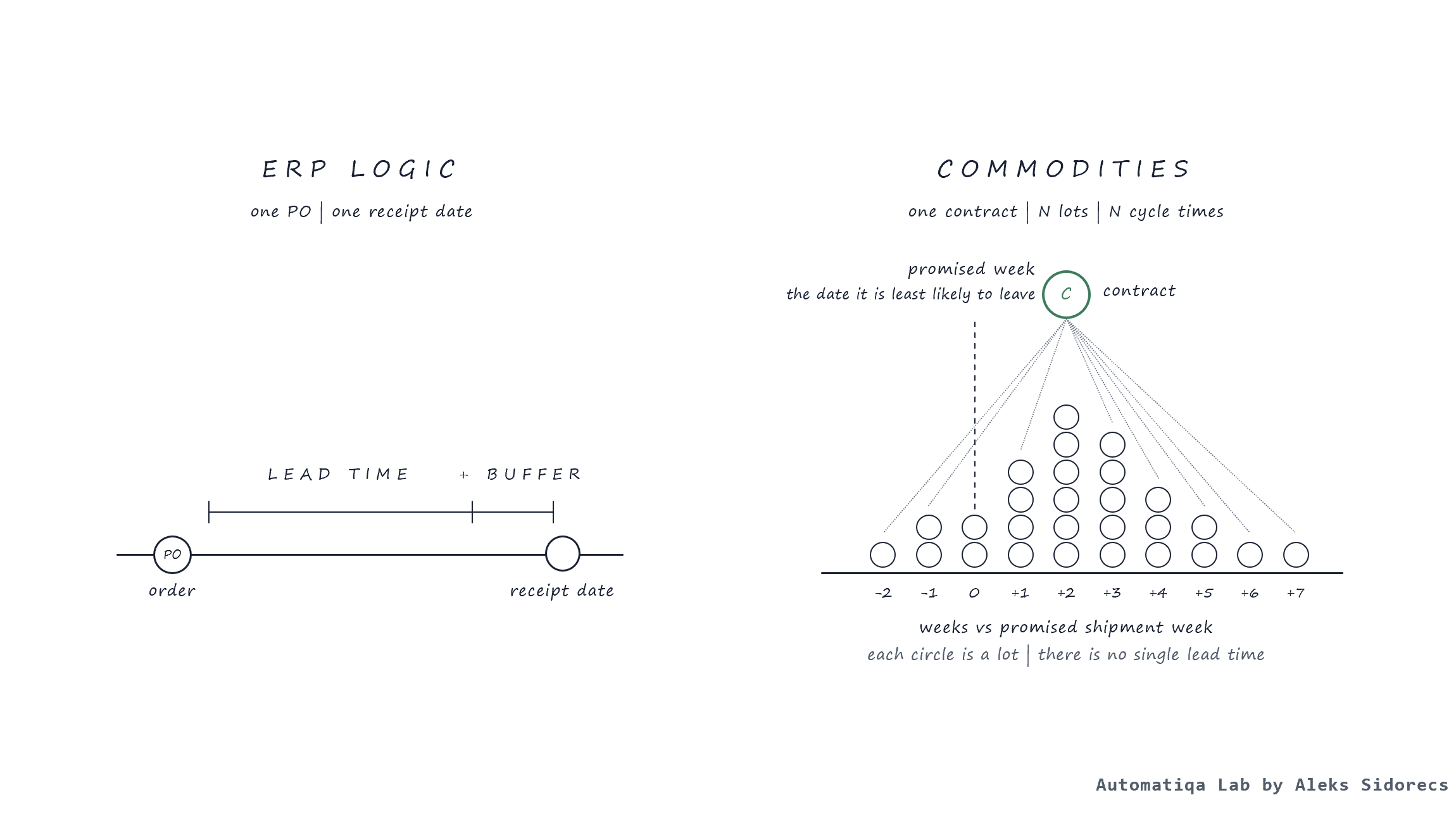
The final point is about trust. When a number changes, the planner tries to figure out the reason. Most often, the answer sits somewhere in a log file, or in a model nobody can replay. That's why planners tend to distrust the system's recommendations (e.g., APO) and do their own maths.
## What is changing. Rules come first, and reliance on probabilities where the world is uncertain
In the [Auspex project overview](https://www.sidorecs.com/notebooks/zero-shot-models-in-supply-chain/01-problem-statement/), I've reflected on the importance of knowing where a large language (or any other probabilistic...) model can really assist, and the critical aspects where we should keep it away, because most supply chain operations are high-stakes business. The rule I prefer to apply in developments like this is: keep it simple.
The same thinking explains why, in this project, netting, allocations, and compliance protocols will be deterministic by design: same inputs -> same repeatable result. For example, arrival dates and shipment delays are pure distributions and should be accessible so users can replay them. An LLM might explain the plan or create a draft email to chase shipping documents from the vendor, but every number in that text should come from the deterministic kernel.
The second design pattern is to avoid replicating what other systems already have. SCOPEC reads contracts, allocations, milestones and bookings from the CTRM (trading system) and the freight management platform and owns only what it decides, predicts or explains: plans, scenarios, parameters, exceptions and the record of every action. I just want to avoid learning while building a second trading system.
## My expectations from the project
A planner/operator can oversee any position by origin and/or commodity grade for the defined period of months. They should be able to grasp working capital exposure quickly (e.g. inventory), navigate expected arrivals or shortfalls. At any moment, the person should decide what will cover gaps or customer fulfilment risks: own stock, then substitute grades (often at a discount), and, in the worst case, a new purchase from a third-party shipper. Operator clicks any number and tracks it back to the contracts, parameters, and algorithms that produced it.
The actor's position in the value chain, upstream (processing facility at origin) or downstream (final ingredient buyer), shapes how various physical facts are read or perceived. That's why the tool should run at least three operating views/perspectives through one kernel. A trader counts stock from shipment and plans against open sale contracts. A cocoa processor (for butter or liquid intermediate products) counts it at the plant, and plans against a production schedule programmed based on specific recipes that are analogous to a Bill of Materials. An ingredient buyer would plan against its own consumption forecast. Yes - to a certain extent, it's going to be the same data, but three completely different readings.
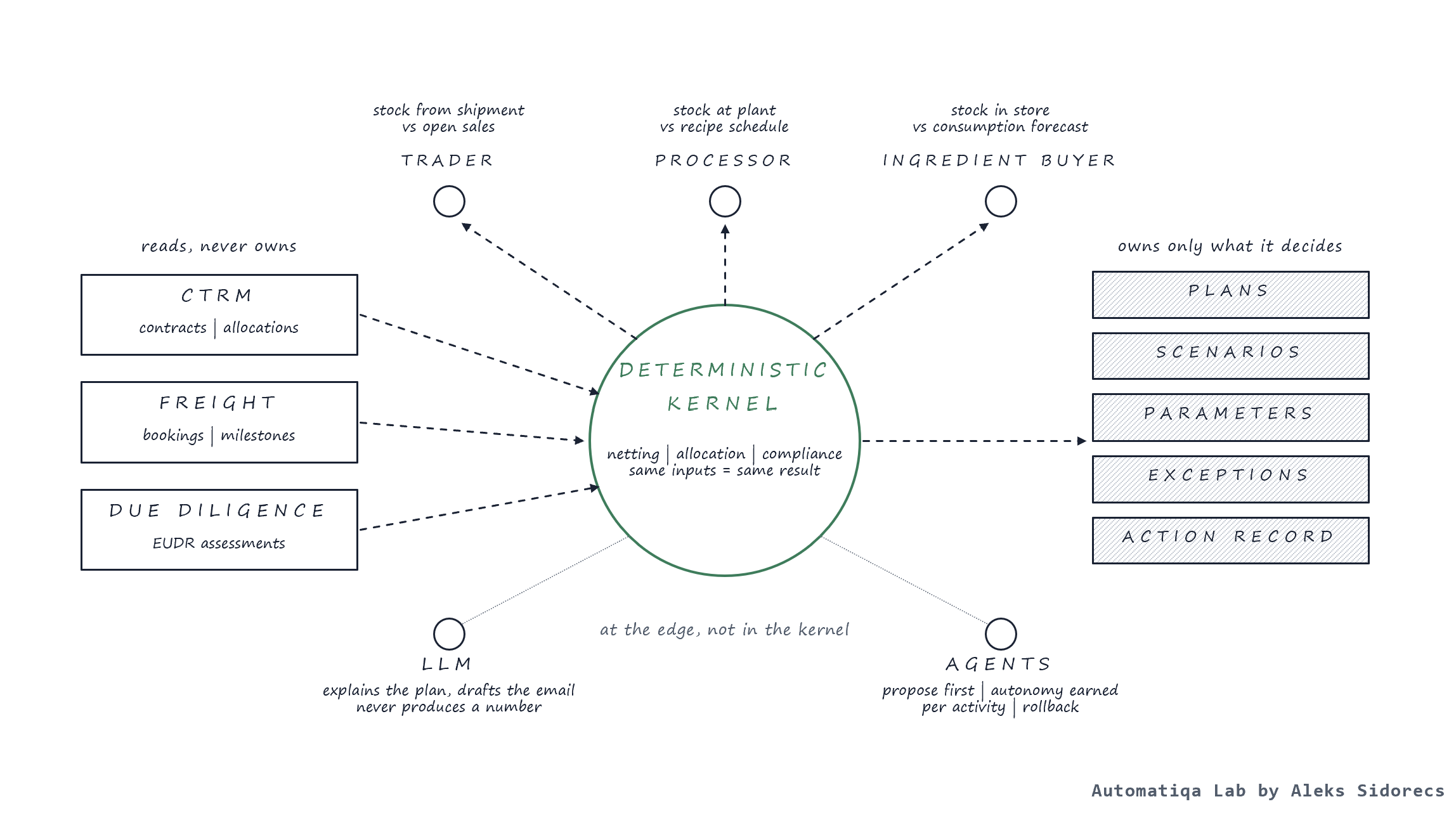
Ah, nearly forgot this. I just updated the architecture plan (I'll publish it later, after I finish the Auspex part) because compliance is another important factor, and I should consider it as a real planning constraint. In 2026, several new regulations added additional constraints applicable to soft and hard commodities (e.g. [EUDR](https://environment.ec.europa.eu/topics/forests/deforestation/regulation-deforestation-free-products_en), [CBAM](https://en.wikipedia.org/wiki/Carbon_Border_Adjustment_Mechanism), [PPWR](https://en.wikipedia.org/wiki/Packaging_and_Packaging_Waste_Regulation) etc.). For European Union-based companies (especially in the agri-food sector), we can meet demand only with valid due diligence data and legality assessments. Platforms that perform these validations produce the assessment results (e.g., Osapiens), so SCOPEC can apply those outcomes to the plan via API integrations.
I decided to put agents last in SCOPEC. Their autonomy to act and orchestrate will be earned, not granted by default (they will propose first). The mission of embedded agents is to take over the most boring part of the supply chain operator's work. Such work is represented by usual exceptions (a late shipment, rolled booking or a specific commodity-grade quality block) that the kernel would delegate to an assigned agent (e.g., escalator, coordinator, etc.). The signals will come from the deterministic solvers (in the form of the data), not the harness.
Autonomy of SCOPEC agents will be assigned per activity type/ID. The operator should be able to increase or reduce the level of autonomy (based on the agent's track record). I'm also considering action/decision rollback logic on top of the glass-box approach (when agents' decisions and actions can be reviewed and audited). Another roadmap item is connecting [MCP](https://modelcontextprotocol.io/) (SCOPEC will have its own MCP server, so any external tool/agent can call it as well) to [LangGraph](https://www.langchain.com/langgraph), as I'm curious to explore how it works in practice.
## How I will judge the completion
For the first phase of SCOPEC, I expect four things based on the sample data that will represent a synthetic company in the commodities sector before I will be able to call the project a success:
1. One kernel for both horizons: planning and execution to operate based on the same data stack to avoid segregation of S&OP and S&OE parts, as it's done in other industries (also the reason I don't reference them in the project title)
2. Outcome reproducibility: inputs should always return the same outputs, as stakes in operations are too high
3. Any action/decision/recommendation is explainable and reversible: operators should be able to understand what's and whys irrespective of their technology skills
4. Example of the synthetic company calibrated to real end-to-end commodities supply chain and operational realities.
I chose the name [SCOPEC](https://github.com/automatiqa-lab/scopec) because it describes what I want to build: a test tool covering supply chain operations planning and execution in commodities.
==============================================================================
# Notebook: Citizen Developers in Supply Chain
- URL: https://www.sidorecs.com/notebooks/citizen-developers-in-supply-chain/
------------------------------------------------------------------------------
## Chapter 01: The system of record isn't where the work happens
- URL: https://www.sidorecs.com/notebooks/citizen-developers-in-supply-chain/01-the-system-of-record/
Over the past two decades, I've transformed operational flows and boosted supply chain performance across eighty countries. My experience spans consumer goods, pharmaceuticals, industrial materials, and soft commodities sectors. I developed and coached more than 300 individuals. Six post-merger integrations challenged my transformation and change-management skills. To complement this, I had the opportunity to shape overall capabilities by deploying AI, Machine Learning, technology integrations, and end-to-end operating model re-engineering.
Such a career trajectory exposes the reflective practitioner to many insights and practices. I want to share a few and hope you find them applicable to your daily operational realities.
This notebook starts with a common case I've seen across various supply chain sub-functions. Whether it's logistics, production, or procurement, teams constantly rely on spreadsheets and email trails. Those serve as a daily system for managing operational priorities and supply chain exceptions. Some of them do it with remarkable skill.
This happens despite companies spending millions on enterprise and supply chain technology solutions. These investments often come with additional costs: expenditures on consultants and system integrators, and the purchase of middleware to enable interoperability between new and legacy systems.
Those two observations lead to one key insight that I would like to reflect on:
**Every supply chain runs on two distinct technology landscapes. The official one records what happened: every transaction, supply chain event, and data point. Alongside this, there's another- a second landscape that enables daily operational decisions. The last one also defines what happens next.**
## 1.1 The two landscapes facing the same reality
The official one first. During site tours triggered by technology initiatives, I always ask for the systems architecture. It's a useful starting point: existing capabilities, blind spots, and readiness to face uncertainties of tomorrow. What I get back is a standard library of acronyms every practitioner recognises: [ERP](https://en.wikipedia.org/wiki/Enterprise_resource_planning) for records and finance; [APS](https://en.wikipedia.org/wiki/Advanced_planning_and_scheduling) for production planning; [TMS](https://en.wikipedia.org/wiki/Transportation_management_system) for logistics and freight; [WMS](https://en.wikipedia.org/wiki/Warehouse_management_system) for warehousing. Sometimes, a [control tower](https://en.wikipedia.org/wiki/Supply_chain_control_tower) stitches those systems together.
The systems I list earn their licence fees by programmatically enforcing workflows with structured records, data, and ledgers. I've implemented more than fifteen digital solutions across global operations, and faced every case any business could throw at us during the projects.
In this and the following chapters, you will find no argument against operational technology - it's indispensable. However, for the benefit of the second landscape, I prefer to ground the thesis in the daily realities most supply chain practitioners face.
I'm a big fan of quantum physics, and the concept of [superposition](https://en.wikipedia.org/wiki/Quantum_superposition) there is quite astonishing. Applied to our discipline, this suggests supply chain exists in two parallel states: when the operator is away from the office and when they return. So, it's Tuesday morning, 08:30. A supply chain operator gets a cup of coffee and logs in to the PC workstation in the office. In that superposition, a vessel skipped a port call in Mombasa, a major buyer changed the order value, and a truck carrying high-value products got stuck at the Mexican border. I'm pretty sure that all these scenarios are familiar to the reader.
In most cases, none of these events fit the screen that the sanctioned technology system or solution provides. After all, these incidents weren't supposed to happen.
What happens next? Our operator turns to Excel. They export data from the system and merge it with three other reports. By 10:30, the challenges get compressed into columns and tables. A few cells point to who owns each highlighted action - for example, an alternative supply strategy to deploy or a safety-stock allocation decision to make. It can be anything.
We should pay close attention to those two hours because that's where the friction between an ERP system and an Excel workbook that triggers actions appears. It's kind of a gravity centre, where the enterprise system of record runs separately from the daily system of work. The day continues, issues pile up, and so do the workarounds.
Figure 1.1. visualises the existing differences between the two systems. Side by side.
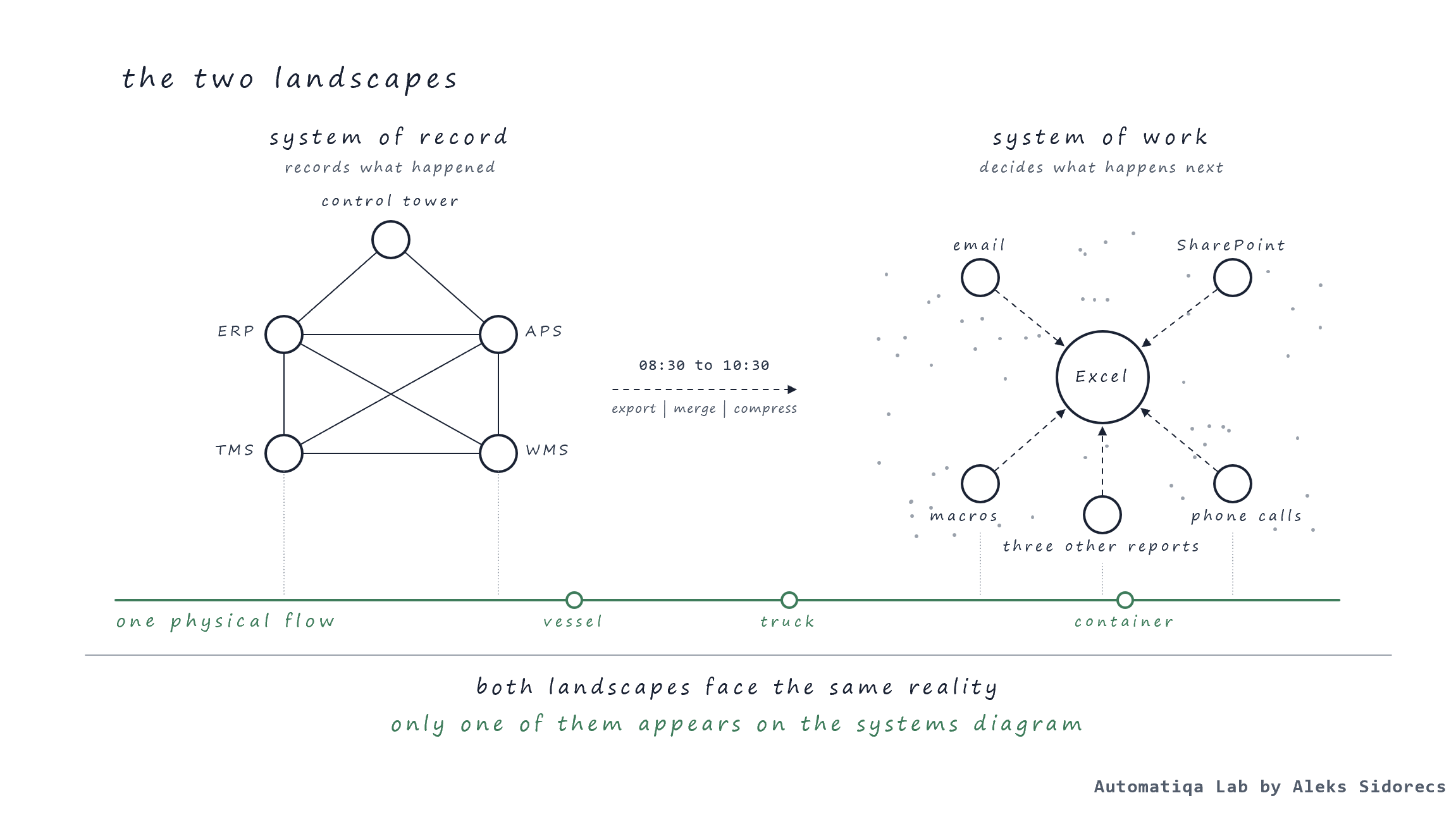
Both landscapes are real. Each is part of the same physical flow, whether vessels, trucks or cargo in a container. When the project team requests a systems diagram before the initiative starts - it normally receives only one. No surprise that when deploying new technology solutions, the part of operations that's executed daily via the workbook is frequently overlooked. This creates an asymmetry that grows year after year.
Such asymmetry comes at a cost: a. resources flow toward the visible part; b. it gets the upgrades and further improvements it needs. The invisible one gets nothing because no one plans to replace the workbook that supports customers' volume allocations. Basically, you can't budget for what you don't see, and the organisation doesn't understand - when it's in the operator's head.
## 1.2 Size of the second landscape
Let me illustrate with another case. I led a global initiative to review supply chain processes. My team worked hard to identify 250+ workflows across [order-to-cash](https://en.wikipedia.org/wiki/Order_to_cash), [purchase-to-pay](https://en.wikipedia.org/wiki/Purchase-to-pay), and goods delivery. It wasn't easy because the team had to dig deep: we zoomed out to understand high-level process types, then zoomed in on the individual transactions our operators performed across twenty-plus countries.
We covered many operational territories in just twenty days (only a few team members were fully dedicated to the task). The landscape we navigated through included contract management, customer service, complaints handling, reconciliations, and many other transactions/activities that had never been formally identified or captured. None of them existed in PowerPoints, but they existed in workbooks, in macros, and/or SharePoint. We even reviewed email rule settings that routed shipping-information updates and vendor report emails into a system. To make things even more complex, our project repository held more than 60 separate Excel reports used by multiple departments.
When I follow any of those artefacts, I always think of archaeologists working at ancient sites somewhere in Peru or Egypt. Here is a spreadsheet that plant operators used to track quality incidents and rejections. The spreadsheet, created in 2016, survived two system upgrades and four team members. Four!
Its users added a new Excel function; later, they added a new pivot table. New joiners implemented additional updates - nobody challenged it. Teams' habits and protocols formed with time. Like paths that appear on a lawn from repeated use.
Here's a kind of provocative statement: Excel represents the most successful [shadow IT](https://en.wikipedia.org/wiki/Shadow_IT) platform ever shipped by the IT function itself. I use the term deliberately as I don't want to insult my cross-functional colleagues. In cybersecurity, "shadow IT" means unapproved/unauthorised tools on user's PC, and I fully agree those tools deserve scrutiny without compromise. I just want to point out that Excel reveals a deeper and broader issue - unmet demand, not unapproved software. It flourishes within the one tool nobody will ever ban.
Shadow implies an exception and in most supply chain functions I've led, this is the operating model. Most of the sanctioned applications run the deterministic supply chain - the flows that behave as designed. Excel runs the real ones: where the product certificate has just expired on its journey across the ocean in a forty-foot container.
## 1.3 Why IT cannot close the gap
But we have to resist blaming IT because it's a wrong reflex - IT function isn't the problem. All this is about the pure arithmetic every practitioner faces in leadership roles, including complex trade-offs. And those are often sophisticated ones.
A significant portion of any IT budget goes to maintenance of the visible landscape. It covers licenses, upgrades, ongoing integrations, security measures, and audits. What remains supports change requests that often flood in from every corner of the organisation.
In such an environment, the supply chain team isn't the only stakeholder fighting for IT resources and attention. Finance is busy wrapping up its period close, or the legal team is pushing implementation of the [EU AI Act](https://en.wikipedia.org/wiki/Artificial_Intelligence_Act) requirements. All demand immediate attention and priority.
Another case from my universe is when a merger comes: each acquisition doubles the systems landscape overnight. In one post-merger integration I've been involved in, we moved from 15 to 27 systems globally. Guess what happens? Such cases reset the IT integration roadmap for years to come. Yes, we're talking years here.
That is why I mentioned at the beginning of this sub-chapter that backlog is arithmetic. Run costs and integrations consume the change budget before a supply chain operator's request reaches the top of any IT requirements list. That's often one reason we turn our attention to a second, invisible part of the landscape.
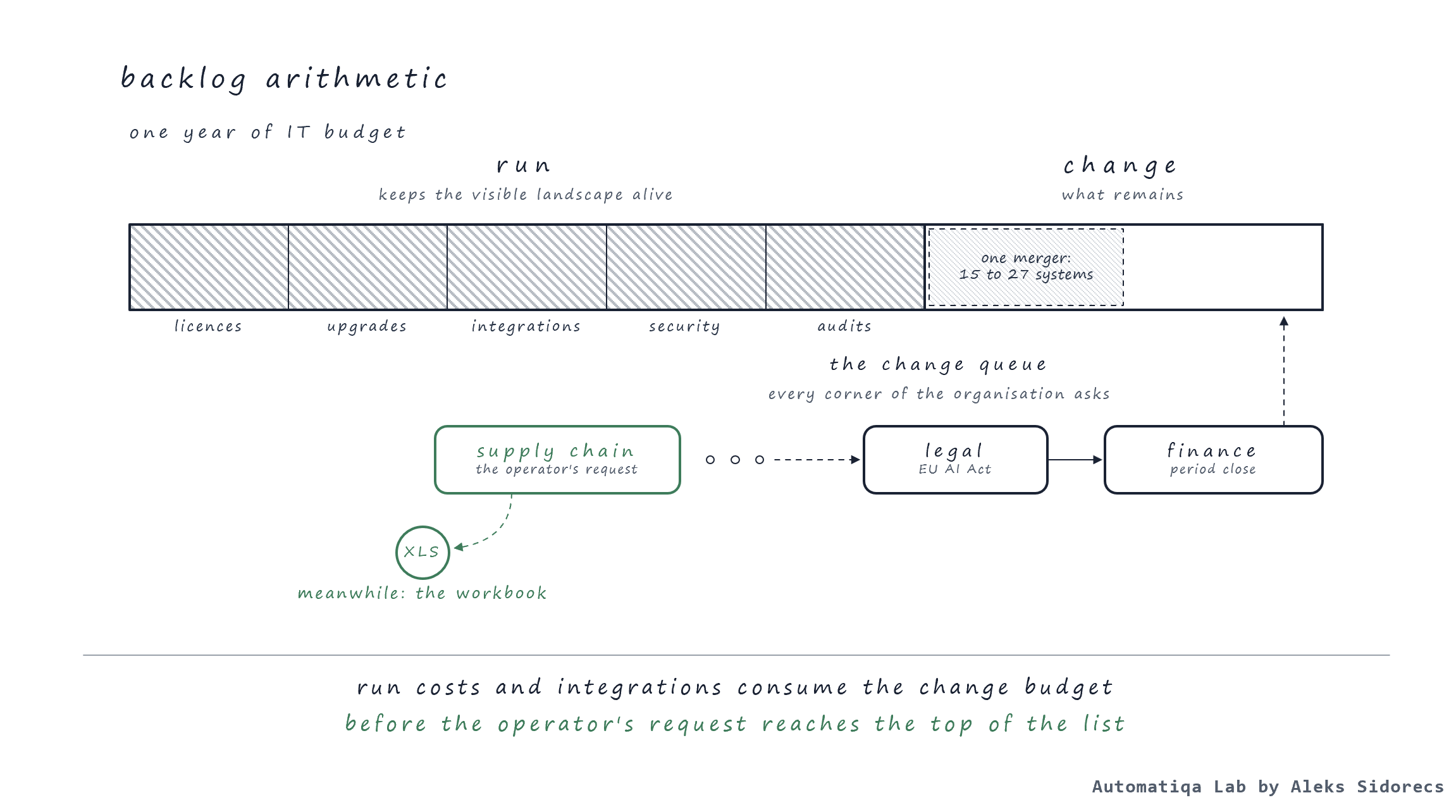
And that also creates another problem. In my two decades of professional experience, I've never seen a supply chain professional leave the role because the ERP system was perfect. In the majority of situations, people resigned because they constantly had to fight with workarounds triggered by flawed technology deployments.
## 1.4 The law the spreadsheet obeys
Supply chain networking events are a useful source of knowledge and experience exchange. When I meet industry peers, they often bring up the point of getting specialists off the Excel needle. In those conversations, I tend to interrupt them mid-question. The reason is that there's a much better way to frame it by looking at the problem from another angle. Ask yourself: Why does the spreadsheet keep outperforming every system any company deploys? I hope you understand the difference.
An answer exists, and it's older than any ERP system. It also challenges a conventional way of thinking, as my question in the previous paragraph did.
In 1956, cybernetician [W. Ross Ashby](https://en.wikipedia.org/wiki/W._Ross_Ashby) formulated a very interesting concept. I came across it during my PhD studies - the [Law of Requisite Variety](https://en.wikipedia.org/wiki/Variety_%28cybernetics%29): only variety can absorb variety[1]. A regulator must carry at least as many possible responses as the disturbances its environment produces. Otherwise, guess what, the disturbance wins.
**Note:** "Variety" might sound too abstract, but it only does so until we identify a reference case. Let's return to the status of our operator's mailbox at 08:30, as in Section 1.1. Now we add two additional crisis situations: a production line stopped in Vietnam due to a safety incident and a new delivery quality claim from the customer in the United States.
Five situations. Each demands a tailored decision - that's what variety looks like. The situation represents the number of scenarios operations must address when the superposition collapses for the operator upon morning login.
But when a system is designed to support only four workflows, it means that it can offer only four answers to a morning that asked five questions. And we've already made the case that, in most situations, in-house solutions give us more questions than answers.
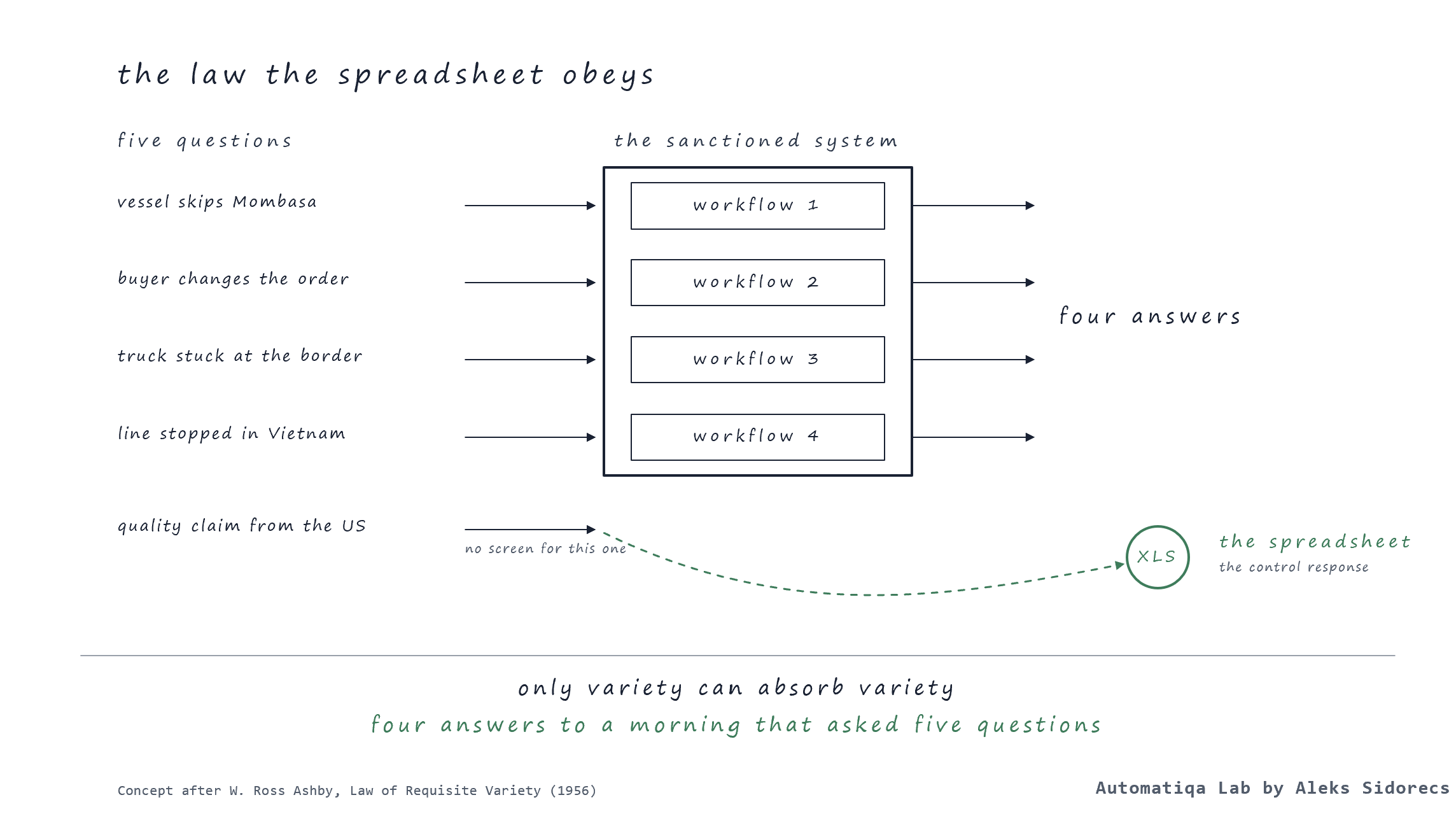
My peers in the community won't be surprised to hear that modern supply chains are machines for absorbing disturbances. Much of that disturbance is non-deterministic, such as port strikes, storms, and container booking rollovers. The variety of issues landing on an operator's desk each morning is wide (and sometimes just wild).
But what to do when the approved system landscape can only accommodate the variety its designers foresaw during the initial planning phase? The spreadsheet becomes justified because it's nothing more than a control response to variety that codified workflows can't handle.
We can certainly try to ban it, but the variety won't disappear - it will just move elsewhere. Into email threads, phone calls, contractors' databases and so on. That's probably why years of Excel elimination programmes achieved nearly nothing. And in such an environment, I doubt we can fully delete the second landscape right now. Most likely, we can only decide whether to keep it invisible.
## 1.5 What and where it is changing
The gap is old. The tools are new.
To summarise: for most of my career, the second landscape had one building material - the spreadsheet. What anyone could build was limited by what an Excel spreadsheet could handle: macros, external links, a [SQL](https://en.wikipedia.org/wiki/SQL) query (well, if someone had a licence and courage). The cap was real, and it kept the second landscape small and even fragile.
But over the past five years, that cap has been slowly collapsing at the speed of light. Drag-and-drop application builders (e.g. [Canva](https://en.wikipedia.org/wiki/Canva)) and workflow automation platforms (e.g. [N8N](https://en.wikipedia.org/wiki/N8n)) moved software-building capabilities down the skill curve. On top of that, AI assistants pushed it far enough that the person who owns/faces a problem can build a working tool in a week or two.
[Gartner](https://en.wikipedia.org/wiki/Gartner) identified this movement as citizen developers back in 2009[2],. In my opinion, little has changed since then. The tools and technology are real, while subject-matter experts increasingly build rather than coders. And here is a recent case: Anthropic ran a global hackathon in 2026: more than 20,000 applicants, 500 selected, one week to build with Claude Code. The top three places went to a doctor-turned-engineer in Istanbul, a former technician in the French Alps, and a computer science teacher in Chile[3].
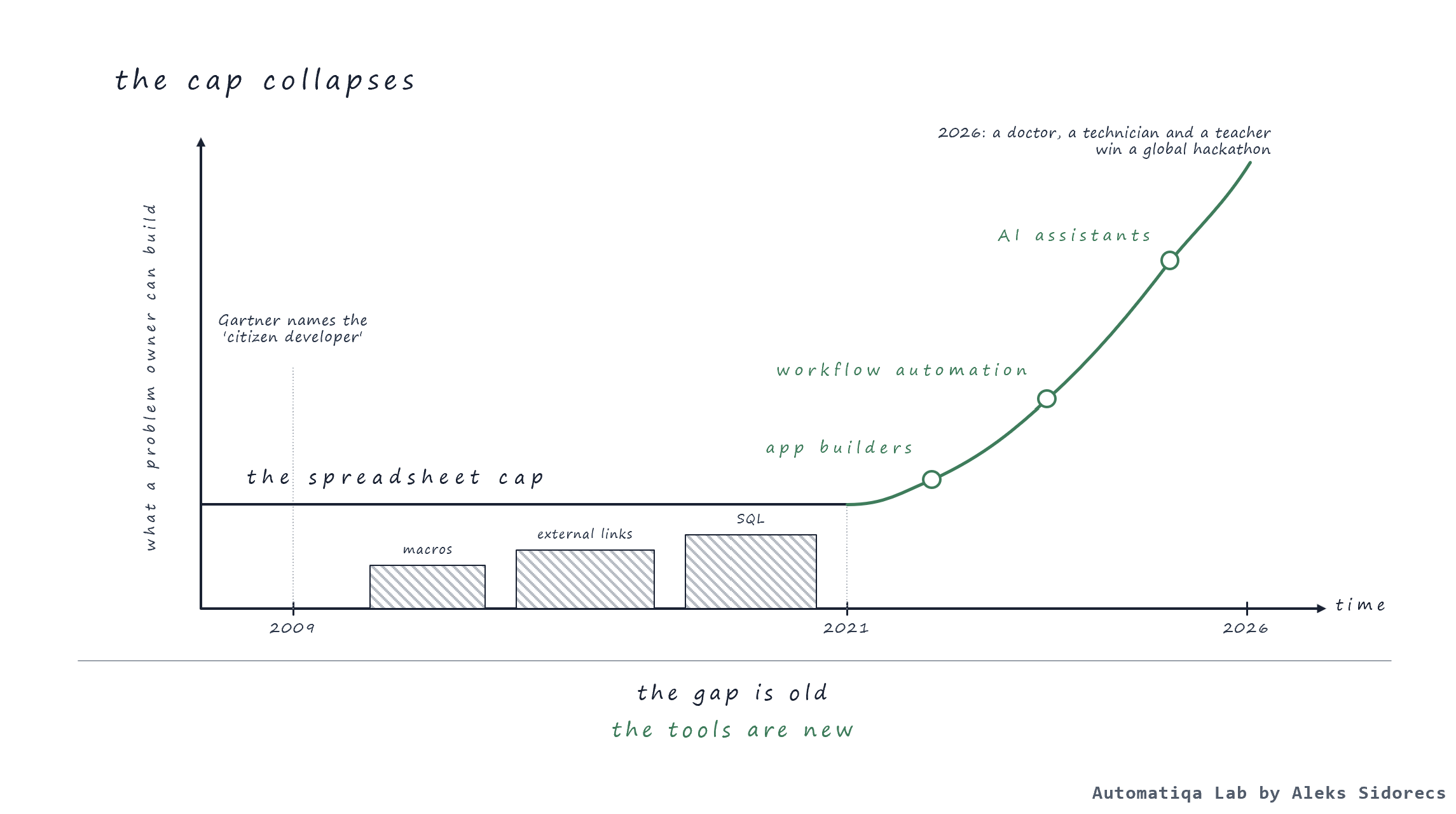
It excites me because people who own problems are becoming able to ship tailored solutions. Supply chain and logistics, for example, have the broadest variety gap in any company powered by rooted spreadsheet culture, the most hazardous data, and the most to gain. A citizen developer in marketing builds a campaign tracker, but a potential citizen developer in supply chain is going to touch the physical flow of goods, contracts and customs declarations. The impact is certainly different.
## 1.6 Potential way forward
Building where problems reside...
Supply chain planners and operators have already created the second landscape I've covered previously. The game rules are changing, so we should start giving them tools and guardrails, not constraints they'll likely ignore. The only question is whether it'll compound or corrode.
But I'd like to clarify one critical point - no corporate citizen developer will rebuild (or should be allowed to) ERP, APS, or a customs filing system. We still need systems (auditable systems of record) designed for deterministic processes and based on configurable, industry-accepted standards. That's their feature and expectation, and I'll defend it.
The territory that we're stepping into is the waystations. I define term "waystation" as a stop between systems where work arrives in one format, is checked by a human hand, and leaves in another with a new name. Waystations are where variety leaks and spreadsheets breed. This territory is much narrower than some [low-code](https://en.wikipedia.org/wiki/Low-code_development_platform) platform vendors claim and much larger than corporate systems diagrams admit. I'll try to map it properly in the following chapters.
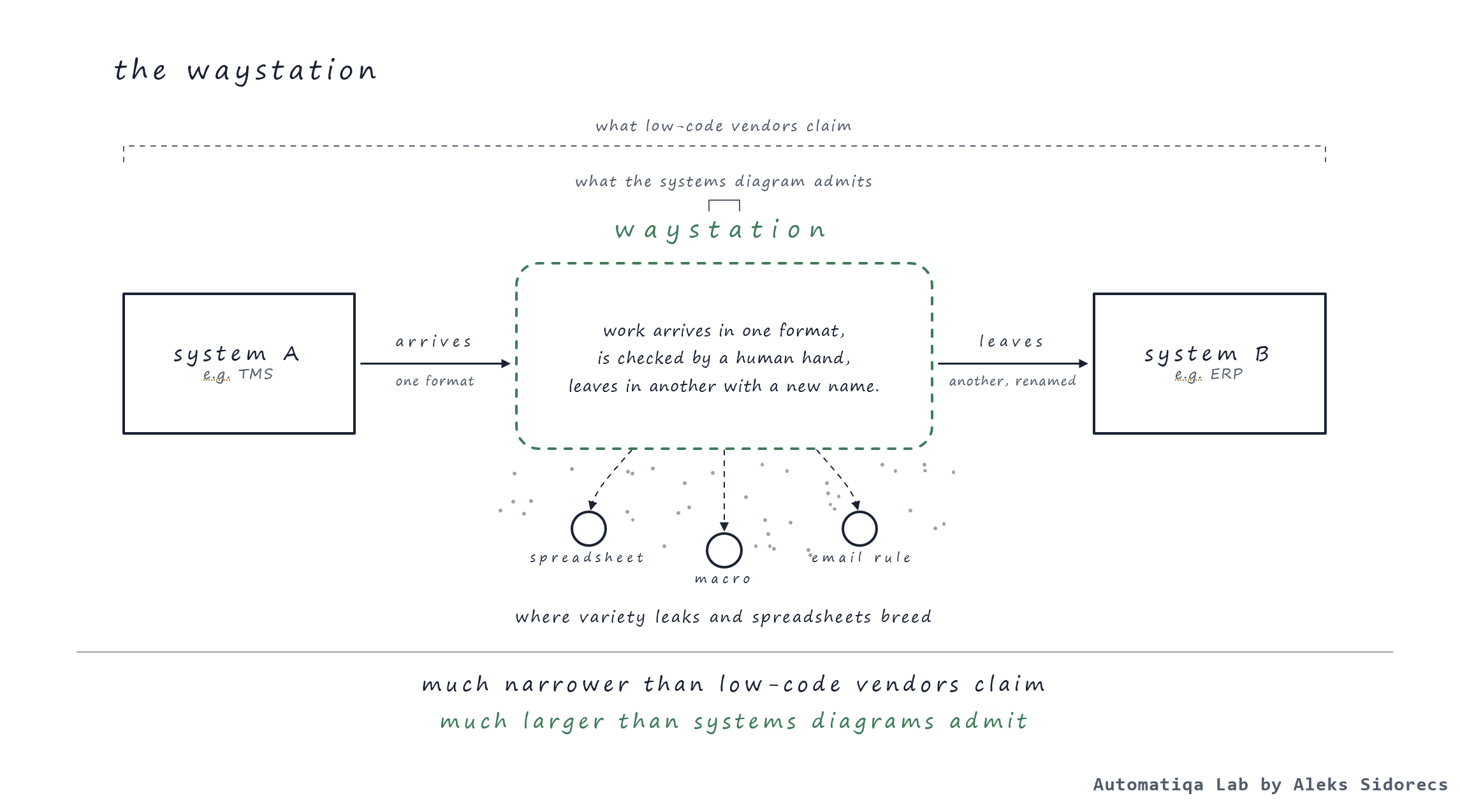
## 1.8 Key takeaways
- Every supply chain runs two IT landscapes: sanctioned and unsanctioned. Second is often a real system of work in operations.
- The spreadsheet represents a control response, not a bad habit of a specific individual.
- The IT function struggles to close this gap. The main reason is that it constantly has to manage backlog trade-offs.
- New tools and solutions emerge. We are entering an era where problem owners can ship real, tailored applications.
## References
1. Ashby, W. R. (1956). An introduction to cybernetics. Chapman & Hall. Principia Cybernetica electronic edition. http://pespmc1.vub.ac.be/books/IntroCyb.pdf
2. Computer Weekly. Gartner urges IT departments to support end-user application development (Ian Finley, Gartner). https://www.computerweekly.com/news/2240105038/Gartner-urges-IT-departments-to-support-end-user-application-development
3. Anthropic (2026). Meet the winners of the Built with Opus 4.7 Claude Code hackathon. https://claude.com/resources/articles/meet-the-winners-of-built-with-opus-4-7-claude-code-hackathon
==============================================================================
# Playbook 01: Operating Model Physics
**Redesigning supply chain and operations for AI agents, one decision loop at a time**
- URL: https://www.sidorecs.com/playbooks/01-operating-model-physics/
- Published: 2026-10-24
> A method for designing operating models: place each [decision loop](https://www.sidorecs.com/heuristics/03-decision-loop-readiness/) on a two-axis map to measure the [variety](https://www.sidorecs.com/heuristics/01-requisite-variety-in-supply-chain/) it has or can absorb. It can move only in the directions the operational [physics](https://www.sidorecs.com/heuristics/02-asymmetric-supply-chain-physics/) permits.
## In short
Operating Model Physics places every decision loop on the Variety Map. It counts two numbers for it: the gate and the size. After that, it moves it one axis at a time where the physics allows. Why?
Because usually target operating model roadmaps have no test. Often their maturity ladder holds only one vector. On top of that, the AI-powered workforce redesign redistributes work and has no check gates to validate whether the prescribed activities will hold.
## What is Operating Model Physics?
An operating model is a portfolio of loops, and physics can test each loop's place.
Operating Model Physics is a method for designing operating models. Each decision loop is placed on a two-axis map by where operational surprises are absorbed and how.
Just two numbers: a. whether the model's responses can match what arrives and b. how much of such variance comes from the outside of company walls. Then it is moved, one axis at a time, only in the directions actual variability stress test permits.
Strategy still chooses (and defines "No" to specific aspects of choices). The physics only forbids and constrains - that's the whole difference from the two habits it replaces.
## What does a target operating model (TOM) leave out?
A TOM says where to go. Operating Model Physics says whether it can stick and get sustained.
A target operating model is a diagram and direction of where the organisation should be: which functions, in which places, on which systems. It also includes governance and critical policies. I've designed several of those myself, and inherited many during transformation programmes I delivered.
None of them includes testing or relevant simulations. Nothing in such a strategy document clearly states whether a loop moved to the centre will still answer inside its response window, or whether a rule book written for last year's exceptions will survive this year's (as COVID did with just-in-time models).
The maturity ladder (or curve) has the opposite challenge. It carries a direction, manual to autonomous (or self-driven, as some AI gurus define it), and applies it to every loop at once.
My issue is that two loops at the same maturity can be very different work activities: one is a rule set in a data centre somewhere in Europe, and the other is a rule set on a truck delivering a container to the port of Santos in Brazil. The maturity assessments often can't capture such differences because
they look at things from an aggregation perspective.
And the word itself does the damage because of some psychological inertia - low maturity reads as a fault. As a result, the loops that should stay there are pushed up until the exception queue becomes the operating model. We know what it means to manage operations by exceptions - operating models would lift or move problems instead of real EBITDA.
The forming trend is the workforce and org. structure redesign. It consists of various steps such as:
- value drivers definitions
- workflows mapping
- decisions about what work should be eliminated
- distributing what's left among employees and AI (sometimes + contractors).
The new direction is emerging: managers become coaches (some even start calling them the 'middleware'), teams get smaller, and the question of who does the work is declared the wrong question.
In my opinion, it's a better habit than the other two, at least because it starts with the work but has no test. A workflow is a sequence of operational (or any other) activities.
A limitation of viewing things through a workflow lens is that it lacks sensing, response configurations, and the ability to handle external variances.
For example, it's hard to predict whether a workflow (when delegated to Agentic AI) is likely to sustain results in cases when the shipping line or the local regulator does something no one expected.
Any methodology or framework can point to work or activities that can be potentially removed. The main constraint I see there is that it can't say which decision loops are likely to fail.
Failures usually arrive (and they always will) after the people who used to absorb them have been counted as P&L-relevant savings. It's also impossible to identify which loops will hold after all the corporate changes and restructuring initiatives.
Operating Model Physics (aka first principles) aims to preserve the strategy's objective and the operating model vectors. It also keeps the ladder as one axis of a map, and maintains the redesign's starting point - the work.
It just adds the element that all three were missing: two measurements per loop.
## What are the parts of the framework?
My main objective is to shape our mental models when we approach TOM or agentic AI initiatives. The framework is a work in progress (and will change over time), but so far it has eight main blocks.
Please read it in order the first time, and then as needed.
The Variety Map is a starting point. It frames and scopes everything else combined with the spectrum that scales it. The four archetypes (you can replace them with your own definitions) are the map's edges.
The physics of operations provides a clear signal whether a loop will hold where it's required or going to be placed. Moves and methods will guide how to shift and shape a loop so it sticks.
The final stroke comes at the crosswalk and glossary modules, where we translate the whole analysis stack into the words/definitions you already apply in your operational context.
| Sheet | What it answers |
|---|---|
| The Variety Map | Two axes + one square + every loop at a point |
| The encoding spectrum | Five stages of one loop: T1 to T5 |
| Four archetypes | Craft - Desk - Engine - Autopilot |
| The physics | The gate and the size - counted on one loop |
| The moves | Four directions with each being gated |
| The method | Map, measure, move - one loop at a time |
| Crosswalk | Where the familiar tools land |
| Glossary | One vocabulary for the set |
------------------------------------------------------------------------------
## Part 2: The Variety Map
- URL: https://www.sidorecs.com/playbooks/01-operating-model-physics/variety-map/
- Published: 2026-11-06
> The Variety Map is grounded in two axes and a square. A loop's uncertainty/surprises get absorbed where the locus runs from the edge towards the centre. The mechanism defines how to shift from judgement to encoding. Every decision loop in an operating model should have one point on it.
## In short
One decision loop at a time guided by two questions is what's being placed on the map.
- first is how it absorbs [variety](https://www.sidorecs.com/heuristics/01-requisite-variety-in-supply-chain/), and where it sits on a spectrum between the edge and the centre (think of headquarters vs manufacturing site somewhere in Mexico)
- second, what's written down and run without them in the Mechanism.
The map in Figure 1 consists of the four quadrants (Craft, Desk, Engine and Autopilot) with five stages on the vertical axis, with no privileged operating corner (T1 to T5).
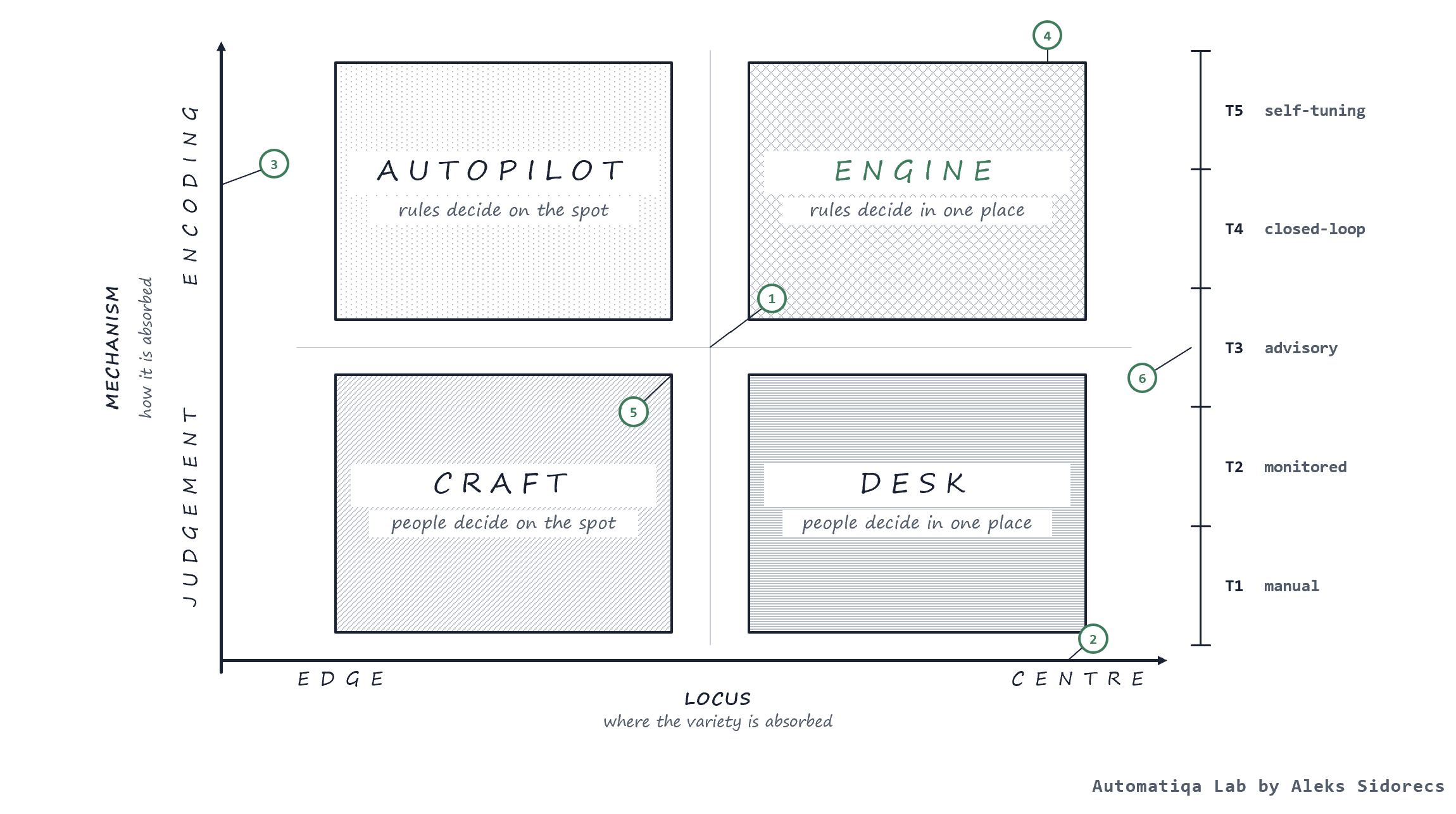
## What gets placed on the map? A loop with one cycle of sense, decide, act.
When I think of Variety Map, my mental model is generally shaped by four key principles:
- any organisational design is mostly constrained by teams and structures
- at the same time, the operating model design charters the loops that keep working when any team changes
- decisions across the supply chain most frequently get triggered when a specific signal on someone's desk
- the action goes out - the result comes back as the new signal.
In my world, a handover chain that ends in a decision represents a single unit of loop. As I mentioned earlier, any operating model consists of several loop portfolios, each with a specific position on the map.
Any team I worked with across the supply chain domain operated mostly through decision loops. The same happened with operational exceptions that we continuously faced across planning, production, sourcing or logistics - those lit up a chain of flows (aka neurons in the human brain), triggering a decision loop within the same operating model.
Three questions power the decision loop diagnostics:
- when this loop meets something it wasn't prepared for - who absorbs an unexpected event?
- where are they relative to where the unexpected event arrives?
- what's written down (e.g. SOPs) and executed without any guidance or protocol?
The last answer gives us the point on the Mechanism spectrum. The first two give us the vector points on the Locus.
[Heuristic 03](https://www.sidorecs.com/heuristics/03-decision-loop-readiness/) challenges us with three questions: who decided (at what moment and place), what inputs were available at that moment of deciding (including the missing ones when those were needed), and whether the outcome reached the person deciding next.
Three 'yes' answers and the loop closes - you can find its decision. The map adds the question about what's written down, placing the loop on Mechanism.
## How is the Variety Map drawn?
1. Important to consider that the element that's placed on the map isn't a team, but a loop!
2. Moving left on Locus enables shortening response time and keeping local knowledge as a differentiator. Moving right pools scale and leverages scarce skills. Locus runs from edge to the centre.
3. Moving up on Mechanism lowers the cost per decision and raises the cost of uncertainty that is often powered by the operational physics ([Heuristic 02](https://www.sidorecs.com/heuristics/02-asymmetric-supply-chain-physics/)). Mechanism runs on a spectrum: from judgement to encoding.
4. The operational physics of the supply chain you're in shapes the decisions about which loops may go and which must stay with the Engine. Indeed, it's counterintuitive gien that in most cases operating models aim to push every loop to the Engine.
5. The edges of the squares aren't kind of borders, but thresholds. Where the decision loop splits its variety, it points to where handoffs reside.
6. The Mechanism is defined by its encoding (the encoding spectrum): from manual (T1) to self-tuning (T5).
## What does Locus actually measure?
By the edge, I mean the surprise (an unexpected event in the form of variability) absorbed where it lands. Those could be different places across your value chain or organisation: port terminal, the operator talking to the shipper or any manufacturing facility across your supply chain network.
What happens at the edge? The unexpected event lands there and gets absorbed locally. The decision loop runs inside, but response time shortens when moving left. On the other side, moving right on the diagram lets the centre see the loop while leveraging its scale - so scarce capabilities are activated in such a way that allows the centre to serve many sites and locations.
Based on my experience, the edge pays in consistency and capabilities at every location. At the same time, the centre pays in latency, information loss (during transfer through organisational channels), and exceptions queuing in front of it. That's how I conclude that in cases where the decision loop's response window is shorter than the cycle time of the round trip it needs to make to the centre and back - the loop shouldn't be allowed to be positioned at the centre.
## What does Mechanism measure?
How a loop's uncertainties are absorbed and graduated by what is encoded.
First is sensing at T2, then decision as a proposal at the T3 level (advisory), followed by decisions and action within limits at T4 (closed-loop). At T5 (self-tuning), the person designs policy because the supply chain operator's part reduces one step at a time (but never reaches zero!).
The key issue we need to be mindful of is the fact that encoded responses will stay fixed until rewritten (normally because rules of specific parts of operations need to change due to new regulations, process changes etc.). As the loop grows the cost of unexpected events will be rising while the cost per decision is expected to fall.
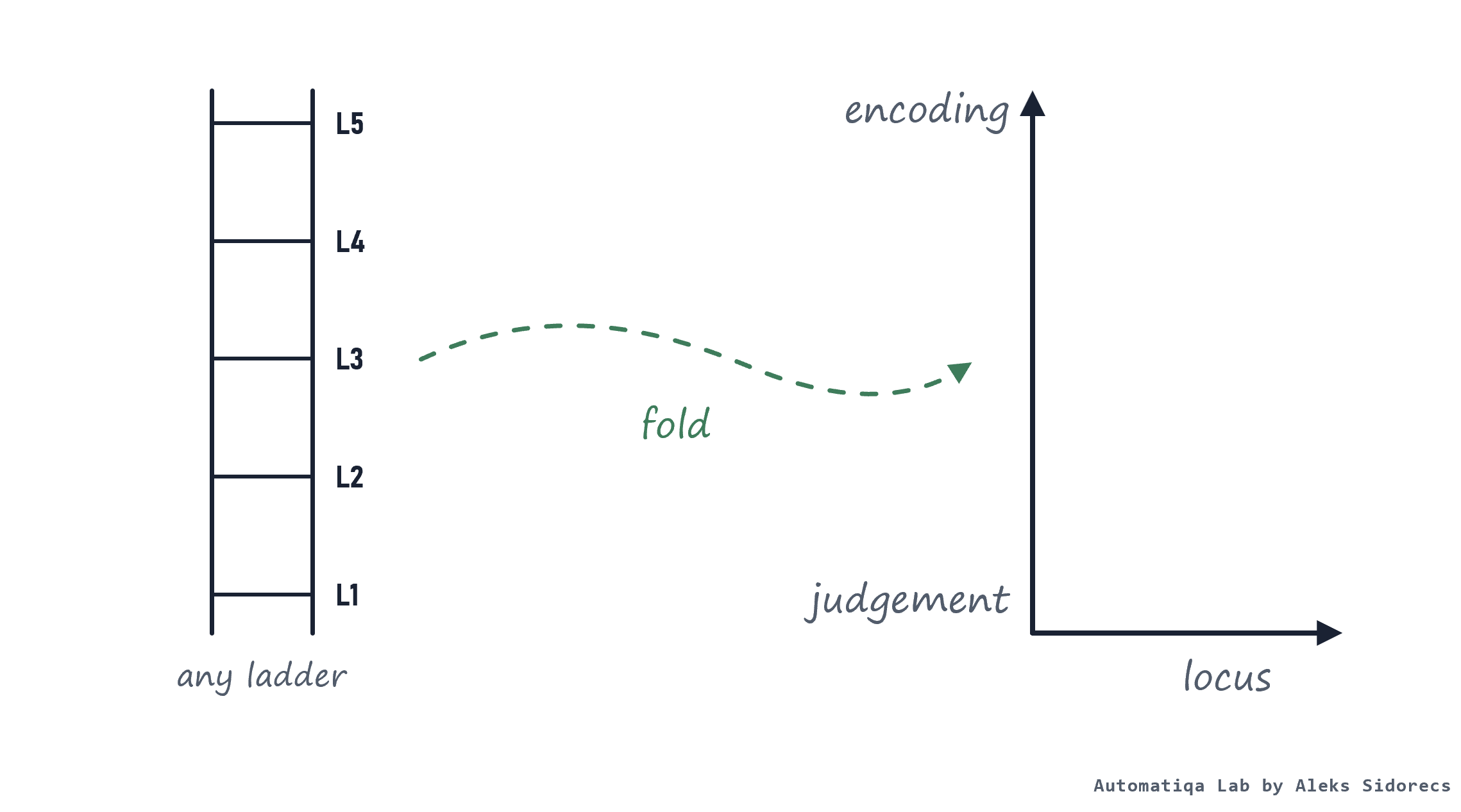
Any ladder or maturity curve your organisation has developed (using ratings like 'manual' to an 'autonomous' maturity spectrum) or inherited from providers like Gartner typically should align with the X & Y axes of this diagram. I've intentionally left the ladder without a bottom layer since most decision loops in operational models would start there. An additional point we have to remember: two loops at T4 may be far apart: one loop could be placed at the Engine, and another loop at the Autopilot.
## But wait, what happens on a divider?
When any loop splits on a divider = split loop inside it gets a handoff.
As mentioned earlier, dividers represent thresholds. For example, a loop placed on a vertical divider will have half its variety absorbed at the edge and another part absorbed at the centre. One such divider has a rule that handles the routine tasks while the operator handles the rest. We should accept this as normal because most decision loops will start there as well (the same way as with the ladder).
Handoffs are exactly the doors where latency, fidelity loss and interpretation enter. You can map the loop with the boundaries it crosses between trigger and return: a function, a system, a P&L. Heuristic 03 writes it as b = f + s + p, from 0 to 3. b sets the assessment order for the mapping: a triple crossing is where the cross-functional meetings exist (and the money), so assess such loops first. The method part of the framework provides all the rules.
==============================================================================
# What does supply chain orchestration actually orchestrate?
- URL: https://www.sidorecs.com/insights/supply-chain-orchestration/
- Published: 2026-10-04
In front of me, a truck arrives at a mill with green dried coffee beans. The driver crosses the weighbridge, the quality manager pulls a sample, checks moisture, and grades the lot delivered. Somewhere in Europe, the trader sets the provisional price on the purchase contract - it'll be fixed later against the commodity exchange. The finance manager in North America, covers the hedges through a separate legal entity with its own P&L. The seller passes title (aka ownership) when the documents define it. A clerk drafts the documents and passes them to a lawyer for checking. The logistics operator chases originals by email. Those movements, handovers, and handshakes are just part of a journey to get Robusta and Arabica coffees from the farm to the cup.
Then there's a parallel universe of technology vendors and solution providers. I read their reports and AI capability overviews related to supply chain orchestration (SCO), sometimes too many. They rarely mention trucks at the gate with the wrong coffee, a broken weighbridge, a trader's provisional price, or financial hedges.
As the category sells it, SCO drives information flows within one company, upstream or downstream[1]. In my agri-food world, the decisions that make or lose money involve cash commitments, title transfers, and P&L. All this happens at the seams that the technology industry is rarely, or only partially, touching.
In the [manifesto](https://www.automatiqa.io/manifesto/), I wrote that the control tower, which often gets positioned under the SCO segment, sees everything and decides nothing autonomously. Jim Frazer at ARC made an even sharper point: that control towers enhanced visibility and didn't improve control[2]. So, what I'm willing to work out is why actually nothing gets decided, and where.
## Orchestrate or not to orchestrate, that's a question
I've read various definitions from vendors and solution providers who seem to own that space. You can easily spot them through Google or generative searches. Plus Gartner's market overviews[3]. They all do differ in their SCO interpretations but mostly agree that orchestration means a single view across demand, supply, logistics, and/or finance. On top of that, there's a common trail of highlights related to harmonised data that's needed to power recommendations for operators and foundations setting for agents to execute specific tasks within configured guardrails. Gartner's research describes the platforms as the "connective layer between supply chain strategy and execution".
To clarify those things for myself, I strip away the adjectives. It brings me down to four things that are generally orchestrated: a. signals, b. workflows, c. exceptions, and d. plans. All those elements represent information in different forms and shapes. Lora Cecere has long argued - the word carries too many definitions[4]. In my opinion, it's true, as there are many blind spots, and they matter more than the variety of definitions.
Compared to classical supply chain management textbooks, I experience a different reality (through the lens of agri-food sector). They emphasise three core flows in operations: material, information, and financial[5], while I experience how physical supply chains actually run on four:
- information: flow of state, signals, forecasts, alerts
- physical: flow of beans, bags, containers, samples, and paper documents as objects
- financial: financing and factoring, provisional and final settlement, hedges, intercompany flows and transfer pricing
- contractual: commercial commitments, title transfers, quality terms, arbitration rules
Let me explain why I'm a bit picky here. The problem is that most publications ignore the last one. But I can't ignore the fact that in my world, the contract isn't just the source of information about a trade or commercial deal - it's the trade itself.
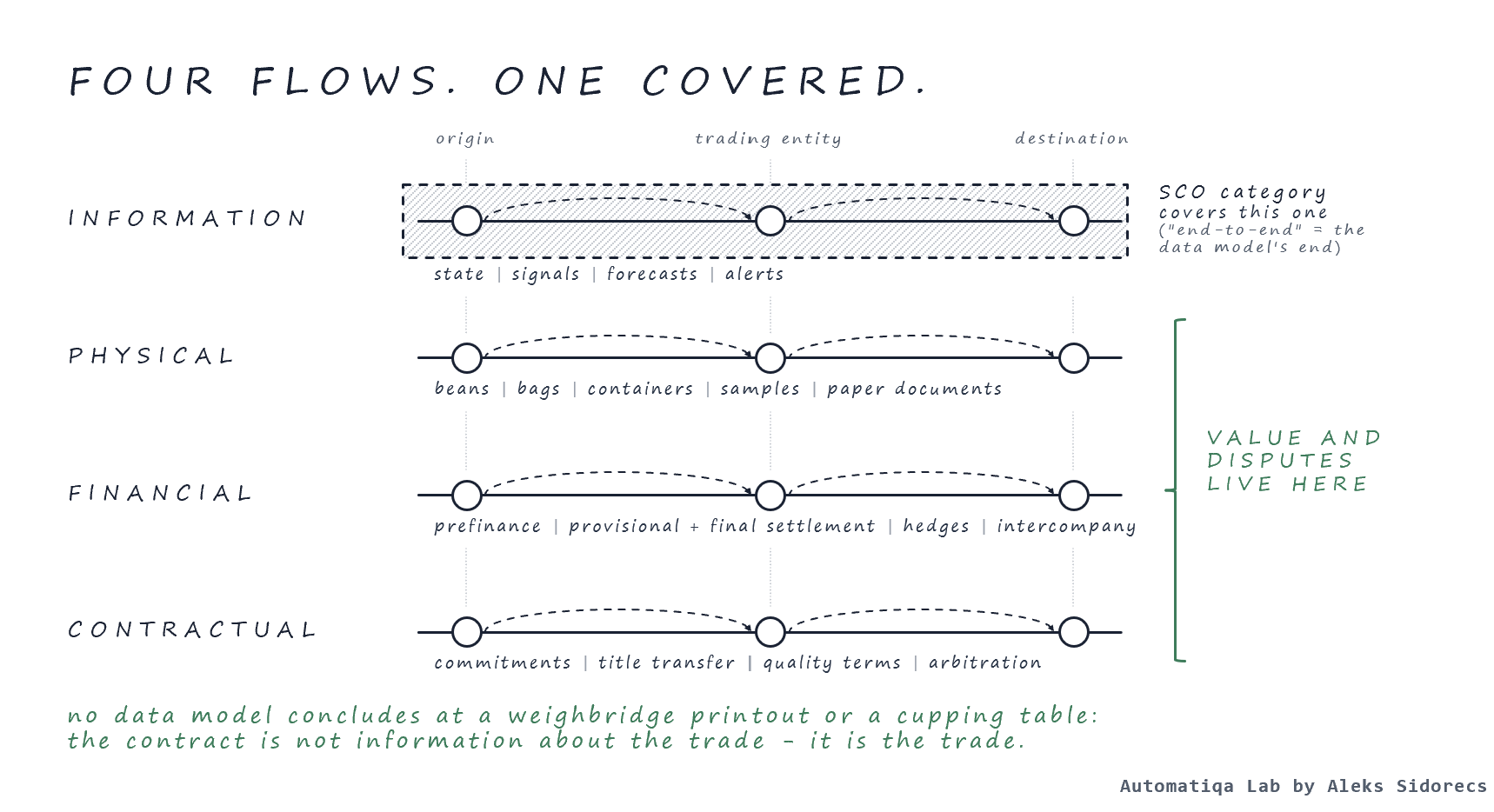
The SCO market category focuses heavily on information flows. The value and disputes I experience originate from the remaining three. When a solution provider claims "end-to-end" capabilities, in my mind, they refer to their data model's end-to-end, but no data model concludes at a weighbridge printout where coffee is delivered or a cupping table that grades coffee quality.
But wait, one exception actually exists. It was discovered through an unexpected source: a patent filing. Oracle's patents on "supply chain financial orchestration" model a physical movement as separate from the financial flow, with margin and tax allocated between legal entities[6]. I appreciate that abstraction, and so far it's the only vendor artefact I've found that separates the flows properly.
Meanwhile, a parallel software universe already orchestrates the other three flows for commodity trading across agri-food, metals, and other segments. Those are so-called CTRM (Commodity Trading and Risk Management System) systems that handle deal capture, provisional pricing, position, settlement, and quality. Gary Vasey writes a lot about the clash between that category and ERP[7]. Most interesting for me is that the commodity-tech side knows SCO platforms exist, but I've yet to meet an SCO algorithm that recognises provisional pricing.
## When it stops inside the company walls
Recently, at Capgemini's [Accelerate Forum 2026](https://www.capgemini.com/ch-en/news/events/accelerator-forum-switzerland/) in the Basel area, I discussed with [Ranko Sevo](https://www.linkedin.com/in/rankosevo/) how orchestration platforms accelerate supply chains. But I preferred to reflect on the broader effects it contributes once that vision is achieved within individual functions.
Well, nothing against technology itself - I've deployed it through more than ten digital transformation initiatives across supply chain and operations. And I've seen it working across consumer goods, life sciences, and agri-food. What does it achieve? Analysis gets performed faster, potential risks are identified before they punch the operator in the face, and optimisation recommendations are visualised. In my soft-commodities world, each of those generated outputs should go somewhere, outside the function:
- replanning cases to a trading desk that has to re-hedge
- early exceptions to a quality team that's still waiting for a physical sample to be delivered by DHL
- faster shipment cases to finance, as they should link contracts between two entities and release prefinance before the original shipment documents are sent to destination.
It becomes obvious that if my cross-functional colleagues run at the old speed, the supply chain's operational and speed gains create a huge queue at the handover.
Basically, it's my favourite Ashby's law when it gets applied to one function downstream[8]. It provides a basis for [Heuristic 01](https://www.sidorecs.com/heuristics/01-requisite-variety-in-supply-chain/): any operation can control only the variety it can absorb ( [Variety Shortfall Test](https://www.sidorecs.com/glossary/#variety-shortfall-test) highlights which layer is short[9]). Let me illustrate it with a metaphor: a Ferrari representing the speed of an orchestrated supply chain function. At the same time, other functions may be and often are slower, running at lower horsepower. Imagine what happens next? Indeed, the problem moves to the neighbour from another function across the office corridor.
## The seam that sets the speed.
With all of the above stated, I came to one simple decision: to start evaluating the cross-functional handovers across all crossing nodes: a. functions, b. systems and c. P&Ls. The reason is that in soft commodities, trading and supply chain operations cross all three nodes at once during any handover between the origin (where goods are supplied from), a trading entity, and the destination location/office. Data integration alone isn't solving it (lately, it also triggered my decision to launch the [Re-Model](https://www.re-model.ch/) project together with [Burak Cetin](https://www.linkedin.com/in/burak-cetin-zh/)).
The context I've provided previously led to one key decision: I've started evaluating the cross-functional handovers across the intra-organisational nodes they cross. The functions, systems and P&Ls. In a soft-commodities trading/supply chain operations, a handover between an origin entity (where coffee is supplied from) and a trading entity usually crosses all three nodes at once. Data integration alone won't solve it. The main reason is that someone has to decide who carries the margin, and I haven't seen any platform that can make that judgment call.
That's why the second prerogative isn't about orchestrating the supply chain harder or broader, but about applying a systematic and integrated approach to all key nodes of trade execution. So in my case, it becomes a four-flow orchestration mechanism (information, physical, financial and contractual) with a vector of activities where all handovers (across all functions and entities) are automated. This would prevent cases where one function's speed isn't absorbed by another one. Efficient absorption prevents unproductive friction.
I do think that "orchestrate" is still the right verb to apply...
## Where it stops at the wall
... but beyond the company wall, the verb changes...
Let me share some additional context and more facts. Soft-commodities operating models are powered by [asymmetric physics](https://www.sidorecs.com/heuristics/02-asymmetric-supply-chain-physics/)[10]. Upstream are farmers' cooperatives with paper-based transactions and sourcing stations where agri-food goods are purchased from hundred farmers in the morning[11]. Downstream are processors and/or roasters powered by their own portals and banks with specific document standards. Every player across the agri-food value chain sits at a different point of the process, technology, and operating-model maturity curve. And four-flow orchestration that I mentioned earlier meets all of them at once.
That's where orchestration stops being what we think it is.
First case - Barry Callebaut and their official Forever Chocolate program. In August 2025, the company reported covering around 85.6% of the mapped plots across its direct cocoa supply chain. They achieved solid performance by raising the number from 72.3% six years ago[12]. But it also tells us another story - after more than nine years, the cocoa processor still hasn't fully mapped the upstream supply chain it's expected to control. At the same time, the indirect supply chain, which represents 40%-60% of global Cocoa supply, is no longer reported. Inside the wall, the performance improves a few points a year. But outside of it, it just stops being published.
Second case - Cargill, also a cocoa case. Their numbers got the same vector but with more precision. Its [Promise](https://www.cargill.com/sustainability/cargill-cocoa-promise) supply chain program centres on a third of the total cocoa volume it sources. Every plot is polygon-mapped, and 217943 of them have assurance by an external validator (KPMG)[13]. Two-thirds of the certified farmers delivered cocoa beans through the first-mile traceability system. Again, the indirect upstream supply chain tells a similar story as at Barry Callebaut. They just refer to the data-verification partner and publish no relevant data points.
Bunge is the last reference example and quite an interesting one. In November 2024, it reported achieving 100% traceability and monitoring of direct and indirect soy sources across priority regions in Brazil, Argentina, and Paraguay. The company moved from around 30% in 2021 to 64% of upstream sourcing monitoring in 2022[14]. I started asking why, and the answer was quite interesting. Bunge developed quite an elegant approach - the company shared its methodology and tools with more than ninety resellers and cooperatives so they could build their own traceability systems.
In my opinion, Bunge represents a quite unique case, because it's not about orchestration or control. It's a pure calibration. Yes, it worked for an upstream supply chain of about two thousand large land plots, and I shouldn't expect any agri-food/soft-commodities business to repeat that success with five million smallholder farmers using the same runbook. But it worked, and it supports the thesis I share in the chapters that follow.
Before jumping to a few other points I planned to share, there's a need to highlight one important aspect. What moved the needle at every company during 2024/2025 wasn't any kind of platform as such. You'll notice a double-digit increase at any of the above-mentioned players related to the sourcing of deforestation-free agricultural goods. And there is one key driver for this: the [EU deforestation regulation](https://environment.ec.europa.eu/topics/forests/deforestation/regulation-deforestation-free-products_en) (EUDR)[15]. What amazes here is how one shared external standard/regulation, in just one year, shaped things the way a decade of orchestration inside the wall couldn't. Reason? EUDR requires every counterparty to produce the same data, leveraging the same taxonomy and format.
One sector -> one data -> one standard...
On my table, I have several copies of a Bill of Lading (B/L), the connecting tissue of international trade and export-driven supply chain operations. Interestingly, it connects all four flows and is still used in a paper format. It has several roles: a. confirmation of receipt of the physical goods, b. cargo carriage contract, c. title transfer (seller-to-buyer) document and d. collateral for the bank in case the deal is financed. As some of my peers know, we still face many situations where the original B/L is being sent in a paper format to various stakeholders involved in ocean freight flows.
Several attempts have tried to digitise it, starting with Seadocs in 1983. Fast forward - forty three years later: only 5% of B/Ls are being shared in electronic format. At the same time, nine shipping lines lifting 75% of global container trade have committed to transition to 100% electronic-B/Ls (eBL) by 2030[16]. But I suspect they won't achieve that by then. Why? Because the level of alignment needed between value chain actors that don't share the same data standards (e.g. EUDR), operate at different levels of technology maturity, and often have conflicting interests. The alignment needs to take into account quite a diverse group of stakeholders: shippers, consignees, freight forwarders, insurance companies, banks, customs and regulatory authorities. Compared to the UK (where eBL was formalised at a legislative level in 2023), some countries (incl. the European Union) still don't treat the eBL as an ownership title-transfer document, unlike its paper twin[17]. Orchestration is pointless here.
There were also some bigger technological ambitions to enable end-to-end orchestration in a multi-agent global supply chain environment. The TradeLens initiative was initially created by Maersk and led by a consortium of major carriers and shippers. The ambition was plausible - to cover a majority of global containerised trade and track billions of logistical events. In 2023, it shut down because of commercial concerns[18]. Some other cases, such as we.trade (closed in 2022), Marco Polo Network (shut in 2023) and Contour (closed in 2023), followed the same pattern. And partially, it makes sense: how do you orchestrate stakeholders that will continuously challenge the onboarding costs, data ownership, and conflict situations when a competitor should route its business through a rival's platform[19]?.
## Three rungs, two seams.
Gartner’s maturity model has placed "orchestrate" at the highest point on their model, defining orchestration as collaborative work among ecosystem actors[20]. At the same time, the term "orchestrator" has been used in the strategy literature for over twenty years – by authors such as Iansiti & Levien, and Adner & Jacobides[21]. Each rung of this model was created long ago. I’m simply taking one of those rungs, previously compressed into a single step by analysts, and emphasising critical joints that act as seams in supply chain management.
1. Supply Chain Orchestration - touches one of the four flows (one of the functions) and gets only one view of the data. Decisions are still routed via operators.
2. Four-flow orchestration - all four flows that represent every function and legal entity across a single enterprise or group of affiliated companies. Handovers are automated in an integrated way, so that every function, system, process, and P&L form a unified fabric of business execution. Hands-off integration with one authority behind it, which is why the term "orchestrate" is still used and accepted here.
3. Ecosystem calibration - all four flows (in my case it's from farm to cup), partners, irrespective of their maturity level and sophistication, get calibrated to shared signals and standards, with no conductor in between.
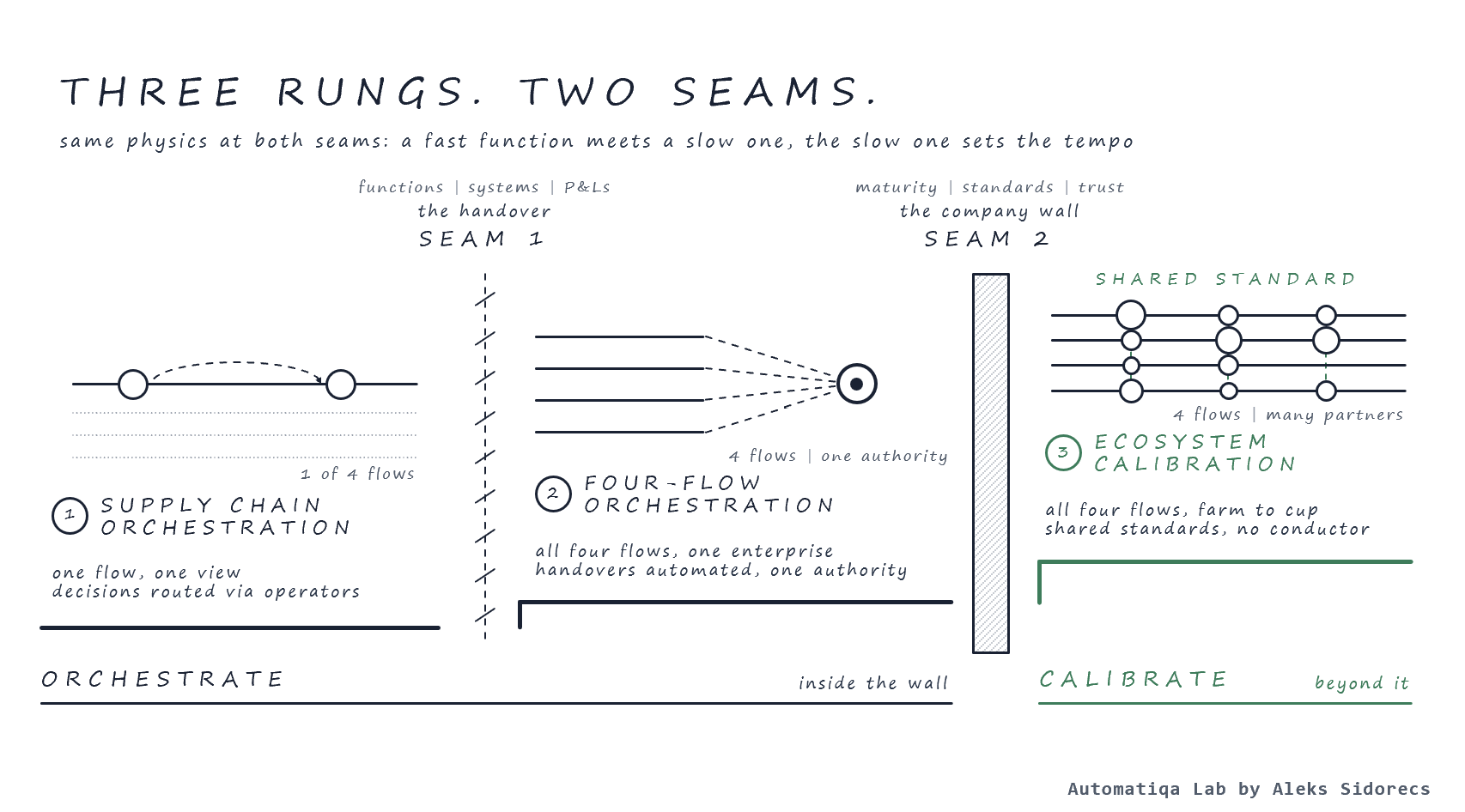
Between one and two, we face the handover problems. Between two and three, the list is that we have to deal with maturity problems. But the physics is the same both times: a fast function/process/system meets a slow one -> the slow one sets the overall tempo/speed.
The third rung. I deliberately don't define it as "orchestrated ecosystem", and there are several reasons for that. In the strategy and business literature, orchestration means a central/hub firm that has taken the position (and the power) to direct the others[21]. I don't expect this to evolve to that level across agri-food value chains because of several reasons. Let's have a look at its current structure based on a coffee sector example:
- the trader is a counterparty to the farmer and to the roaster. It would be illusory for a trader to expect either of them to accept being orchestrated by someone on the other side of the market
- the roaster lacks reach and representation at the origins (where green coffee beans are sourced from), and a single-owner digital platform is likely to die because of the distrust (see the case of TradeLens from above)
- a marketing board has authority and uses it for price stability, often against traceability - Ethiopia's exchange eliminated farm-level traceability for four-fifths of exports until the speciality carve-outs came[22]
- standards-setting bodies/institutions can set the beat but can't execute.
That's why I'm confident that the only thing left here is a calibration. I define it as industry peers aligning their own flows to shared standards: the same data schema, the same chain-of-custody rules. This happens without anyone conducting or acting as a hub company (steering is still a viable option here, like [GS1](https://www.gs1.org/) in consumer goods).
Synchronisation is what we get, not what we do. Alexander's the Great's quartermasters synchronised the army's marches with harvest cycles two thousand years before anyone orchestrated anything[23]. It's the older idea, and beyond the company wall it's the only one that doesn't need a conductor nobody will accept.
Synchronisation is a prize, but a standard is a ticket to get there...
## Where I think this goes
The vendors are now promoting the third meaning of the word: agentic orchestration, where agents coordinate agents, and every major platform has announced one. Thanks to my direct exposure to development and experimentation, I've formed a personal point of view that also shapes how I deploy agentic/AI initiatives across physical operations. And the core thesis behind it:
- there is a high chance (if approached with the wrong mental and operating models) that the agents can end up where many corporate dashboards did (e.g., Power BI) unless we put them at the seams I already described in the previous part of this publication[24].
Inside the walls. That's where they'll perform the way many of us anticipate. An agent that works, for example, in logistics and replans a shipment based on specific signals is a much faster (and I think much more efficient and less expensive) version of what the control towers have been for the past twenty years. The next is likely to scale across the work that human-driven seams used to execute: mirroring inter-company transactions/flows, or releasing prefinance against the full document set. At the end, it will bring us to the four-flow orchestration, and I expect it to become a great success, but only in firms that own their data (I mean end-to-end data here!).
But the path to get there isn't that easy. Actually, not easy at all. Why? Because someone should write and authorise the policy that lets agentic code move the company's money between several P&Ls, profit and cost centres. My hypothesis there is that a handover crossing all three boundaries at once might stay human for years. At the same time, a single handover crossing path will be taken over by Agentic AI much sooner[25]. This means the major friction areas are here to stay, despite all AI speculation. I still might be wrong, so let's sit and observe.
Now, let's step out beyond the walls of the company. I certainly expect a very different reality versus what the SCO technology sector is pitching to supply chain professionals. No one can orchestrate the farm, cooperative, or complex multi-stakeholder ecosystem. Still, I'm confident we will reach a point when agents on both sides of the wall learn to speak the same schema (for example, based on [Agent-to-Agent](https://a2a-protocol.org/) standards already being developed by the Linux Foundation)[26].
I already mentioned how the EU deforestation regulation (EUDR) already created (and pushed on industry) the first one: a plot polygon, a legal-use declaration, a due-diligence statement. It comes in one format/standard for every soft-commodity operator. Orchestrate inside the walls, but calibrate beyond them.
## References
1. Automatiqa Lab (2026). Supply chain orchestration. In Automatiqa Lab glossary. https://www.automatiqa.io/glossary/#supply-chain-orchestration
2. Frazer, J. (2026). Control towers are not control systems in supply chain operations. Logistics Viewpoints / ARC Advisory. https://logisticsviewpoints.com/2026/04/29/control-towers-are-not-control-systems-in-supply-chain-operations/
3. Gartner (2026). Market Overview for Supply Chain Orchestration Platforms. Gartner Research (paywalled). https://www.gartner.com/en/documents/8136629
4. Cecere, L. (2025). The orchestration shuffle. Supply Chain Shaman. https://www.supplychainshaman.com/the-orchestration-shuffle/
5. Shah, P., & Kirche, E. (2025). Supply chain management - an integrated approach, sec. 1.4 Supply chain flows. Pressbooks. https://pressbooks.pub/supplychainmanagement3005/
6. Oracle International Corp. (2020; 2022). Supply chain financial orchestration system. US Patents 10,679,166 B2 and 11,250,367 B2. https://patents.google.com/patent/US10679166B2/en
7. Vasey, G. M. (2020). CTRM and commodity management. CTRM Center. https://www.ctrmcenter.com/blog/ctrm-and-commodity-management/
8. Ashby, W. R. (1956). An introduction to cybernetics. Chapman & Hall. Principia Cybernetica electronic edition. http://pespmc1.vub.ac.be/books/IntroCyb.pdf
9. Sidorecs, A. (2026). Heuristic 01 - Requisite variety in supply chain. https://www.sidorecs.com/heuristics/01-requisite-variety-in-supply-chain/
10. Sidorecs, A. (2026). Heuristic 02 - Asymmetric supply chain physics. https://www.sidorecs.com/heuristics/02-asymmetric-supply-chain-physics/
11. TraceX Technologies (2026). Aggregated traceability under EUDR - a buyer's guide; Farmforce. Tackling food's first mile. https://tracextech.com/aggregated-traceability-under-eudr/
12. Barry Callebaut (2025). ESG data sheet 2024/25 - Forever Chocolate progress. Barry Callebaut AG. https://www.barry-callebaut.com/system/files/2025-11/ESG%20Datasheet%202024_25_0.pdf
13. Cargill (2025). Cargill Impact Report 2025 - Cocoa, crop year 2024/25. Cargill, Inc. https://www.cargill.com/sustainability/doc/1451373894196/2025-cargill-impact-report-cocoa.pdf
14. Bunge (2024, Nov 21). Bunge reaches 100% monitoring of its indirect soy value chain in Brazil's priority regions. https://www.bunge.com/press-releases/bunge-reaches-100-monitoring-of-its-indirect-soy-value-chain
15. Regulation (EU) 2023/1115 on deforestation-free products (EUDR), as amended by Regulation (EU) 2025/2650. https://eur-lex.europa.eu/eli/reg/2023/1115/oj
16. DCSA (2023, Feb 15). DCSA's member carriers commit to a fully standardised electronic bill of lading by 2030. https://dcsa.org/newsroom/dcsas-member-carriers-commit-to-a-fully-standardised-electronic-bill-of-lading-by-2030
17. Electronic Trade Documents Act 2023 (c. 38), UK; DCSA. Overcoming legal and regulatory barriers to eBL adoption. https://www.legislation.gov.uk/ukpga/2023/38/contents
18. Maersk & IBM (2022, Nov 29). A.P. Moller-Maersk and IBM to discontinue TradeLens. https://www.maersk.com/news/articles/2022/11/29/maersk-and-ibm-to-discontinue-tradelens
19. Wass, S. (2022). Trade finance industry remains hopeful on blockchain despite failed projects. S&P Global Market Intelligence. https://www.spglobal.com/market-intelligence/en/news-insights/articles/2022/10/trade-finance-industry-remains-hopeful-on-blockchain-despite-failed-projects-72557910
20. Gartner (2013). Introducing the five-stage S&OP maturity model - react, anticipate, integrate, collaborate, orchestrate. https://www.gartner.com/en/documents/2587021
21. Iansiti & Levien (2004), The keystone advantage; Dhanaraj & Parkhe (2006); Adner (2017); Jacobides, Cennamo & Gawer (2018). https://www.hbs.edu/faculty/Pages/item.aspx?num=16920
22. Mbakop, L., Jenkins, G., Leung, L., & Sertoglu, K. (2023). Traceability, value, and trust in the coffee market. Agriculture, 13(2), 368. https://doi.org/10.3390/agriculture13020368
23. Sidorecs, A. (2026). The Intelligent Orchestration Manifesto. Automatiqa Lab. https://www.automatiqa.io/manifesto/
24. Gartner (2026, May 6). Gartner survey shows AI is not driving supply chain operating model transformation. https://www.gartner.com/en/newsroom/press-releases/2026-05-06-gartner-survey-shows-ai-is-not-driving-supply-chain-operating-model-transformation
25. Sidorecs, A. (2026). Why process maps don't tell you what to delegate to an AI agent. Automatiqa Lab. https://www.automatiqa.io/intelligent-orchestration/why-process-maps-dont-tell-you-what-to-delegate-to-an-ai-agent/
26. Linux Foundation (2025, Jun 23). Linux Foundation launches the Agent2Agent Protocol Project. https://www.linuxfoundation.org/press/linux-foundation-launches-the-agent2agent-protocol-project-to-enable-secure-intelligent-communication-between-ai-agents
==============================================================================
# Insights
- URL: https://www.sidorecs.com/insights/
- 2026-10-18: Problem statement: why commodities require different planning and execution solutions (chapter, Supply chain planning and execution in commodities) - https://www.sidorecs.com/notebooks/commodities-supply-chain-planning/01-problem-statement/ - After some years in this industry, I've discovered the gap is never in the data.
- 2026-10-06: Problem statement: what I'm solving (chapter, Zero-shot prediction models in supply chain) - https://www.sidorecs.com/notebooks/zero-shot-models-in-supply-chain/01-problem-statement/ - Alternative methods also existed, but getting from a table to a proper forecast or prediction was always a painful project.
- 2026-10-04: What does supply chain orchestration actually orchestrate? (article, sidorecs.com) - https://www.sidorecs.com/insights/supply-chain-orchestration/ - Orchestrate inside the walls, but calibrate beyond them.
- 2026-09-19: Why process maps don't tell you what to delegate to an AI agent (article, Automatiqa Lab) - https://www.automatiqa.io/intelligent-orchestration/why-process-maps-dont-tell-you-what-to-delegate-to-an-ai-agent/ - A process map shows how work moves, not where it waits on a decision or which decision fails. Readiness is a property of one decision, not a company.
- 2026-09-17: The Intelligent Orchestration Manifesto (article, Automatiqa Lab) - https://www.automatiqa.io/manifesto/ - The structural argument for why coordination in physical operations, human for twenty-three centuries, is moving from people to systems.
- 2026-08-10: The system of record isn't where the work happens (essay, Citizen Developers in Supply Chain) - https://www.sidorecs.com/notebooks/citizen-developers-in-supply-chain/01-the-system-of-record/ - Every supply chain runs on two distinct technology landscapes. The official one records what happened: every transaction, supply chain event, and data point.
- 2026-06-22: The Invisible Chain - an event about AI in supply chain, but the biggest lever is different (article, LinkedIn) - https://www.linkedin.com/pulse/invisible-chain-event-ai-supply-biggest-lever-aleks-sidorecs-fuvie/ - Reflections on The Invisible Chain. The room ranked internal complexity five to one over external disruption, and put the operating model ahead of AI as the lever.