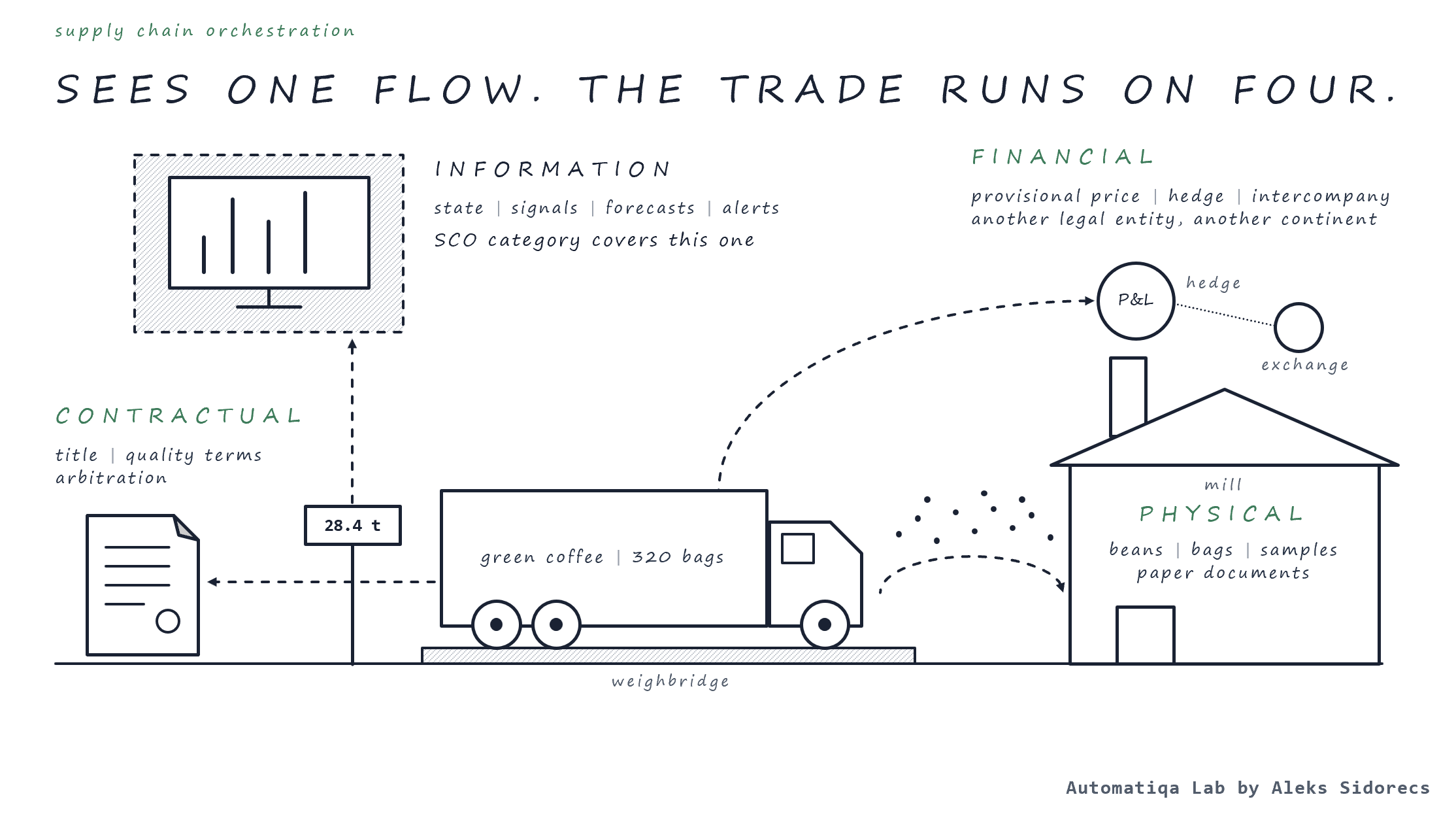
In front of me, a truck arrives at a mill with green dried coffee beans. The driver crosses the weighbridge, the quality manager pulls a sample, checks moisture, and grades the lot delivered. Somewhere in Europe, the trader sets the provisional price on the purchase contract - it'll be fixed later against the commodity exchange. The finance manager in North America, covers the hedges through a separate legal entity with its own P&L. The seller passes title (aka ownership) when the documents define it. A clerk drafts the documents and passes them to a lawyer for checking. The logistics operator chases originals by email. Those movements, handovers, and handshakes are just part of a journey to get Robusta and Arabica coffees from the farm to the cup.
Then there's a parallel universe of technology vendors and solution providers. I read their reports and AI capability overviews related to supply chain orchestration (SCO), sometimes too many. They rarely mention trucks at the gate with the wrong coffee, a broken weighbridge, a trader's provisional price, or financial hedges.
As the category sells it, SCO drives information flows within one company, upstream or downstream1Automatiqa Lab (2026). Supply chain orchestration. In Automatiqa Lab glossary. source ↗. In my agri-food world, the decisions that make or lose money involve cash commitments, title transfers, and P&L. All this happens at the seams that the technology industry is rarely, or only partially, touching.
In the manifesto, I wrote that the control tower, which often gets positioned under the SCO segment, sees everything and decides nothing autonomously. Jim Frazer at ARC made an even sharper point: that control towers enhanced visibility and didn't improve control2Frazer, J. (2026). Control towers are not control systems in supply chain operations. Logistics Viewpoints / ARC Advisory. source ↗. So, what I'm willing to work out is why actually nothing gets decided, and where.
Orchestrate or not to orchestrate, that's a question
I've read various definitions from vendors and solution providers who seem to own that space. You can easily spot them through Google or generative searches. Plus Gartner's market overviews3Gartner (2026). Market Overview for Supply Chain Orchestration Platforms. Gartner Research (paywalled). source ↗. They all do differ in their SCO interpretations but mostly agree that orchestration means a single view across demand, supply, logistics, and/or finance. On top of that, there's a common trail of highlights related to harmonised data that's needed to power recommendations for operators and foundations setting for agents to execute specific tasks within configured guardrails. Gartner's research describes the platforms as the "connective layer between supply chain strategy and execution".
To clarify those things for myself, I strip away the adjectives. It brings me down to four things that are generally orchestrated: a. signals, b. workflows, c. exceptions, and d. plans. All those elements represent information in different forms and shapes. Lora Cecere has long argued - the word carries too many definitions4Cecere, L. (2025). The orchestration shuffle. Supply Chain Shaman. source ↗. In my opinion, it's true, as there are many blind spots, and they matter more than the variety of definitions.
Compared to classical supply chain management textbooks, I experience a different reality (through the lens of agri-food sector). They emphasise three core flows in operations: material, information, and financial5Shah, P., & Kirche, E. (2025). Supply chain management - an integrated approach, sec. 1.4 Supply chain flows. Pressbooks. source ↗, while I experience how physical supply chains actually run on four:
- information: flow of state, signals, forecasts, alerts
- physical: flow of beans, bags, containers, samples, and paper documents as objects
- financial: financing and factoring, provisional and final settlement, hedges, intercompany flows and transfer pricing
- contractual: commercial commitments, title transfers, quality terms, arbitration rules
Let me explain why I'm a bit picky here. The problem is that most publications ignore the last one. But I can't ignore the fact that in my world, the contract isn't just the source of information about a trade or commercial deal - it's the trade itself.
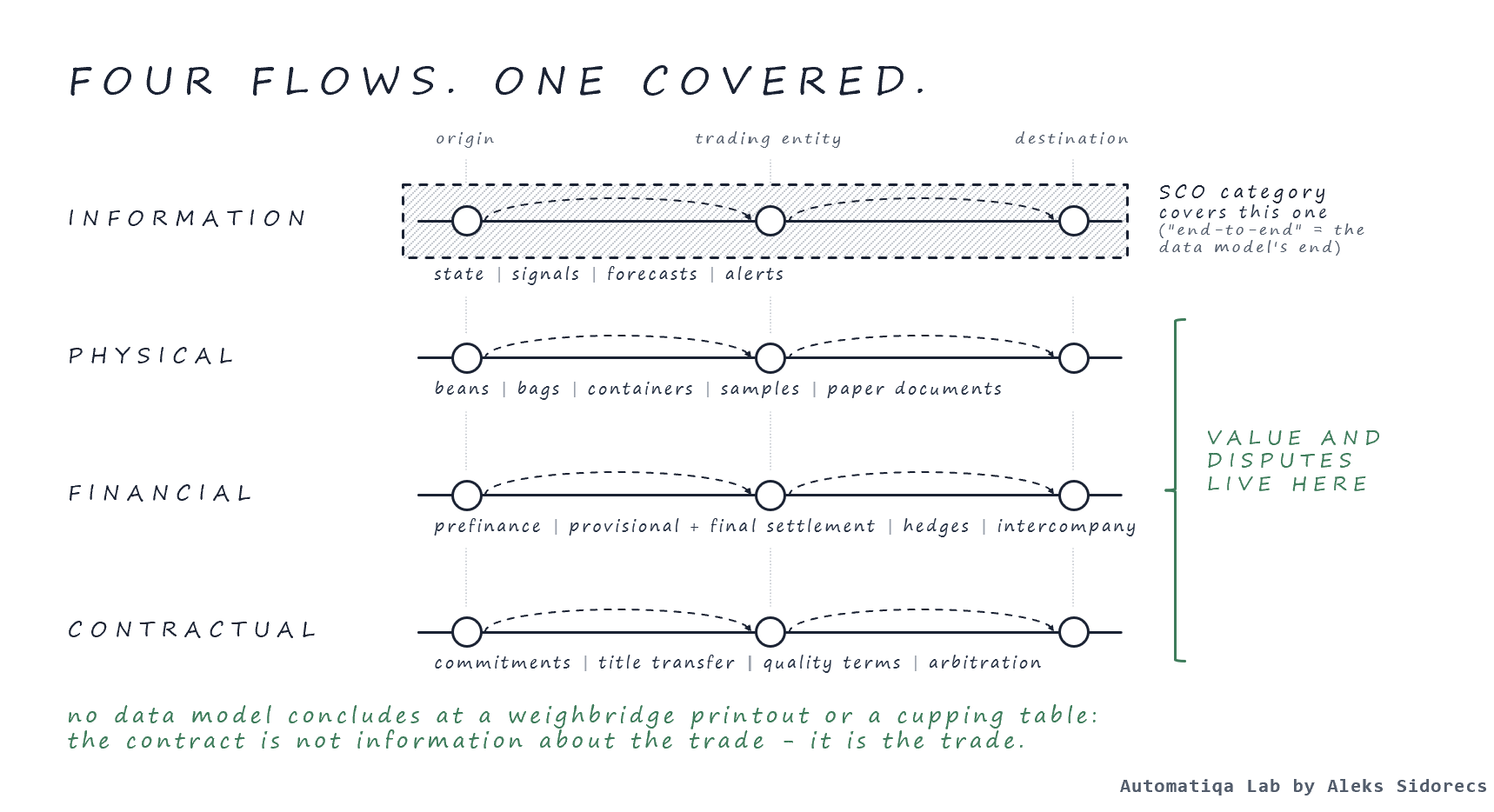
The SCO market category focuses heavily on information flows. The value and disputes I experience originate from the remaining three. When a solution provider claims "end-to-end" capabilities, in my mind, they refer to their data model's end-to-end, but no data model concludes at a weighbridge printout where coffee is delivered or a cupping table that grades coffee quality.
But wait, one exception actually exists. It was discovered through an unexpected source: a patent filing. Oracle's patents on "supply chain financial orchestration" model a physical movement as separate from the financial flow, with margin and tax allocated between legal entities6Oracle International Corp. (2020; 2022). Supply chain financial orchestration system. US Patents 10,679,166 B2 and 11,250,367 B2. source ↗. I appreciate that abstraction, and so far it's the only vendor artefact I've found that separates the flows properly.
Meanwhile, a parallel software universe already orchestrates the other three flows for commodity trading across agri-food, metals, and other segments. Those are so-called CTRM (Commodity Trading and Risk Management System) systems that handle deal capture, provisional pricing, position, settlement, and quality. Gary Vasey writes a lot about the clash between that category and ERP7Vasey, G. M. (2020). CTRM and commodity management. CTRM Center. source ↗. Most interesting for me is that the commodity-tech side knows SCO platforms exist, but I've yet to meet an SCO algorithm that recognises provisional pricing.
When it stops inside the company walls
Recently, at Capgemini's Accelerate Forum 2026 in the Basel area, I discussed with Ranko Sevo how orchestration platforms accelerate supply chains. But I preferred to reflect on the broader effects it contributes once that vision is achieved within individual functions.
Well, nothing against technology itself - I've deployed it through more than ten digital transformation initiatives across supply chain and operations. And I've seen it working across consumer goods, life sciences, and agri-food. What does it achieve? Analysis gets performed faster, potential risks are identified before they punch the operator in the face, and optimisation recommendations are visualised. In my soft-commodities world, each of those generated outputs should go somewhere, outside the function:
- replanning cases to a trading desk that has to re-hedge
- early exceptions to a quality team that's still waiting for a physical sample to be delivered by DHL
- faster shipment cases to finance, as they should link contracts between two entities and release prefinance before the original shipment documents are sent to destination.
It becomes obvious that if my cross-functional colleagues run at the old speed, the supply chain's operational and speed gains create a huge queue at the handover.
Basically, it's my favourite Ashby's law when it gets applied to one function downstream8Ashby, W. R. (1956). An introduction to cybernetics. Chapman & Hall. Principia Cybernetica electronic edition. source ↗. It provides a basis for Heuristic 01: any operation can control only the variety it can absorb ( Variety Shortfall Test highlights which layer is short9Sidorecs, A. (2026). Heuristic 01 - Requisite variety in supply chain. source ↗). Let me illustrate it with a metaphor: a Ferrari representing the speed of an orchestrated supply chain function. At the same time, other functions may be and often are slower, running at lower horsepower. Imagine what happens next? Indeed, the problem moves to the neighbour from another function across the office corridor.
The seam that sets the speed.
With all of the above stated, I came to one simple decision: to start evaluating the cross-functional handovers across all crossing nodes: a. functions, b. systems and c. P&Ls. The reason is that in soft commodities, trading and supply chain operations cross all three nodes at once during any handover between the origin (where goods are supplied from), a trading entity, and the destination location/office. Data integration alone isn't solving it (lately, it also triggered my decision to launch the Re-Model project together with Burak Cetin).
The context I've provided previously led to one key decision: I've started evaluating the cross-functional handovers across the intra-organisational nodes they cross. The functions, systems and P&Ls. In a soft-commodities trading/supply chain operations, a handover between an origin entity (where coffee is supplied from) and a trading entity usually crosses all three nodes at once. Data integration alone won't solve it. The main reason is that someone has to decide who carries the margin, and I haven't seen any platform that can make that judgment call.
That's why the second prerogative isn't about orchestrating the supply chain harder or broader, but about applying a systematic and integrated approach to all key nodes of trade execution. So in my case, it becomes a four-flow orchestration mechanism (information, physical, financial and contractual) with a vector of activities where all handovers (across all functions and entities) are automated. This would prevent cases where one function's speed isn't absorbed by another one. Efficient absorption prevents unproductive friction.
I do think that "orchestrate" is still the right verb to apply...
Where it stops at the wall
... but beyond the company wall, the verb changes...
Let me share some additional context and more facts. Soft-commodities operating models are powered by asymmetric physics10Sidorecs, A. (2026). Heuristic 02 - Asymmetric supply chain physics. source ↗. Upstream are farmers' cooperatives with paper-based transactions and sourcing stations where agri-food goods are purchased from hundred farmers in the morning11TraceX Technologies (2026). Aggregated traceability under EUDR - a buyer's guide; Farmforce. Tackling food's first mile. source ↗. Downstream are processors and/or roasters powered by their own portals and banks with specific document standards. Every player across the agri-food value chain sits at a different point of the process, technology, and operating-model maturity curve. And four-flow orchestration that I mentioned earlier meets all of them at once.
That's where orchestration stops being what we think it is.
First case - Barry Callebaut and their official Forever Chocolate program. In August 2025, the company reported covering around 85.6% of the mapped plots across its direct cocoa supply chain. They achieved solid performance by raising the number from 72.3% six years ago12Barry Callebaut (2025). ESG data sheet 2024/25 - Forever Chocolate progress. Barry Callebaut AG. source ↗. But it also tells us another story - after more than nine years, the cocoa processor still hasn't fully mapped the upstream supply chain it's expected to control. At the same time, the indirect supply chain, which represents 40%-60% of global Cocoa supply, is no longer reported. Inside the wall, the performance improves a few points a year. But outside of it, it just stops being published.
Second case - Cargill, also a cocoa case. Their numbers got the same vector but with more precision. Its Promise supply chain program centres on a third of the total cocoa volume it sources. Every plot is polygon-mapped, and 217943 of them have assurance by an external validator (KPMG)13Cargill (2025). Cargill Impact Report 2025 - Cocoa, crop year 2024/25. Cargill, Inc. source ↗. Two-thirds of the certified farmers delivered cocoa beans through the first-mile traceability system. Again, the indirect upstream supply chain tells a similar story as at Barry Callebaut. They just refer to the data-verification partner and publish no relevant data points.
Bunge is the last reference example and quite an interesting one. In November 2024, it reported achieving 100% traceability and monitoring of direct and indirect soy sources across priority regions in Brazil, Argentina, and Paraguay. The company moved from around 30% in 2021 to 64% of upstream sourcing monitoring in 202214Bunge (2024, Nov 21). Bunge reaches 100% monitoring of its indirect soy value chain in Brazil's priority regions. source ↗. I started asking why, and the answer was quite interesting. Bunge developed quite an elegant approach - the company shared its methodology and tools with more than ninety resellers and cooperatives so they could build their own traceability systems.
In my opinion, Bunge represents a quite unique case, because it's not about orchestration or control. It's a pure calibration. Yes, it worked for an upstream supply chain of about two thousand large land plots, and I shouldn't expect any agri-food/soft-commodities business to repeat that success with five million smallholder farmers using the same runbook. But it worked, and it supports the thesis I share in the chapters that follow.
Before jumping to a few other points I planned to share, there's a need to highlight one important aspect. What moved the needle at every company during 2024/2025 wasn't any kind of platform as such. You'll notice a double-digit increase at any of the above-mentioned players related to the sourcing of deforestation-free agricultural goods. And there is one key driver for this: the EU deforestation regulation (EUDR)15Regulation (EU) 2023/1115 on deforestation-free products (EUDR), as amended by Regulation (EU) 2025/2650. source ↗. What amazes here is how one shared external standard/regulation, in just one year, shaped things the way a decade of orchestration inside the wall couldn't. Reason? EUDR requires every counterparty to produce the same data, leveraging the same taxonomy and format.
One sector -> one data -> one standard...
On my table, I have several copies of a Bill of Lading (B/L), the connecting tissue of international trade and export-driven supply chain operations. Interestingly, it connects all four flows and is still used in a paper format. It has several roles: a. confirmation of receipt of the physical goods, b. cargo carriage contract, c. title transfer (seller-to-buyer) document and d. collateral for the bank in case the deal is financed. As some of my peers know, we still face many situations where the original B/L is being sent in a paper format to various stakeholders involved in ocean freight flows.
Several attempts have tried to digitise it, starting with Seadocs in 1983. Fast forward - forty three years later: only 5% of B/Ls are being shared in electronic format. At the same time, nine shipping lines lifting 75% of global container trade have committed to transition to 100% electronic-B/Ls (eBL) by 203016DCSA (2023, Feb 15). DCSA's member carriers commit to a fully standardised electronic bill of lading by 2030. source ↗. But I suspect they won't achieve that by then. Why? Because the level of alignment needed between value chain actors that don't share the same data standards (e.g. EUDR), operate at different levels of technology maturity, and often have conflicting interests. The alignment needs to take into account quite a diverse group of stakeholders: shippers, consignees, freight forwarders, insurance companies, banks, customs and regulatory authorities. Compared to the UK (where eBL was formalised at a legislative level in 2023), some countries (incl. the European Union) still don't treat the eBL as an ownership title-transfer document, unlike its paper twin17Electronic Trade Documents Act 2023 (c. 38), UK; DCSA. Overcoming legal and regulatory barriers to eBL adoption. source ↗. Orchestration is pointless here.
There were also some bigger technological ambitions to enable end-to-end orchestration in a multi-agent global supply chain environment. The TradeLens initiative was initially created by Maersk and led by a consortium of major carriers and shippers. The ambition was plausible - to cover a majority of global containerised trade and track billions of logistical events. In 2023, it shut down because of commercial concerns18Maersk & IBM (2022, Nov 29). A.P. Moller-Maersk and IBM to discontinue TradeLens. source ↗. Some other cases, such as we.trade (closed in 2022), Marco Polo Network (shut in 2023) and Contour (closed in 2023), followed the same pattern. And partially, it makes sense: how do you orchestrate stakeholders that will continuously challenge the onboarding costs, data ownership, and conflict situations when a competitor should route its business through a rival's platform19Wass, S. (2022). Trade finance industry remains hopeful on blockchain despite failed projects. S&P Global Market Intelligence. source ↗?.
Three rungs, two seams.
Gartner’s maturity model has placed "orchestrate" at the highest point on their model, defining orchestration as collaborative work among ecosystem actors20Gartner (2013). Introducing the five-stage S&OP maturity model - react, anticipate, integrate, collaborate, orchestrate. source ↗. At the same time, the term "orchestrator" has been used in the strategy literature for over twenty years – by authors such as Iansiti & Levien, and Adner & Jacobides21Iansiti & Levien (2004), The keystone advantage; Dhanaraj & Parkhe (2006); Adner (2017); Jacobides, Cennamo & Gawer (2018). source ↗. Each rung of this model was created long ago. I’m simply taking one of those rungs, previously compressed into a single step by analysts, and emphasising critical joints that act as seams in supply chain management.
- Supply Chain Orchestration - touches one of the four flows (one of the functions) and gets only one view of the data. Decisions are still routed via operators.
- Four-flow orchestration - all four flows that represent every function and legal entity across a single enterprise or group of affiliated companies. Handovers are automated in an integrated way, so that every function, system, process, and P&L form a unified fabric of business execution. Hands-off integration with one authority behind it, which is why the term "orchestrate" is still used and accepted here.
- Ecosystem calibration - all four flows (in my case it's from farm to cup), partners, irrespective of their maturity level and sophistication, get calibrated to shared signals and standards, with no conductor in between.
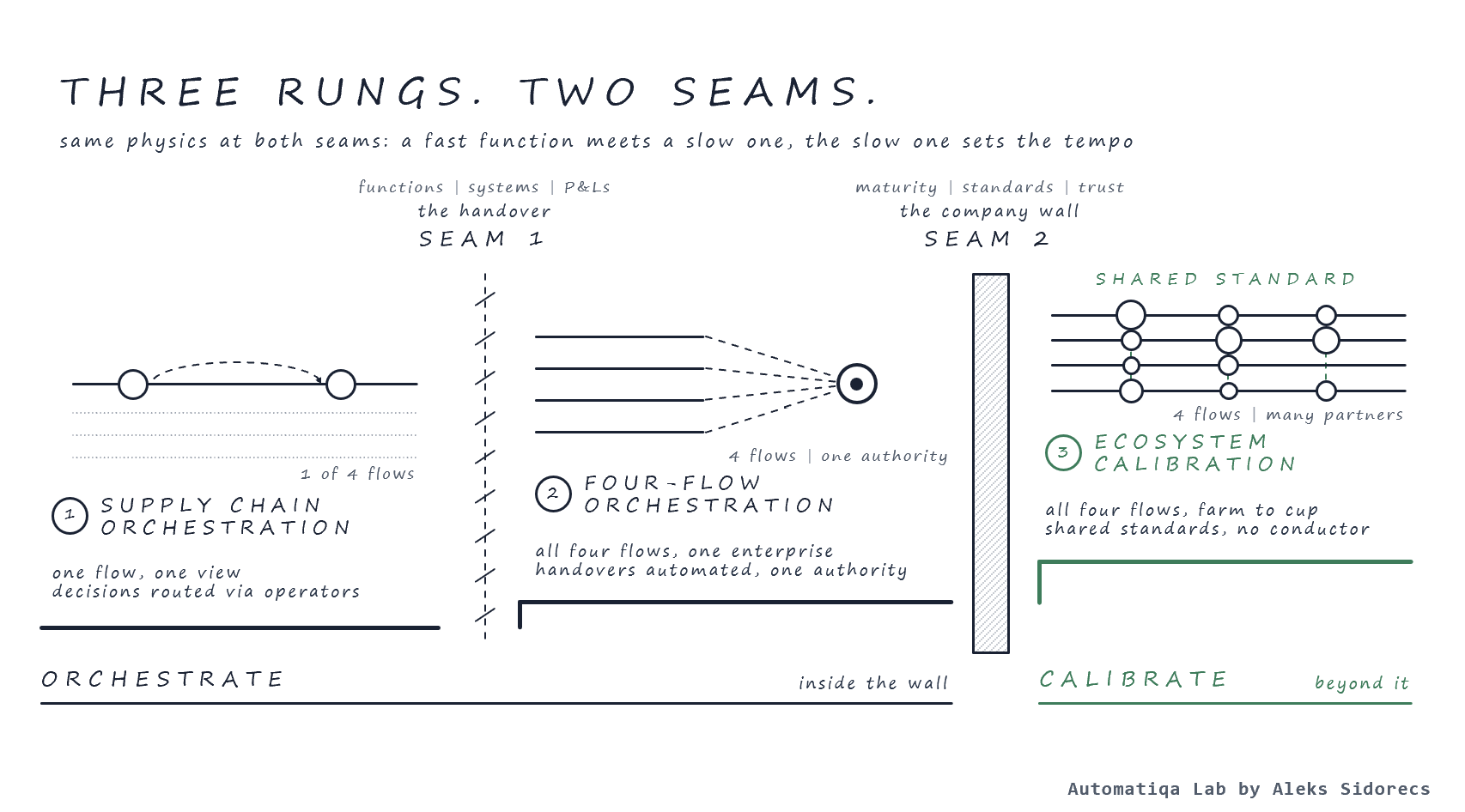
Between one and two, we face the handover problems. Between two and three, the list is that we have to deal with maturity problems. But the physics is the same both times: a fast function/process/system meets a slow one -> the slow one sets the overall tempo/speed.
The third rung. I deliberately don't define it as "orchestrated ecosystem", and there are several reasons for that. In the strategy and business literature, orchestration means a central/hub firm that has taken the position (and the power) to direct the others21Iansiti & Levien (2004), The keystone advantage; Dhanaraj & Parkhe (2006); Adner (2017); Jacobides, Cennamo & Gawer (2018). source ↗. I don't expect this to evolve to that level across agri-food value chains because of several reasons. Let's have a look at its current structure based on a coffee sector example:
- the trader is a counterparty to the farmer and to the roaster. It would be illusory for a trader to expect either of them to accept being orchestrated by someone on the other side of the market
- the roaster lacks reach and representation at the origins (where green coffee beans are sourced from), and a single-owner digital platform is likely to die because of the distrust (see the case of TradeLens from above)
- a marketing board has authority and uses it for price stability, often against traceability - Ethiopia's exchange eliminated farm-level traceability for four-fifths of exports until the speciality carve-outs came22Mbakop, L., Jenkins, G., Leung, L., & Sertoglu, K. (2023). Traceability, value, and trust in the coffee market. Agriculture, 13(2), 368. source ↗
- standards-setting bodies/institutions can set the beat but can't execute.
That's why I'm confident that the only thing left here is a calibration. I define it as industry peers aligning their own flows to shared standards: the same data schema, the same chain-of-custody rules. This happens without anyone conducting or acting as a hub company (steering is still a viable option here, like GS1 in consumer goods).
Synchronisation is what we get, not what we do. Alexander's the Great's quartermasters synchronised the army's marches with harvest cycles two thousand years before anyone orchestrated anything23Sidorecs, A. (2026). The Intelligent Orchestration Manifesto. Automatiqa Lab. source ↗. It's the older idea, and beyond the company wall it's the only one that doesn't need a conductor nobody will accept.
Synchronisation is a prize, but a standard is a ticket to get there...
Where I think this goes
The vendors are now promoting the third meaning of the word: agentic orchestration, where agents coordinate agents, and every major platform has announced one. Thanks to my direct exposure to development and experimentation, I've formed a personal point of view that also shapes how I deploy agentic/AI initiatives across physical operations. And the core thesis behind it:
- there is a high chance (if approached with the wrong mental and operating models) that the agents can end up where many corporate dashboards did (e.g., Power BI) unless we put them at the seams I already described in the previous part of this publication24Gartner (2026, May 6). Gartner survey shows AI is not driving supply chain operating model transformation. source ↗.
Inside the walls. That's where they'll perform the way many of us anticipate. An agent that works, for example, in logistics and replans a shipment based on specific signals is a much faster (and I think much more efficient and less expensive) version of what the control towers have been for the past twenty years. The next is likely to scale across the work that human-driven seams used to execute: mirroring inter-company transactions/flows, or releasing prefinance against the full document set. At the end, it will bring us to the four-flow orchestration, and I expect it to become a great success, but only in firms that own their data (I mean end-to-end data here!).
But the path to get there isn't that easy. Actually, not easy at all. Why? Because someone should write and authorise the policy that lets agentic code move the company's money between several P&Ls, profit and cost centres. My hypothesis there is that a handover crossing all three boundaries at once might stay human for years. At the same time, a single handover crossing path will be taken over by Agentic AI much sooner25Sidorecs, A. (2026). Why process maps don't tell you what to delegate to an AI agent. Automatiqa Lab. source ↗. This means the major friction areas are here to stay, despite all AI speculation. I still might be wrong, so let's sit and observe.
Now, let's step out beyond the walls of the company. I certainly expect a very different reality versus what the SCO technology sector is pitching to supply chain professionals. No one can orchestrate the farm, cooperative, or complex multi-stakeholder ecosystem. Still, I'm confident we will reach a point when agents on both sides of the wall learn to speak the same schema (for example, based on Agent-to-Agent standards already being developed by the Linux Foundation)26Linux Foundation (2025, Jun 23). Linux Foundation launches the Agent2Agent Protocol Project. source ↗.
I already mentioned how the EU deforestation regulation (EUDR) already created (and pushed on industry) the first one: a plot polygon, a legal-use declaration, a due-diligence statement. It comes in one format/standard for every soft-commodity operator. Orchestrate inside the walls, but calibrate beyond them.