The Variety Map is grounded in two axes and a square. A loop's uncertainty/surprises get absorbed where the locus runs from the edge towards the centre. The mechanism defines how to shift from judgement to encoding. Every decision loop in an operating model should have one point on it.
In short
One decision loop at a time guided by two questions is what's being placed on the map.
- first is how it absorbs variety, and where it sits on a spectrum between the edge and the centre (think of headquarters vs manufacturing site somewhere in Mexico)
- second, what's written down and run without them in the Mechanism.
The map in Figure 1 consists of the four quadrants (Craft, Desk, Engine and Autopilot) with five stages on the vertical axis, with no privileged operating corner (T1 to T5).
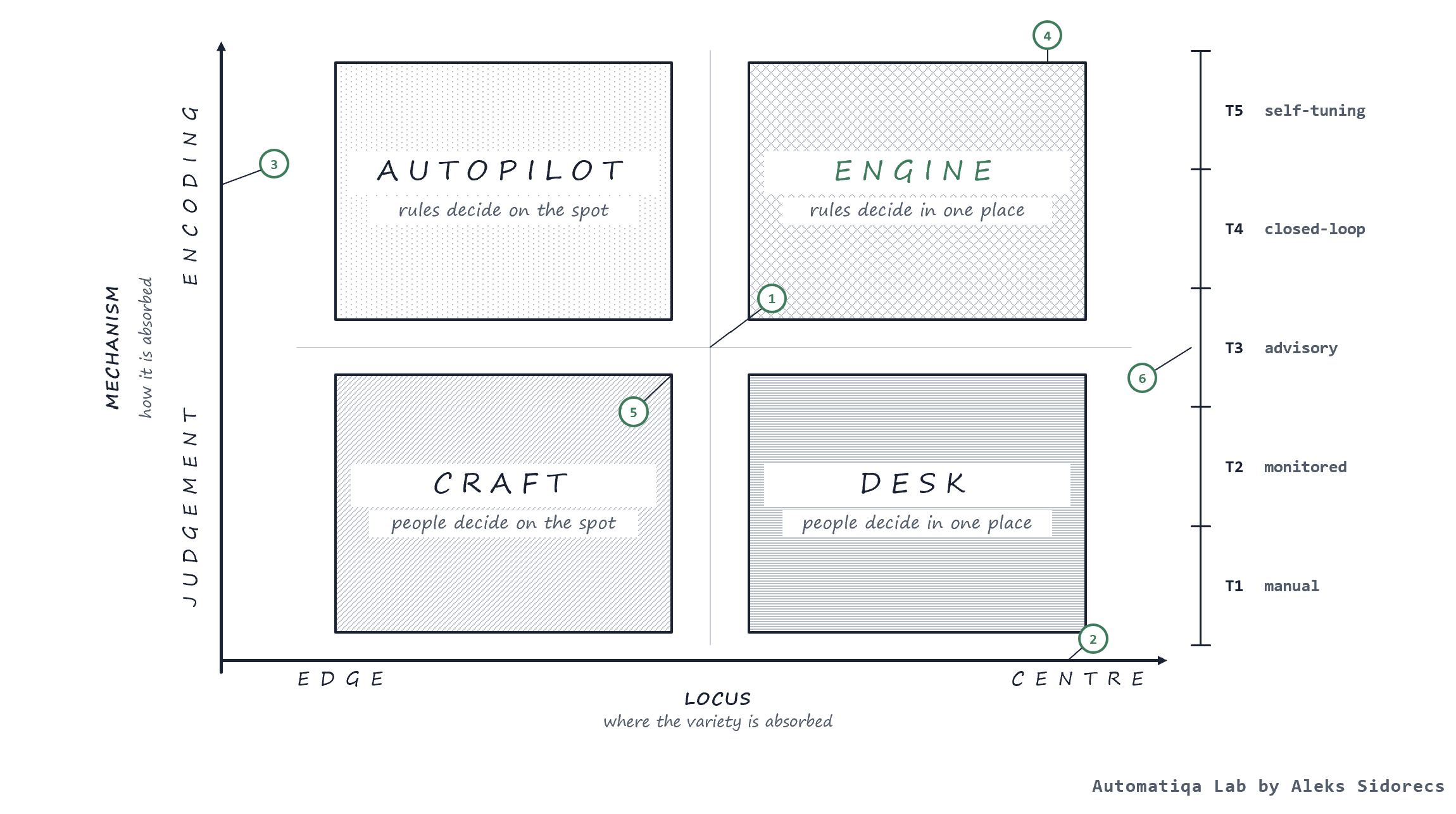
What gets placed on the map? A loop with one cycle of sense, decide, act.
When I think of Variety Map, my mental model is generally shaped by four key principles:
- any organisational design is mostly constrained by teams and structures
- at the same time, the operating model design charters the loops that keep working when any team changes
- decisions across the supply chain most frequently get triggered when a specific signal on someone's desk
- the action goes out - the result comes back as the new signal.
In my world, a handover chain that ends in a decision represents a single unit of loop. As I mentioned earlier, any operating model consists of several loop portfolios, each with a specific position on the map.
Any team I worked with across the supply chain domain operated mostly through decision loops. The same happened with operational exceptions that we continuously faced across planning, production, sourcing or logistics - those lit up a chain of flows (aka neurons in the human brain), triggering a decision loop within the same operating model.
Three questions power the decision loop diagnostics:
- when this loop meets something it wasn't prepared for - who absorbs an unexpected event?
- where are they relative to where the unexpected event arrives?
- what's written down (e.g. SOPs) and executed without any guidance or protocol?
The last answer gives us the point on the Mechanism spectrum. The first two give us the vector points on the Locus.
Heuristic 03 challenges us with three questions: who decided (at what moment and place), what inputs were available at that moment of deciding (including the missing ones when those were needed), and whether the outcome reached the person deciding next.
Three 'yes' answers and the loop closes - you can find its decision. The map adds the question about what's written down, placing the loop on Mechanism.
How is the Variety Map drawn?
- Important to consider that the element that's placed on the map isn't a team, but a loop!
- Moving left on Locus enables shortening response time and keeping local knowledge as a differentiator. Moving right pools scale and leverages scarce skills. Locus runs from edge to the centre.
- Moving up on Mechanism lowers the cost per decision and raises the cost of uncertainty that is often powered by the operational physics (Heuristic 02). Mechanism runs on a spectrum: from judgement to encoding.
- The operational physics of the supply chain you're in shapes the decisions about which loops may go and which must stay with the Engine. Indeed, it's counterintuitive gien that in most cases operating models aim to push every loop to the Engine.
- The edges of the squares aren't kind of borders, but thresholds. Where the decision loop splits its variety, it points to where handoffs reside.
- The Mechanism is defined by its encoding (the encoding spectrum): from manual (T1) to self-tuning (T5).
What does Locus actually measure?
By the edge, I mean the surprise (an unexpected event in the form of variability) absorbed where it lands. Those could be different places across your value chain or organisation: port terminal, the operator talking to the shipper or any manufacturing facility across your supply chain network.
What happens at the edge? The unexpected event lands there and gets absorbed locally. The decision loop runs inside, but response time shortens when moving left. On the other side, moving right on the diagram lets the centre see the loop while leveraging its scale - so scarce capabilities are activated in such a way that allows the centre to serve many sites and locations.
Based on my experience, the edge pays in consistency and capabilities at every location. At the same time, the centre pays in latency, information loss (during transfer through organisational channels), and exceptions queuing in front of it. That's how I conclude that in cases where the decision loop's response window is shorter than the cycle time of the round trip it needs to make to the centre and back - the loop shouldn't be allowed to be positioned at the centre.
What does Mechanism measure?
How a loop's uncertainties are absorbed and graduated by what is encoded.
First is sensing at T2, then decision as a proposal at the T3 level (advisory), followed by decisions and action within limits at T4 (closed-loop). At T5 (self-tuning), the person designs policy because the supply chain operator's part reduces one step at a time (but never reaches zero!).
The key issue we need to be mindful of is the fact that encoded responses will stay fixed until rewritten (normally because rules of specific parts of operations need to change due to new regulations, process changes etc.). As the loop grows the cost of unexpected events will be rising while the cost per decision is expected to fall.
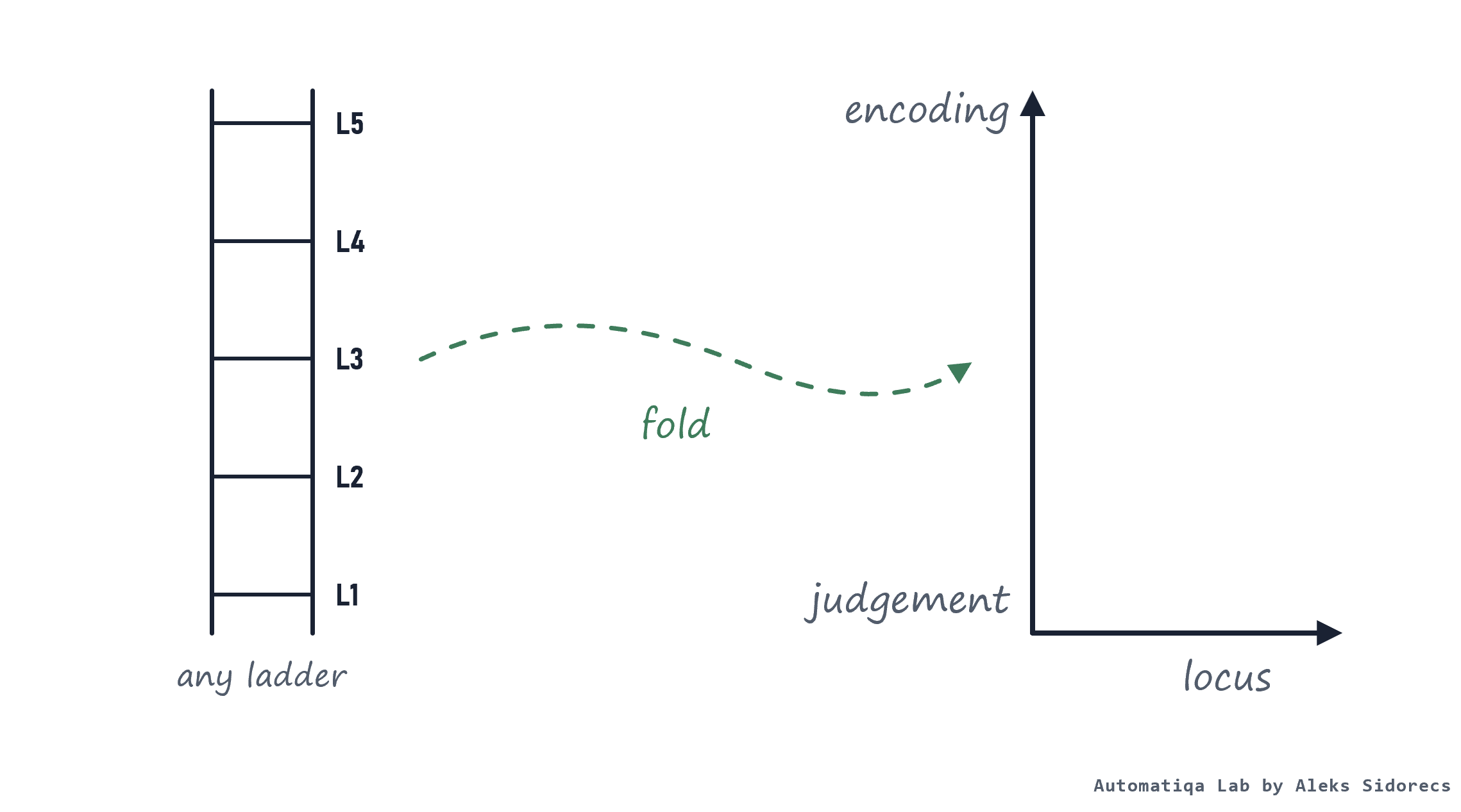
Any ladder or maturity curve your organisation has developed (using ratings like 'manual' to an 'autonomous' maturity spectrum) or inherited from providers like Gartner typically should align with the X & Y axes of this diagram. I've intentionally left the ladder without a bottom layer since most decision loops in operational models would start there. An additional point we have to remember: two loops at T4 may be far apart: one loop could be placed at the Engine, and another loop at the Autopilot.
But wait, what happens on a divider?
When any loop splits on a divider = split loop inside it gets a handoff.
As mentioned earlier, dividers represent thresholds. For example, a loop placed on a vertical divider will have half its variety absorbed at the edge and another part absorbed at the centre. One such divider has a rule that handles the routine tasks while the operator handles the rest. We should accept this as normal because most decision loops will start there as well (the same way as with the ladder).
Handoffs are exactly the doors where latency, fidelity loss and interpretation enter. You can map the loop with the boundaries it crosses between trigger and return: a function, a system, a P&L. Heuristic 03 writes it as b = f + s + p, from 0 to 3. b sets the assessment order for the mapping: a triple crossing is where the cross-functional meetings exist (and the money), so assess such loops first. The method part of the framework provides all the rules.